Life
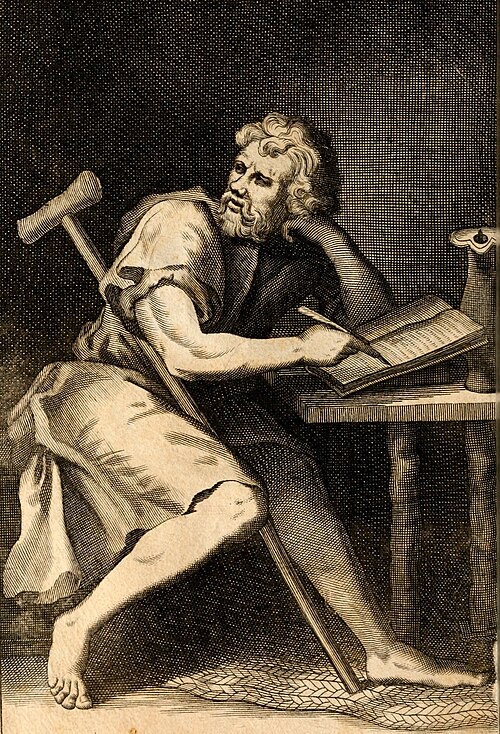
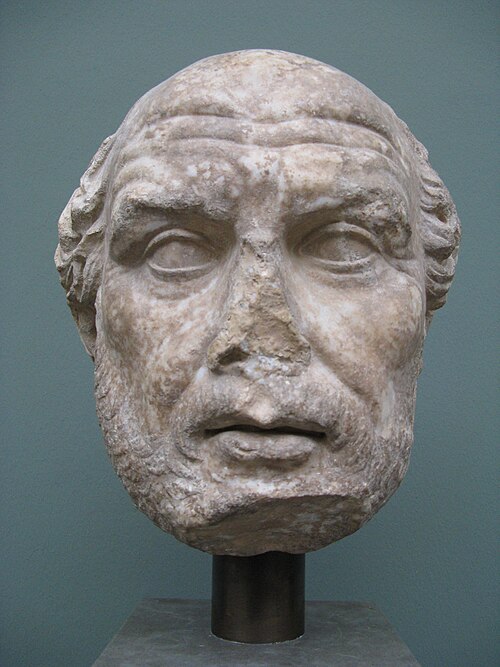
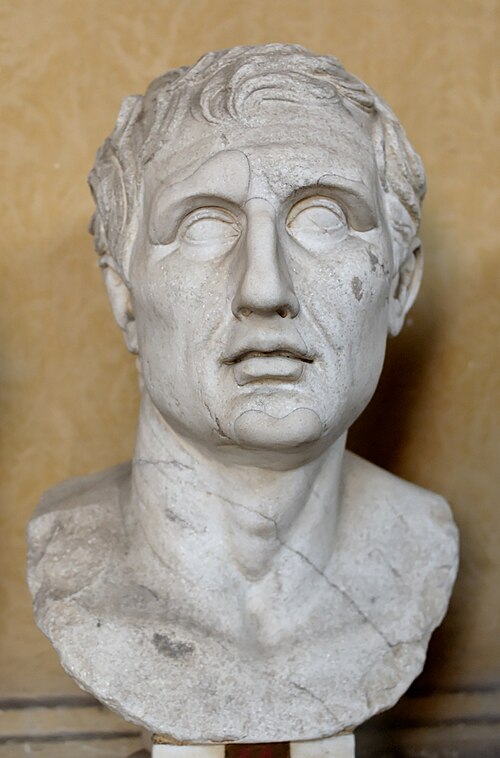
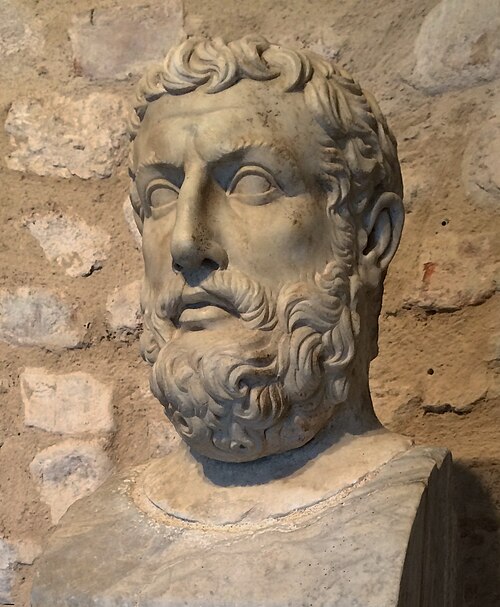
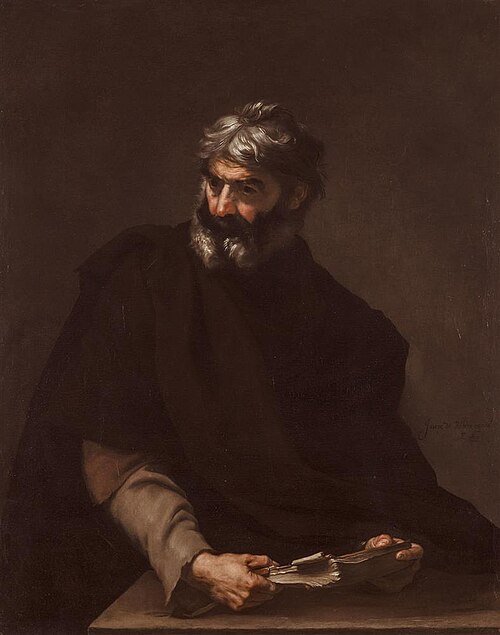
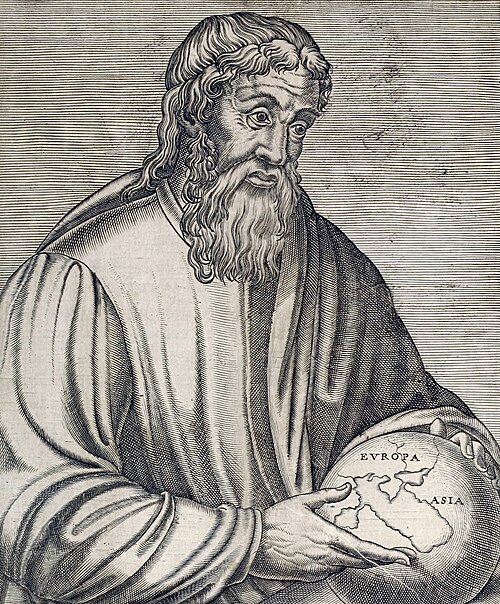
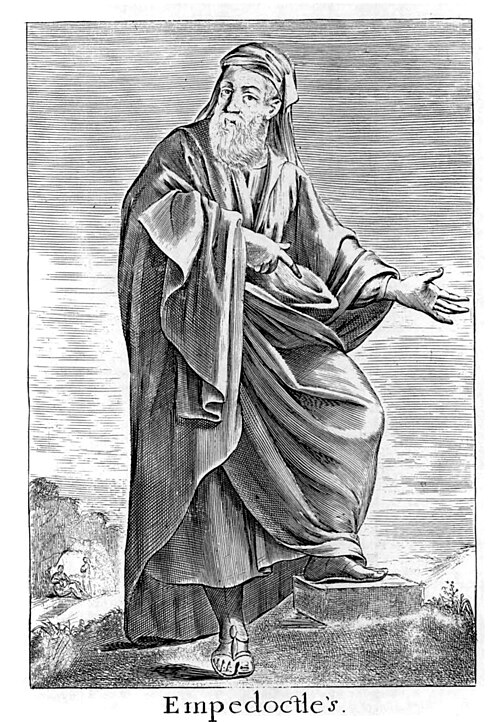
Empedocles came from Acragas, the Greek city now called Agrigento, on Sicily’s southern coast. He lived in the fifth century BC; dates around 490–430 are approximate, not a securely documented lifespan. His city’s political changes formed the setting for later accounts that describe him as an opponent of tyranny and a supporter of the people. Such reports may preserve historical memories, but they were written much later and cannot all be accepted as direct evidence. The familiar lists of his supposed teachers are likewise uncertain.
He acquired a reputation as a poet, healer and persuasive public figure. His own verses helped shape the extraordinary image later biographers constructed around him. Stories of miraculous cures therefore need to be distinguished from what the surviving words actually establish. Accounts of his death disagree. The best-known tale has him jump into Mount Etna, only for a bronze sandal to reveal the supposed disappearance; it is a legend, not a reliable death report. We know him more securely through his poetry, preserved in quotations by later writers and in ancient papyrus fragments. This uneven evidence invites curiosity and careful reading rather than a smooth biography filled with dramatic certainties.
Works

Empedocles called the lasting constituents of things four roots: earth, water, air and fire. They are not the chemical elements of today’s periodic table. In his account, things appear and disappear because roots mix and separate; the constituents themselves do not simply arise from nothing or vanish into nothing. Love and Strife name powers involved in that changing arrangement. These poetic names should not be reduced either to ordinary personal emotions or to modern scientific forces with mathematical definitions.
His teachings survive under the traditional titles On Nature and Purifications. Scholars debate whether these represent two separate poems or parts of a closely connected project. The fragments explore cosmic change, living creatures, perception and the soul’s journey, while also urging purification and restraint from killing animals. Physical inquiry and religious concerns cannot be cleanly divided into two unrelated careers. A papyrus published in 1999 strengthened the need to read them together. His verse addresses listeners and makes abstract claims memorable through images and rhythm. The table therefore lists two traditional textual groupings and two doctrines, not four independent books. Read the original line as an invitation to listen before trying to reconstruct the whole system.
Legacy in Greece today
Empedocles belongs to the Greek-speaking world of ancient Sicily, a reminder that Greek cultural history reaches beyond the borders of today’s Greece. His ideas also entered later discussions through Aristotle and other ancient readers. For a learner, his most accessible inheritance is a small set of words for the natural world.
Compare ancient ὕδωρ and πῦρ with modern νερό and φωτιά, then notice the more familiar γη and αέρας. Draw four labelled boxes and describe how they join or separate using ενώνω and χωρίζω. Finally, read the ancient ἄκουε beside modern άκουσε. This short activity connects historical thought with useful Modern Greek while keeping ancient vocabulary and modern science distinct.
Did you know?
- He wrote philosophy in Greek hexameter verse.
- His four roots are not modern chemical elements.
- The Etna leap and bronze sandal belong to a legend, not established biography.
Key works
| Greek title | Title | Year |
|---|---|---|
| Περὶ φύσεως (συμβατικός τίτλος) | On Nature: traditional grouping of fragments | 5th century BC |
| Καθαρμοί (παραδοσιακός τίτλος) | Purifications: traditional grouping of fragments | 5th century BC |
| Τέσσερα ῥιζώματα (διδασκαλία) | Four roots: doctrine | 5th century BC |
| Φιλότης καὶ Νεῖκος (διδασκαλία) | Love and Strife: doctrine | 5th century BC |
A line to remember
τέσσαρα γὰρ πάντων ῥιζώματα πρῶτον ἄκουε·
In today's GreekΆκουσε πρώτα τις τέσσερις ρίζες όλων των πραγμάτων.
tessara gar pantōn rhizōmata prōton akoue
First, hear the four roots of all things.