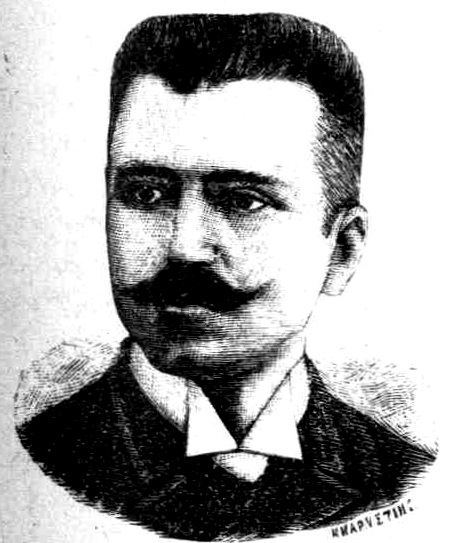
Life
Ghika was born in Athens on 26 February 1906 into a wealthy and cultivated family; his mother's family, the Hadjikyriakos, had old roots on the island of Hydra, where they owned a large mansion. He began drawing as a child and, at sixteen, in 1922, went to Paris, where he studied painting under Roger Bissière and literature at the Sorbonne. He had his first solo exhibition in Paris in 1927, still in his early twenties, and absorbed the work of Picasso, Braque and the other artists of the School of Paris.
In 1934 he returned to Greece. With friends he founded the art and literature review Το Τρίτο Μάτι (The Third Eye, 1935–1937), and he became part of the circle of modernist writers and artists known as the Generation of the Thirties, close to Giorgos Seferis and Odysseas Elytis. For years he painted at the family house on Hydra, where foreign friends visited him, among them the writers Henry Miller in 1939 and later Patrick Leigh Fermor, who stayed there for long periods.
From 1941 to 1958 he taught drawing at the School of Architecture of the National Technical University in Athens. The Hydra house burned down in 1961. In 1961 he married his second wife, Barbara Hutchinson, and in 1973 he was elected a member of the Academy of Athens. He died in Athens on 3 September 1994.
Works

Ghika's great achievement was to show that modern art could be Greek. In Paris he had learned the lessons of Cubism: break the subject into planes, flatten the space, build the picture like an architect. Back home he applied this method to the Greek world he knew best, the islands and above all Hydra, with its stone houses climbing the hill, its stairways, windows, roofs and boats. In his landscapes of the 1930s and later the houses become cubes and triangles, the sea and sky become flat fields of blue, and everything is held together by a strong, clear light. It is not a tourist picture of Greece but an analysis of it.
He believed that the Greek tradition, ancient, Byzantine and popular, was already «modern» in its love of geometry and clear form, and this idea, shared with Seferis and Elytis, was at the heart of the Generation of the Thirties. His later work moved between abstraction and nature: mountains, olive trees, studios, still lifes.
Ghika was also a theorist and writer on art, a teacher of a generation of Greek architects, an illustrator of books and a designer of stage sets and costumes for theatre and ballet. His range, from painting to sculpture, architecture and writing, made him the most complete «intellectual painter» of modern Greece.
Legacy in Greece today
The best place to meet Ghika is the Πινακοθήκη Γκίκα (Ghika Gallery) of the Benaki Museum, his former home in Kriezotou Street, Kolonaki, Athens, which he left to the museum. You can see his paintings, his studio and the rooms where he received Seferis, Elytis and his foreign friends. His works are also in the National Gallery in Athens. On Hydra, walk up from the harbour and look at the island the way he painted it: as cubes of white and grey in the light. Books about the Generation of the Thirties always begin with him, Seferis and Elytis.
Did you know?
- He went to Paris to study at sixteen and had his first solo show there at about twenty-one.
- Henry Miller describes visiting him on Hydra in The Colossus of Maroussi, his book about Greece in 1939.
- The family mansion on Hydra, where so many writers stayed, burned down in 1961.
- For seventeen years he taught drawing to future architects at the National Technical University of Athens.
Key works
| Greek title | Title | Year |
|---|---|---|
| Πρώτη ατομική έκθεση στο Παρίσι | First solo exhibition, Paris | 1927 |
| Το Τρίτο Μάτι (περιοδικό) | The Third Eye (art review he co-founded) | 1935–1937 |
| Τοπία της Ύδρας | Landscapes of Hydra | 1930s onwards |
| Καθηγητής Ελεύθερου Σχεδίου στο Πολυτεχνείο | Professor of drawing, National Technical University of Athens | 1941–1958 |
| Πινακοθήκη Γκίκα, Μουσείο Μπενάκη | Ghika Gallery of the Benaki Museum, his house in Kolonaki |
A line to remember
Το Τρίτο Μάτι
To Trito Mati
The Third Eye