Life
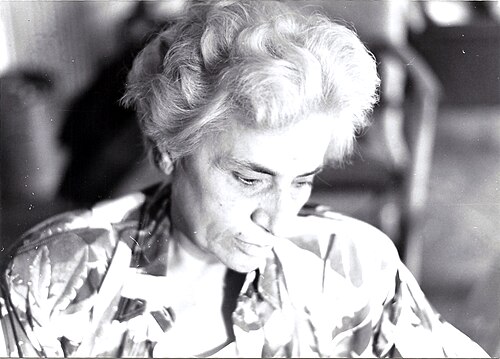
Samiou was born on 12 October 1928 in Kaisariani, Athens, into a poor family of Greek refugees from Asia Minor, who had come to Greece after the catastrophe of 1922 and the exchange of populations. She grew up in a refugee neighbourhood, hearing the songs her mother and the neighbours had brought from the other side of the Aegean. As a young woman she joined the circle of Simon Karas, the musicologist who was devoted to Byzantine chant and traditional Greek music, and in his society she learned to sing in the old style, to read the music and to understand the modes.
From 1954 to 1971 she worked for the Greek national radio (EIR), and her job took her from village to village with a tape recorder. She recorded old men and women singing the songs of weddings, harvests, laments and feasts, songs that had never been written down and that were disappearing as the villages emptied. Her first LP came out in 1962, and in the 1970s she began to give concerts, first in small venues, then in large concerts with younger musicians, and she made a long series of records. In 1981 she founded the Domna Samiou Greek Folk Music Society, «Καλλιτεχνικός Σύλλογος Δημοτικής Μουσικής Δόμνα Σαμίου», to publish recordings and to teach. She kept singing, teaching and travelling into her eighties, and died in Athens on 10 March 2012.
Works

Samiou's work had two halves that fed each other. As a researcher she collected: her field recordings, made in the mountains of Epirus and Macedonia, on the islands, in Thrace and among the refugee communities from Asia Minor and Pontus, are one of the great sound archives of Greek tradition. She wrote down where each song came from, who sang it and on what occasion, at a time when many people in Athens thought village music old-fashioned and a little embarrassing.
As a singer she gave the songs back. She did not modernise them with orchestras and pop arrangements; she sang them as she had heard them, with the ornaments, the free rhythms and the plain, strong voice of the villages, often with traditional instruments such as the λύρα, the κλαρίνο, the σαντούρι and the ούτι. Her records cover whole regions: songs of Asia Minor, of Thrace, of the islands, carnival songs, wedding songs, laments, children's songs and κάλαντα (carols). In the 1970s, when young Greeks were looking for roots after the dictatorship, her concerts showed them that the δημοτικό τραγούδι was not a museum piece but a living music, and she became a teacher to many of today's folk musicians. She also presented programmes on Greek radio and television, introducing the songs region by region to a wide audience.
Legacy in Greece today
The Domna Samiou Greek Folk Music Society in Athens is still active: it keeps her archive, publishes her recordings and runs programmes that bring traditional song and dance to schools and young musicians. Her records are the first stop for anyone who wants to learn Greek folk song as it was sung, and many of today's traditional singers call her their teacher. Folk music festivals and concerts in her memory are held regularly. A good thing to do: look for her recordings of songs from Asia Minor or of the κάλαντα, the carols children sing door to door at Christmas, New Year and Epiphany, and follow the words; folk songs repeat their lines, which makes them ideal for a learner.
Did you know?
- Her parents were refugees from Asia Minor, and the songs of the lost homeland were the first music she heard.
- She learned traditional singing from Simon Karas, the musicologist of Byzantine chant.
- Before she became famous as a singer she worked for the radio, recording village singers on tape.
- The society she founded in 1981 still carries her name.
Key works
| Greek title | Title | Year |
|---|---|---|
| Μαθήτρια του Σίμωνα Καρά | Student and collaborator of Simon Karas | 1940s–50s |
| Ηχογραφήσεις στα χωριά για το ραδιόφωνο | Field recordings in the villages for Greek radio | 1954–1971 |
| Πρώτος δίσκος: «Τραγούδια της στεριάς και της θάλασσας» | First LP: Songs of the Land and the Sea | 1962 |
| Καλλιτεχνικός Σύλλογος Δημοτικής Μουσικής «Δόμνα Σαμίου» | Founding of the Domna Samiou Greek Folk Music Society | 1981 |
A line to remember
Μήλο μου κόκκινο, ρόιδο βαμμένο, / γιατί με μαραζώνεις τον πικραμένο;
Milo mou kokkino, roido vammeno, / giati me marazoneis ton pikrameno?
My red apple, my painted pomegranate, / why do you make me pine, poor bitter me?