Life
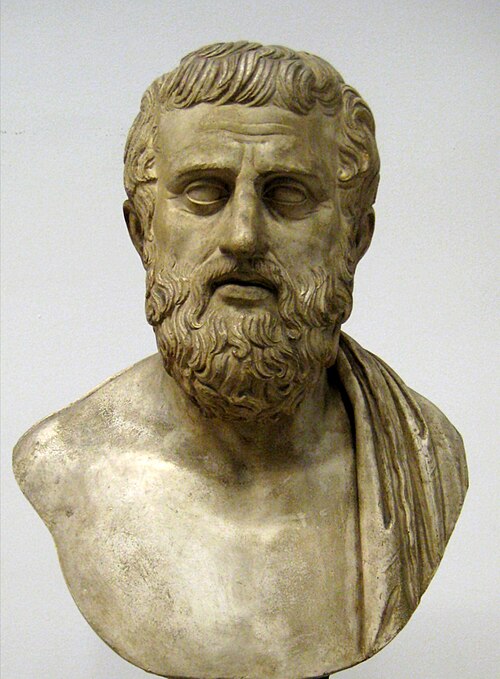
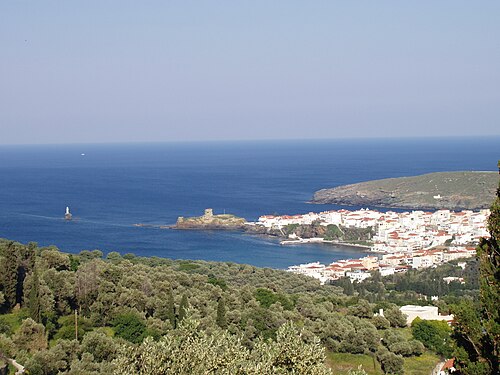
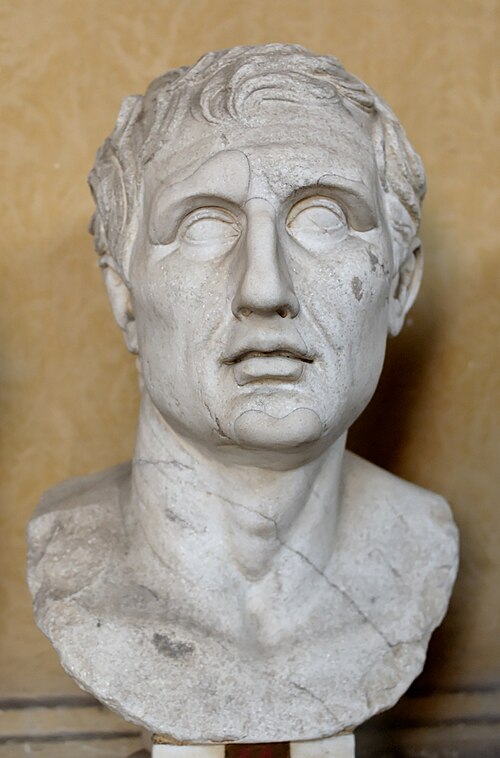
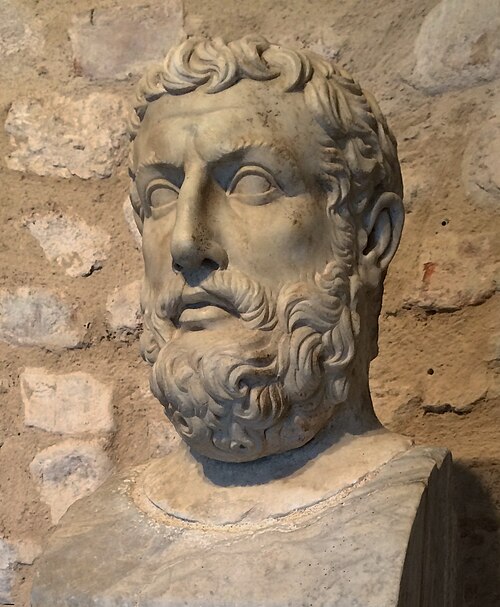
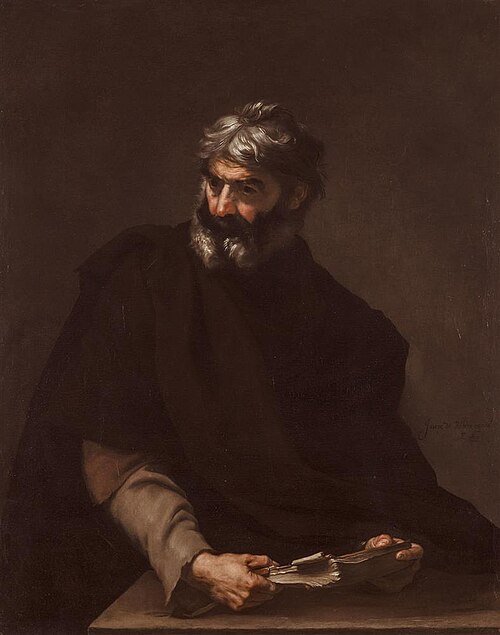
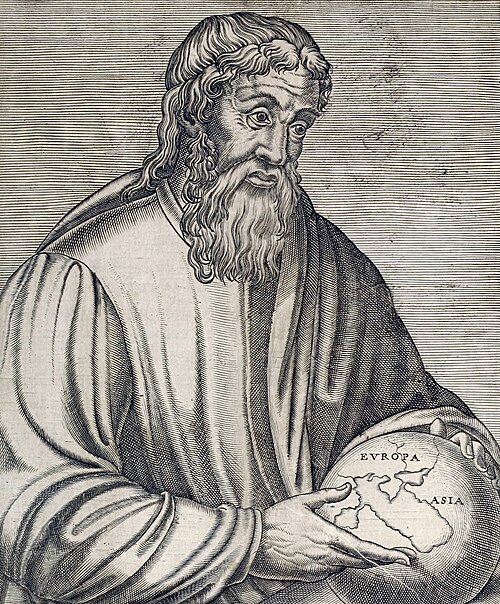
Aristarchus came from Samos, the eastern Aegean island, and lived roughly between 310 and 230 BC. Those are conventional approximate dates, not a fully documented lifespan. His education is linked by ancient testimony with Strato of Lampsacus. Attempts to reconstruct exactly where he studied or spent each stage of his career go beyond the limited evidence. We meet him chiefly through mathematical writing and references by other ancient authors, rather than a detailed personal biography.
His work belongs to the Hellenistic world, when Greek-speaking scholars connected mathematical proof with questions about the heavens. Archimedes, a near-contemporary, discusses his hypotheses in The Sand Reckoner; later authors add further reports. Vitruvius attributes a hemispherical sundial, the scaphe, to him, which provides a second kind of evidence about his reputation. These witnesses have different purposes and dates. They should not be combined into an uninterrupted story of a lone genius persecuted for discovering the complete modern solar system. The secure interest is more specific: an ancient thinker used mathematical assumptions to investigate scale and proposed that Earth might move. The survival of one treatise and the loss of another make both his achievement and the limits of our knowledge visible.
Works

On the Sizes and Distances of the Sun and Moon begins with hypotheses, including that the Moon receives light from the Sun. It then builds geometrical propositions about relative sizes and distances. A half-illuminated Moon provides a right-angle relationship; eclipse geometry contributes further arguments. The reasoning is substantial, but some assumed observational values are inaccurate, so the numerical results do not match modern astronomy. Mathematical precision in a proof does not guarantee precise starting observations.
That surviving treatise does not present the heliocentric proposal. For the latter, Archimedes reports a lost work in which the Sun and fixed stars remain unmoved while Earth circles the Sun. We cannot recover all its arguments or a complete planetary model. Nor should we quote Archimedes’ summary as words copied from Aristarchus’ surviving book. The four rows below therefore identify one extant work, a reported lost hypothesis, a method within the extant work and an instrument attributed by Vitruvius. The quotation is authentic Greek from the first hypothesis, with a Modern Greek rendering. It offers a small, verifiable entry into his reasoning without inventing the contents of the missing heliocentric text.
Legacy in Greece today
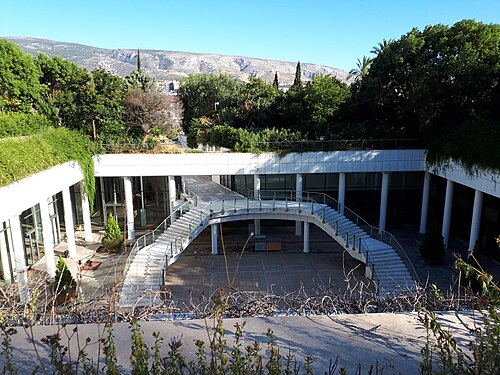
Aristarchus connects Samos with the Greek language of light, movement and scientific hypotheses. His name also belongs to the Aristarchos telescope at Helmos Observatory in the Peloponnese. On the observatory’s Greek site, recognise Τηλεσκόπιο and ΑΡΙΣΤΑΡΧΟΣ, then describe what a telescope is used to observe.
Draw Sun, Earth and Moon on paper and label ήλιος, γη and σελήνη. Write Η Γη κινείται γύρω από τον Ήλιο and Ο Ήλιος φωτίζει τη Σελήνη. Compare the ancient quotation with its modern rendering: φῶς becomes φως, while λαμβάνειν is rendered παίρνει. The B1 activity uses supported Modern Greek; it does not assume independent reading of the ancient mathematical proofs.
Did you know?
- Only one of his mathematical treatises survives.
- The heliocentric proposal is reported by Archimedes in The Sand Reckoner.
- Vitruvius attributes a bowl-shaped sundial to him.
Key works
| Greek title | Title | Year |
|---|---|---|
| Περὶ μεγεθῶν καὶ ἀποστημάτων ἡλίου καὶ σελήνης | On the Sizes and Distances of the Sun and Moon: surviving work | 3rd century BC |
| Ηλιοκεντρική υπόθεση | Heliocentric hypothesis: lost writing reported by Archimedes | 3rd century BC |
| Γεωμετρία της διχοτόμου σελήνης | Half-Moon geometry: method in the surviving work | 3rd century BC |
| Σκάφη: ηλιακό ρολόι | Scaphe sundial: attribution by Vitruvius | 3rd century BC |
A line to remember
Τὴν σελήνην παρὰ τοῦ ἡλίου τὸ φῶς λαμβάνειν.
In today's GreekΗ Σελήνη παίρνει το φως της από τον Ήλιο.
Tēn selēnēn para tou hēliou to phōs lambanein.
That the Moon receives its light from the Sun.