Life
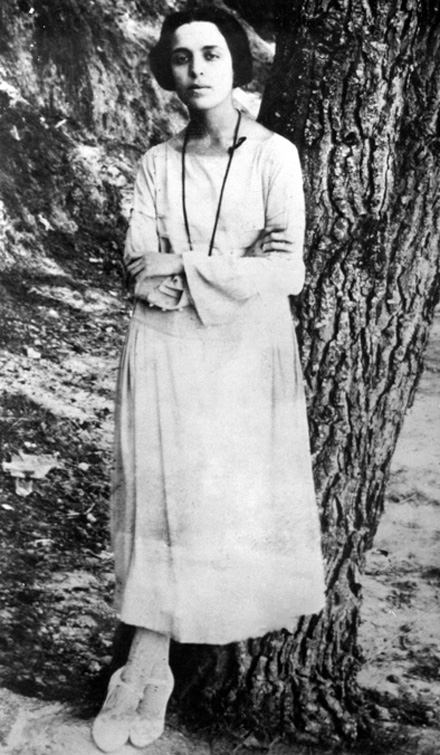
Maria Polydouri was born on 1 April 1902 in Kalamata, in the Peloponnese, the daughter of a schoolteacher of literature; the family moved with his postings to Gytheio and Filiatra. She was clever and restless, began publishing poems as a schoolgirl, and at sixteen was already working as a clerk in the prefecture of Messenia. In 1920 both her parents died within a few weeks of each other. The following year she transferred to the prefecture of Attica in Athens and enrolled at the law school, more from ambition than from any wish to be a lawyer.
In the office in 1922 she met a colleague, the poet Kostas Karyotakis. They fell in love; he was twenty-five, she was twenty. Within months Karyotakis discovered he had syphilis and ended the relationship without telling her why. Polydouri, hurt and bewildered, became engaged to a lawyer, broke it off, left her studies and the civil service, and enrolled in the drama school, appearing briefly on stage. In 1926 she left for Paris, where she studied dressmaking and lived in poverty; there she fell ill with tuberculosis.
She came back to Athens in 1928 and entered the Sotiria sanatorium, the great tuberculosis hospital on the slopes of Mount Hymettus. In July of that year Karyotakis shot himself in Preveza. Polydouri, who had kept loving him, poured the rest of her life into two slim books and a diary. She died in an Athens clinic on 29 April 1930, aged twenty-eight.
Works

Polydouri's two collections, Οι τρίλλιες που σβήνουν (The Trills That Fade, 1928) and Ηχώ στο χάος (Echo in Chaos, 1929), were both printed while she was in the sanatorium, and almost every poem in them is addressed to someone absent: the dead parents, the lost lover, death itself, which she writes about as a bridegroom coming to fetch her. The Greek is demotic and musical, with regular rhyme and metre, and the tone is a mixture of adolescent exaltation and clear-eyed sorrow that no other Greek poet of the 1920s quite has. Critics of her time placed her, with Karyotakis, in the «generation of the twenties», poets of disappointment after the Asia Minor catastrophe of 1922; but where Karyotakis is ironic, Polydouri is unguarded.
Her most famous poem, «Μόνο γιατί μ' αγάπησες» (Only Because You Loved Me), turns the usual order of love poetry upside down: she sings, she says, not because she is beautiful or gifted, but only because she was once loved, and that love gave her a voice and a reason to exist. Other poems people know are Σ' αγαπώ (I Love You), Γιατί σ' αγάπησα (Because I Loved You) and the poems to Karyotakis after his death. Her diary from the sanatorium and the prose piece Ημερολόγιο (Diary) show the same voice in plain prose, unsentimental about illness and death. After her death her poems were collected, with unpublished pieces, in a single volume of Άπαντα (Complete Works).
Legacy in Greece today
Polydouri and Karyotakis are Greece's great doomed literary couple, and their story has been told in novels and in television drama. Her poems are read in gymnasium and lyceum literature classes alongside his, and «Μόνο γιατί μ' αγάπησες» has been set to music several times; the sung versions are on every streaming service and are the easiest way to meet her. In Kalamata, her birthplace, a street carries her name and a bust of her stands in the city, which keeps a room devoted to her. The Sotiria hospital in Athens, where she wrote her second book, is still the country's main chest hospital. Her complete poems are in the public domain and free to read online, which makes her one of the first poets a learner can read whole.
Did you know?
- She and Karyotakis met as colleagues in the prefecture of Attica in Athens in 1922; both were civil servants who wrote poetry after hours.
- Both her collections were published while she was a patient in the Sotiria tuberculosis sanatorium.
- Her death on 29 April 1930 came less than two years after Karyotakis' suicide in Preveza in July 1928.
- She was publishing poems as a schoolgirl in Kalamata and working as a civil servant at sixteen.
Key works
| Greek title | Title | Year |
|---|---|---|
| Οι τρίλλιες που σβήνουν | The Trills That Fade | 1928 |
| Μόνο γιατί μ' αγάπησες | Only Because You Loved Me | 1928 |
| Ηχώ στο χάος | Echo in Chaos | 1929 |
| Ημερολόγιο | Diary (from the sanatorium) | 1928–30 |
| Άπαντα | Complete Works (posthumous) | posthumous |
From the works


Public-domain pictures from Wikimedia Commons.
A line to remember
Δεν τραγουδώ παρά γιατί μ' αγάπησες / στα περασμένα χρόνια.
Den tragoudo para giati m' agapises / sta perasmena chronia.
I sing only because you loved me / in the years gone by.
From the original
The text as Maria Polydouri wrote it, out of copyright, with our own translation beside it.
«Γιατί μ’ αγάπησες»Only Because You Loved Me
Written in the sanatorium and addressed to the poet Kostas Karyotakis, whom she had loved: the first four of the poem's nine five-line stanzas, each closing on the line it opened with. The page's quote is its first line and a half.
«Μόνο γιατί μ’ αγάπησες» (Οι τρίλλιες που σβήνουν, 1928), stanzas 1–4 of 9 · Public-domain text, source: el.wikisource.org