Life
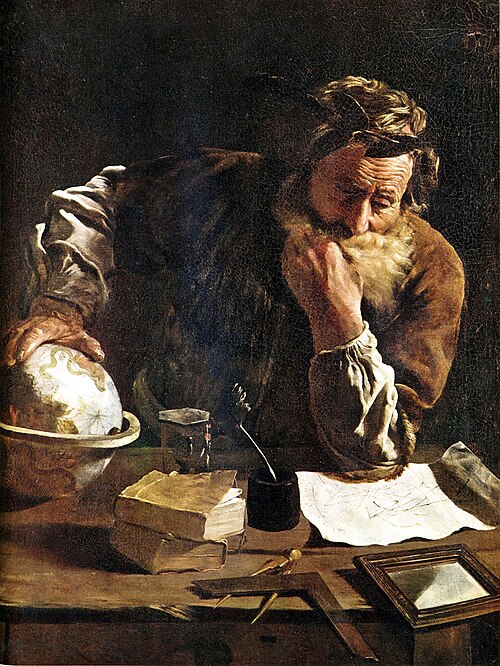
Archimedes was born around 287 BC in Syracuse, the richest Greek city of Sicily, the son of an astronomer named Phidias. He seems to have spent some time in Alexandria, the scientific capital of the age, and all his life he kept up a correspondence with the mathematicians there, Conon of Samos, Dositheus and Eratosthenes, to whom he sent his discoveries as letters. He was related to, or at least a close friend of, King Hieron II of Syracuse, and the king's practical problems, a suspect gold crown, a giant ship, the defence of the city, gave rise to many of the famous stories.
Plutarch, who describes him in his life of the Roman general Marcellus, says that Archimedes cared only for pure mathematics and considered his machines beneath him, yet those machines made him legendary. When the Romans besieged Syracuse in 214 BC during the Second Punic War, his catapults, cranes and «claws» that lifted ships out of the water kept the fleet at bay for two years, so that the Roman soldiers, Plutarch says, fled whenever a rope or beam appeared over the walls.
Syracuse fell in 212 BC. Marcellus had ordered that Archimedes be spared, but a soldier found the old man absorbed in a diagram and killed him; tradition gives him the last words «do not disturb my circles». On his tomb, at his own wish, was carved a sphere inside a cylinder, the discovery he was proudest of. Cicero found the neglected grave outside Syracuse in 75 BC.
Works

Archimedes' treatises survive, and they are real mathematics, not anecdotes. In Περί σφαίρας και κυλίνδρου (On the Sphere and Cylinder) he proved that a sphere has two thirds of the volume and surface of the cylinder that encloses it. In Κύκλου μέτρησις (Measurement of a Circle) he squeezed the value of π between 3 10/71 and 3 1/7 by drawing polygons of 96 sides inside and outside a circle. In Περί επιπέδων ισορροπιών (On the Equilibrium of Planes) he gave the law of the lever and the idea of the centre of gravity, and in Περί οχουμένων (On Floating Bodies) the principle that still bears his name: a body in a liquid is pushed up by a force equal to the weight of the liquid it displaces.
Ψαμμίτης (The Sand Reckoner), addressed to the king's son Gelon, invents a way of writing enormous numbers in order to count the grains of sand that would fill the universe. The most remarkable text is the Έφοδος (The Method), lost for centuries and found in 1906 by the Danish scholar Heiberg underneath the prayers of a medieval parchment in Constantinople: there Archimedes explains how he first guessed his results by imagining figures balanced on a lever. The inventions, the water-raising screw still called the Archimedean screw, the war machines and the burning mirrors of later legend, come to us only through other writers, as does the Eureka story told by Vitruvius: asked whether Hieron's crown was pure gold, he noticed in the bath that his body displaced water, and had his answer.
Legacy in Greece today
Every Greek pupil meets Archimedes twice: in mathematics, with the circle and π, and in physics, where «η αρχή του Αρχιμήδη» (Archimedes' principle) explains why ships float, and the law of the lever is taught with his boast about moving the Earth. The exclamation «Εύρηκα!» is used in Greek, and in most languages, whenever someone solves a problem, and «μη μου τους κύκλους τάραττε» is quoted, with a smile, by anyone who wants to be left in peace. The Archimedes palimpsest, bought at auction in 1998 and read with X-rays in Baltimore, has been published online. In Syracuse a tourist can visit the Tecnoparco Archimede, with working models of his machines; in Greece streets and schools carry his name, and the Archimedes Research Centre at Athens honours him in the sciences.
Did you know?
- The Archimedes palimpsest, a tenth-century copy of his works scraped off and overwritten with prayers in the thirteenth century, was sold at Christie's in 1998 for two million dollars and deciphered with X-ray imaging.
- His estimate of π, between 3 10/71 and 3 1/7, was the most accurate in the world for several centuries.
- Plutarch says he was so absorbed in geometry that he drew figures in the ashes of the fire and on his own oiled skin after the bath.
- Cicero found his forgotten tomb near Syracuse in 75 BC by looking for the sphere and cylinder carved on it.
Key works
| Greek title | Title | Year |
|---|---|---|
| Περί επιπέδων ισορροπιών | On the Equilibrium of Planes (the law of the lever) | 3rd century BC |
| Κύκλου μέτρησις | Measurement of a Circle (the value of π) | 3rd century BC |
| Περί σφαίρας και κυλίνδρου | On the Sphere and Cylinder | 3rd century BC |
| Περί οχουμένων | On Floating Bodies (Archimedes' principle) | 3rd century BC |
| Ψαμμίτης | The Sand Reckoner | c. 216 BC |
| Έφοδος (Μέθοδος) | The Method (the palimpsest) | 3rd century BC |
From the works


Public-domain pictures from Wikimedia Commons.
A line to remember
Δῶς μοι πᾶ στῶ καὶ τὰν γᾶν κινάσω.
In today's GreekΔώσε μου ένα μέρος να σταθώ και θα κινήσω τη Γη.
Dos moi pa sto kai tan gan kinaso.
Give me a place to stand and I will move the Earth.
From the original
The text as Archimedes wrote it, out of copyright, with our own translation beside it.
«Ψαμμίτης»The Sand Reckoner
The Sand Reckoner, addressed to Gelon of Syracuse, sets out to count the grains of sand that would fill the universe. Here, in Archimedes' Doric Greek, its opening, and the passage that is our main witness to Aristarchus' heliocentric hypothesis.
Ψαμμίτης 1.1 and 1.4–5 (c. 216 BC), in Heiberg's edition; one sentence omitted between the two passages · Public-domain text, source: scaife.perseus.org