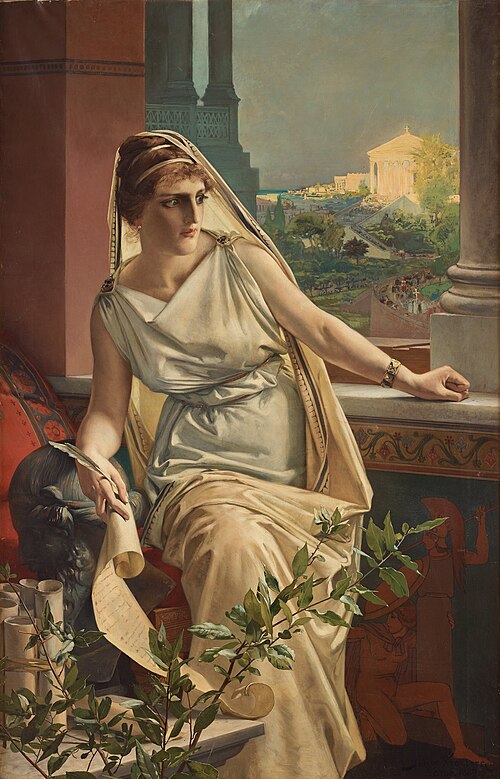
Life
Hypatia's father, Theon of Alexandria, was a mathematician and astronomer attached to the Museum, the ancient research institution founded by the Ptolemies; he is the last member of it we know by name. He taught his daughter, and she soon surpassed him. By the 390s she was giving public lectures in Alexandria on Plato, Aristotle and the Neoplatonist philosophers, and private lessons to a circle of devoted students. One of them, Synesius of Cyrene, later a Christian bishop, wrote her letters that survive; he calls her «mother, sister, teacher» and asks her advice on building a hydrometer and an astrolabe.
She never married and, according to the sources, lived with a dignity that won her the respect of the city's leading men, pagan and Christian alike. That respect became dangerous when Alexandria split between the imperial prefect Orestes, who consulted her, and the new bishop Cyril, who was fighting Orestes for control of the city. Rumours spread that Hypatia was the obstacle to peace between the two men.
In March 415, during Lent, a crowd led by a church lector named Peter pulled her from her carriage, dragged her into the Caesareum, a former temple turned church, stripped her and killed her with broken roof tiles, then burned her body. The church historian Socrates Scholasticus, writing a generation later and himself a Christian, recorded the crime with disgust, saying that nothing could be further from the spirit of Christianity than such murders.
Works

Not one line of Hypatia's own writing survives, but the tenth-century encyclopaedia called the Suda lists what she wrote: a commentary on the Arithmetica of Diophantus, the founder of algebra, a commentary on the Conics of Apollonius of Perga, the geometry of ellipses, parabolas and hyperbolas, and an «astronomical canon», tables of the kind used to predict the positions of the planets. Her father's edition of the third book of Ptolemy's Almagest, the standard textbook of astronomy for 1,400 years, carries a note that it was revised by «my daughter Hypatia the philosopher». Some scholars think that the surviving Greek text of Diophantus owes its form to her lessons.
As a philosopher she belonged to the Neoplatonist tradition of Plotinus, which taught that the soul rises through mathematics and contemplation towards a single divine source; mathematics for her was not a trade but a path. Synesius' letters show the practical side: she helped him design an astrolabe, the instrument for measuring the height of stars, and a device for measuring the density of liquids.
Her teaching, not her books, was her real work. In a city where pagan temples had been closed in 391 and religious violence was common, her school took Christians and pagans alike and stayed out of the quarrels of the churches. That independence, more than any doctrine, is what made her famous and what killed her.
Legacy in Greece today
Hypatia has been re-imagined by every age: by Enlightenment writers as a martyr of reason, by Charles Kingsley in his novel Hypatia (1853), by the painters of the nineteenth century, and by the film Agora (2009), in which Rachel Weisz plays her in a reconstructed Alexandria. A crater on the Moon and the asteroid 238 Hypatia carry her name. In Greece Υπατία is a girl's name that families still give, often with her story in mind, and she appears in school discussions of the end of the ancient world and of women in science. The best way to meet her is through the Greek sources, which are short: the chapter of Socrates Scholasticus' Ecclesiastical History (7.15) that describes her death, and the letters of Synesius, a learner's window on a real friendship between a bishop and a pagan teacher.
Did you know?
- Her student Synesius became a Christian bishop and still wrote to her as his teacher, asking her help to build a hydrometer.
- The main account of her murder comes from a Christian church historian, Socrates Scholasticus, who condemned it in the strongest terms.
- Her father Theon is the last person known to have belonged to the Museum of Alexandria, the research institution of the Ptolemies.
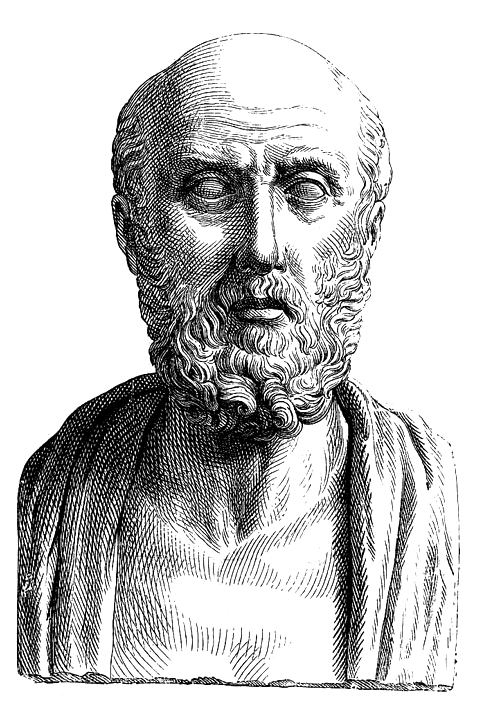
- Every famous portrait of her, from the nineteenth-century paintings to the film Agora, is imaginary; no ancient image of her exists.
Key works
| Greek title | Title | Year |
|---|---|---|
| Έκδοση του τρίτου βιβλίου της Μαθηματικής Σύνταξης του Πτολεμαίου (με τον Θέωνα) | Revision of Book III of Ptolemy's Almagest (with Theon) | c. 380s |
| Υπόμνημα στα Αριθμητικά του Διόφαντου | Commentary on Diophantus' Arithmetica (lost) | |
| Υπόμνημα στα Κωνικά του Απολλώνιου | Commentary on Apollonius' Conics (lost) | |
| Αστρονομικός Κανών | Astronomical Canon (lost) | |
| Ο αστρολάβος του Συνέσιου | The astrolabe designed with Synesius | c. 400 |
From the works


Public-domain pictures from Wikimedia Commons.
A line to remember
Ἦν τις γυνὴ ἐν τῇ Ἀλεξανδρείᾳ τοὔνομα Ὑπατία· […] ἐπὶ τοσοῦτον δὲ προὔβη παιδείας, ὡς ὑπερακοντίσαι τοὺς κατ' αὐτὴν φιλοσόφους.
In today's GreekΥπήρχε στην Αλεξάνδρεια μια γυναίκα με το όνομα Υπατία· έφτασε σε τέτοιο ύψος μόρφωσης, ώστε ξεπέρασε όλους τους φιλοσόφους της εποχής της.
In tis gyni en ti Alexandreia tounoma Ypatia; epi tosouton de prouvi paideias, os yperakontisai tous kat' aftin filosofous.
There was a woman in Alexandria named Hypatia; she advanced so far in learning that she surpassed all the philosophers of her time.