Life
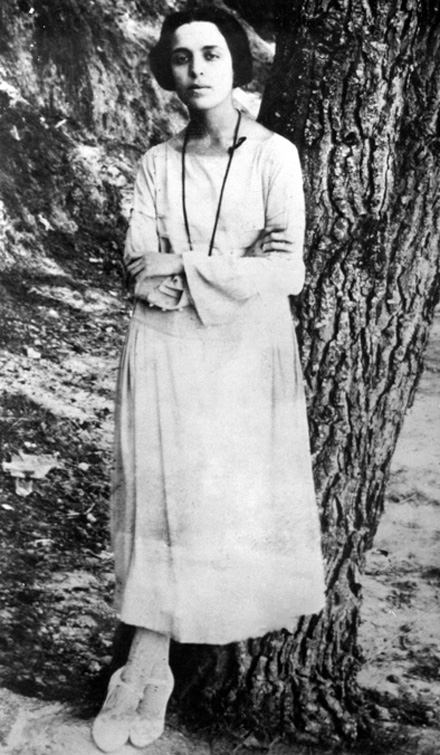
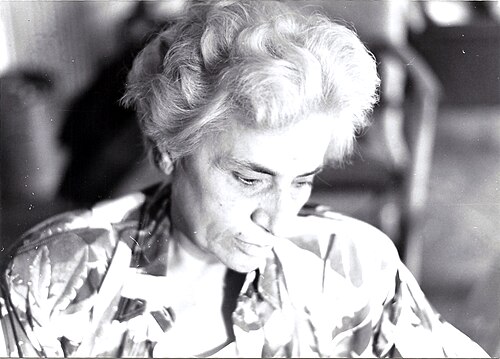
Maria Iordanidou was born in Constantinople (Istanbul) in 1897, into the large Greek community of the city, the Ρωμιοί of the Polis. Her parents were often away, and she spent much of her childhood with her grandmother Loxandra, a strong and lively woman who ran her household in the old-fashioned way. The world of that house, with its kitchen, its feasts, its neighbours and its fears, stayed with Maria all her life.
In 1914, at seventeen, she went on holiday to Batumi in the Caucasus, then part of the Russian Empire, and there she was caught first by the First World War and then by the Russian Revolution, which kept her there for about five years; she later turned these years into a book. After a time in Constantinople and in Alexandria, she married the teacher Iordanis Iordanidis in 1923 and settled in Athens, where she worked for many years, at the Soviet embassy and as a teacher of foreign languages, and lived through the difficult decades of the Occupation and the Civil War. Those who knew her remembered an independent mind and a sharp sense of humour.
Only in her sixties did she begin to write. Λωξάντρα appeared in 1963 and was an immediate and lasting success. Encouraged, she went on writing for more than twenty years, and her books became a kind of family history of the Greeks of the twentieth century. She died in Athens in November 1989, aged over ninety.
Works

Λωξάντρα (Loxandra, 1963) is the story of her grandmother, a well-off Greek housewife of Constantinople in the late nineteenth century. Loxandra cooks enormous meals, celebrates every name day and religious feast, believes in the evil eye, gives food to everyone and fights with everyone, and lives side by side with Turkish, Armenian and Jewish neighbours. Through her, the novel shows a whole lost world: the markets and the Bosphorus, Easter and Christmas customs, recipes, songs and proverbs. It is told with humour and tenderness, but also with a sense of loss, because the world it describes has disappeared: the Greek community of Istanbul, once huge, now numbers only a few thousand.
Her next book, Διακοπές στον Καύκασο (Holidays in the Caucasus, 1965), is based on her own youth: a girl from Constantinople goes on what should be a short trip to the Caucasus and finds herself trapped for years by war and revolution. Σαν τα τρελά πουλιά (Like Mad Birds, 1978) follows the same heroine in Athens between the wars and through the political storms of the following decades.
Iordanidou's style is simple, oral and full of the Greek of Constantinople, with its special words and expressions. She does not analyse; she tells, as a grandmother tells stories at the table. That is exactly why readers loved her.
Legacy in Greece today
Λωξάντρα has been reprinted dozens of times and is still one of the most popular Greek novels; many Greek families have a copy, and its recipes and customs are often quoted. The book was adapted in 1980 as a television series by the Greek state broadcaster ERT, with Betty Valasi as Loxandra, which made the heroine a household name. For Greeks whose families came from Constantinople, it is a book of memory. Name days, the evil eye, the cooking of Holy Week: many learners first discover these customs through Loxandra. It is a good first Greek novel to read, together with Dido Sotiriou's Ματωμένα χώματα (Farewell Anatolia).
Did you know?
- She published her first book, Loxandra, in 1963, at the age of sixty-six.
- The heroine of Loxandra is her own grandmother.
- As a young woman she was stranded in the Caucasus by the First World War and the Russian Revolution.
- She kept writing until her late eighties and lived past ninety.
Key works
| Greek title | Title | Year |
|---|---|---|
| Λωξάντρα | Loxandra | 1963 |
| Διακοπές στον Καύκασο | Holidays in the Caucasus | 1965 |
| Σαν τα τρελά πουλιά | Like Mad Birds | 1978 |
| Λωξάντρα (τηλεοπτική σειρά της ΕΡΤ) | Loxandra (ERT television series) | 1980 |
A line to remember
Λωξάντρα
Loxantra
Loxandra