Life
Markos was born on 10 May 1905 in Ano Syros, the Catholic hill town above the port of Ermoupoli on the Cycladic island of Syros; the Catholics of Syros are called Φραγκοσυριανοί, which gave his most famous song its title. The family was poor and he worked from childhood in the fields and the cotton mill. At fifteen, in 1920, he left the island for Piraeus and did every hard job the port offered: coal carrier, docker, and for years a slaughterman at the municipal slaughterhouses.
Around 1924 he heard a bouzouki for the first time and, by his own account, swore he would learn it within six months or cut off his hand with a butcher's cleaver. He learned it, playing in the tekedes, the hashish dens of Piraeus, where the bouzouki was then an outlaw instrument. His first records appeared in 1932–33, and in 1934 he formed with Stratos Pagioumtzis, Giorgos Batis and Anestis Delias the «famous quartet of Piraeus» (Τετράς η ξακουστή του Πειραιώς), the first rebetiko group to play in public. A disastrous marriage, the censorship of the Metaxas dictatorship in 1937, and the Occupation years followed.
After the war his style fell out of fashion, arthritis stiffened his fingers and he was reduced to playing in cheap tavernas. The revival came in 1960, when Grigoris Bithikotsis recorded Frangosyriani and a younger public discovered the old songs; Markos spent his last decade honoured and recording again. He died in Athens on 8 February 1972. His autobiography, dictated to Angeliki Vellou-Keil, appeared in 1973.
Works

Rebetiko came out of the refugee quarters and ports of the 1920s, mixing the music of Smyrna with the songs of the Greek underworld. Markos gave it its Piraeus form: a hoarse, unornamented voice, the bouzouki played with a hard, steady rhythm, and lyrics about his own life in plain words. His early records, such as Καραντουζένι (1933) and Χαράματα η ώρα τρεις (Three in the Morning, 1935), speak openly of the tekes, prison and hashish, and they were banned after 1937, when the dictatorship outlawed such themes.
Φραγκοσυριανή (Frangosyriani, 1935) is a love song to a Catholic girl from Syros, a tour of the island's beaches and villages set to a slow zeibekiko, and it is sung at every Greek wedding and panigyri. Τα ματόκλαδά σου λάμπουν (Your Eyelashes Shine, c. 1936) is a hasapiko in his most tender vein. Όλοι οι ρεμπέτες του ντουνιά (All the Rebetes of the World, c. 1937) is a manifesto of the rebetiko brotherhood, and Ο Μάρκος μαθητής (Markos the Pupil) jokes about a schoolboy Markos in love with his teacher. He also wrote about work, poverty, drink and death, always in a direct first person, without the sentimentality of later popular song.
Nearly all rebetiko composers after him, Tsitsanis above all, started as his imitators, and the three-stringed bouzouki, the dance zeibekiko and the whole sound of Greek laiko song descend from the records he made between 1932 and 1940.
Legacy in Greece today
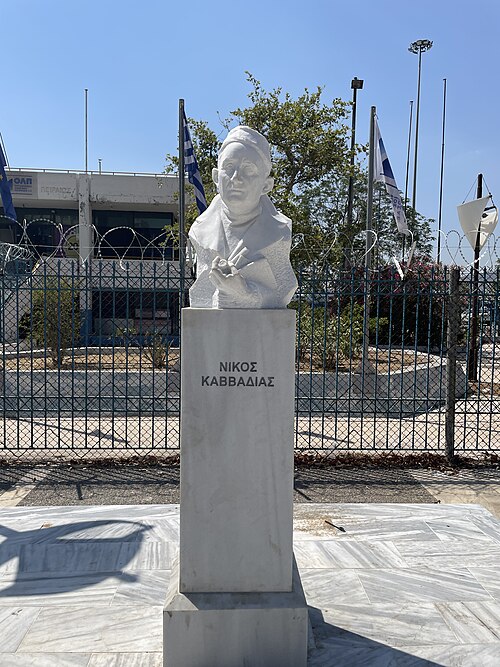
Rebetiko was added to UNESCO's list of intangible cultural heritage in 2017, and Markos is its founding figure. Frangosyriani is the song to learn first: Greeks of every generation know the words, and recordings by Bithikotsis, Dalaras and dozens of others sit beside Markos' own 1935 original. In Ano Syros a small Markos Vamvakaris Museum occupies a house in the old town, his bust stands in the square named after him, and the island's annual festival carries his name. His songs appear in school music lessons and in every rebetiko evening in Athens, and the phrase «ο πατριάρχης του ρεμπέτικου» (the patriarch of rebetiko) means him alone. The site's B2 listening exercise on the history of Greek music and the speaking exercise about rebetiko are natural next steps after this page.
Did you know?
- He swore to learn the bouzouki in six months or cut off his hand with a cleaver; he learned it.
- He was a Catholic from Syros, which is what Φραγκοσυριανός means, in a music that was overwhelmingly Orthodox.
- The Piraeus quartet of 1934 is considered the first rebetiko band to play on a public stage, rather than in a tekes.
- After years of neglect, Grigoris Bithikotsis' 1960 recording of Frangosyriani made him famous again at the age of fifty-five.
Key works
| Greek title | Title | Year |
|---|---|---|
| Καραντουζένι | Karantouzeni | 1933 |
| Φραγκοσυριανή | Frangosyriani (The Girl from Catholic Syros) | 1935 |
| Τα ματόκλαδά σου λάμπουν | Your Eyelashes Shine | c. 1936 |
| Όλοι οι ρεμπέτες του ντουνιά | All the Rebetes of the World | c. 1937 |
| Ο Μάρκος μαθητής | Markos the Pupil | c. 1937 |
| Αυτοβιογραφία | Autobiography (dictated, published posthumously) | 1973 |
From the works

Public-domain pictures from Wikimedia Commons.
A line to remember
Μια φούντωση, μια φλόγα έχω μέσα στην καρδιά
Mia fountosi, mia floga echo mesa stin kardia
A blaze, a flame I have inside my heart