Life
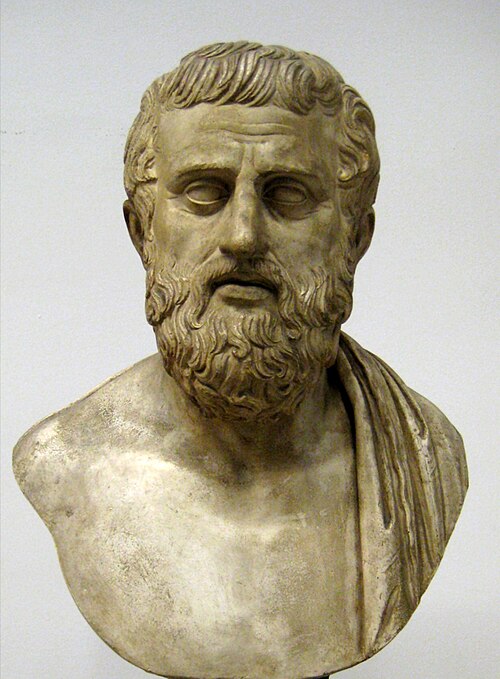
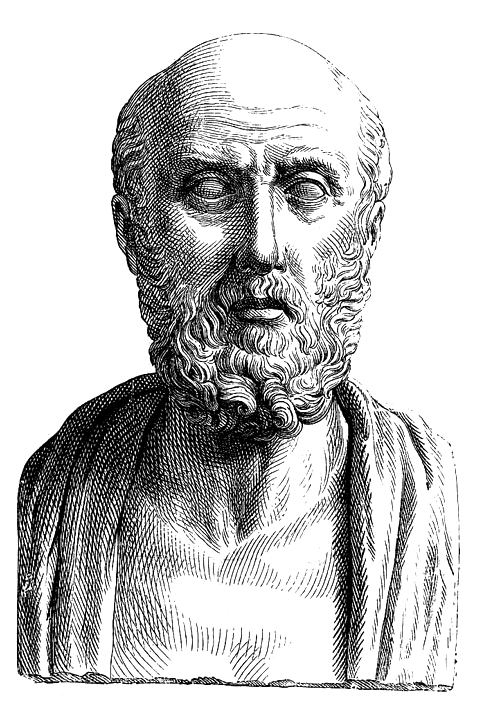
Hippocrates was born on Kos, an island off the coast of Asia Minor, around 460 BC, into the Asclepiads, a family of physicians who traced their descent from the healing god Asclepius. He learned medicine from his father, Heraclides, and taught it in turn, reportedly accepting pupils from outside the family for a fee, which was new. Plato, writing within his lifetime, mentions «Hippocrates of Kos, the Asclepiad» as the obvious example of a famous doctor, and Aristotle calls him «the great Hippocrates»; these two mentions are almost all we securely know.
Later biographies, written centuries after his death, fill in the rest: that he travelled widely in Thrace, Thessaly, Macedonia and the islands, treating patients and teaching; that he declined an invitation from the Persian king; that he was called to Athens during the plague; that he taught under a plane tree in the town of Kos. Some of this is legend. What is certain is that he spent much of his life on the mainland and died in Larissa, in Thessaly, at a great age, around 370 BC.
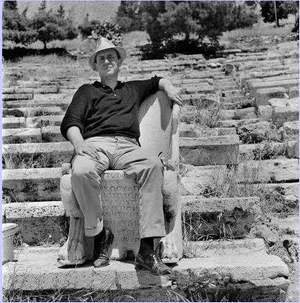
In Greek he is Ιπποκράτης, in English Hippocrates, in French Hippocrate. The sanctuary of Asclepius on Kos, the Asklepieion, whose ruins visitors walk through today, was built after his death, in the fourth and third centuries BC, partly in his honour.
Works

About sixty medical treatises in the Ionic dialect have come down under his name, the Hippocratic Corpus. Scholars agree that they were written by several authors of his school over more than a century, and nobody can say which, if any, are by Hippocrates himself. What unites them is a method. «Περί ιερής νούσου» (On the Sacred Disease) argues that epilepsy is no more divine than any other illness and has a cause in the body. «Περί αέρων, υδάτων, τόπων» (Airs, Waters, Places) relates disease to climate, water and season, the beginning of environmental medicine. The seven books of «Επιδημίαι» (Epidemics) record individual patients day by day, with the honest note that many of them died.
The «Προγνωστικόν» (Prognostic) teaches the doctor to read the signs of the body and foresee the course of an illness; the thin, sharp face of a dying patient is still called the Hippocratic face. The theory that health is a balance of four humours, blood, phlegm, yellow bile and black bile, comes from this school and governed European medicine for two thousand years. The «Αφορισμοί» (Aphorisms) collect short rules for practice, beginning with the famous «life is short, the art long».
And there is the «Όρκος» (Oath): the young doctor swears by Apollo and Asclepius to honour his teacher, to use treatment for the benefit of the sick, to give no deadly drug, to keep what he sees in patients' houses secret. The sentence «to help, or at least not to harm» stands in the Epidemics; the Oath says the same in its own words.
Legacy in Greece today
In Greece medical graduates still take the Hippocratic Oath in a modern form, and the first line, «Ὄμνυμι Ἀπόλλωνα ἰητρόν», is one of the few pieces of ancient Greek most people can recognise. On Kos a learner can sit under the Plane Tree of Hippocrates (Πλάτανος του Ιπποκράτη) in the main square of the town, a tree that is in fact a few centuries old but stands where tradition places his teaching, and then walk up to the Asklepieion on its three terraces above the sea. Kos has an International Hippocratic Foundation and a Hippocrates museum, and his statue stands in the town. Every Greek town has an Ιπποκράτους street, and the phrase ιπποκρατικός όρκος is used far beyond medicine for any solemn professional promise. The site's C1 reading on Asclepius tells the myth behind his family.
Did you know?
- Plato mentions Hippocrates twice, in the Protagoras and the Phaedrus, which makes him one of the very few figures of his time attested by a contemporary.
- Of the roughly sixty Hippocratic treatises, probably none can be proven to be by Hippocrates himself; they are the work of his school over more than a hundred years.
- The original Oath forbids the doctor to use the knife and leaves surgery to «those who practise this craft», and it is sworn by Apollo, Asclepius, Hygieia and Panacea.
- The modern words «crisis», «chronic», «diagnosis» and «epidemic» are all ancient Greek medical terms found in the Hippocratic writings.
Key works
| Greek title | Title | Year |
|---|---|---|
| Όρκος | The Hippocratic Oath | c. 400 BC |
| Περί ιερής νούσου | On the Sacred Disease | c. 400 BC |
| Περί αέρων, υδάτων, τόπων | Airs, Waters, Places | c. 400 BC |
| Επιδημίαι | Epidemics | 5th–4th c. BC |
| Προγνωστικόν | Prognostic | c. 400 BC |
| Αφορισμοί | Aphorisms | c. 400 BC |
From the works


Public-domain pictures from Wikimedia Commons.
A line to remember
Ὁ βίος βραχύς, ἡ δὲ τέχνη μακρή, ὁ δὲ καιρὸς ὀξύς, ἡ δὲ πεῖρα σφαλερή, ἡ δὲ κρίσις χαλεπή.
In today's GreekΗ ζωή είναι σύντομη, η τέχνη μακριά, η ευκαιρία φευγαλέα, η πείρα απατηλή, η κρίση δύσκολη.
O vios vrachys, i de techni makri, o de kairos oxys, i de peira sfaleri, i de krisis chalepi.
Life is short, the art is long, the right moment fleeting, experience deceptive, judgement difficult.
From the original
The text as Hippocrates wrote it, out of copyright, with our own translation beside it.
«Ἱπποκράτειος Ὅρκος»The Hippocratic Oath
The second half of the Oath, after the pledges to one's teacher: here stand the promises every medical student still recognises, to do no harm, to give no poison, to respect the patient's house and to keep what one sees secret, sealed by a blessing and a curse.
Ὅρκος (c. 400 BC), second half: from the pledge on treatment to the closing prayer · Public-domain text, source: el.wikisource.org