Life
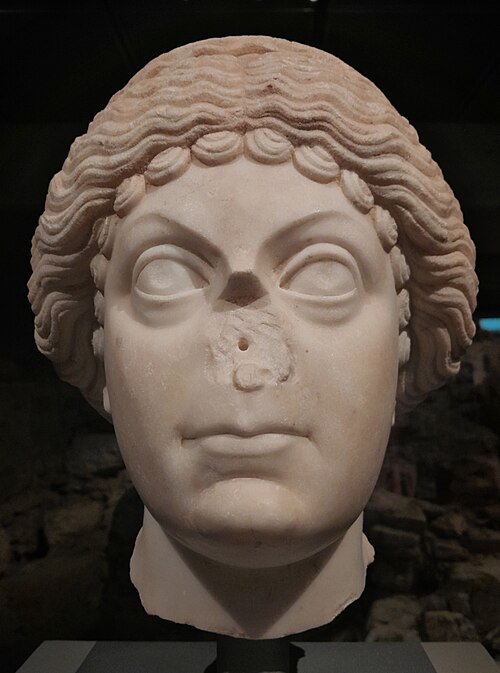
Irene came from Athens and was born around 752, although little is securely known about her childhood. She arrived at Constantinople in 769 and married the future emperor Leo IV that year. Her son Constantine was born in 771. When Leo died in 780, Constantine VI was still a child, and Irene became regent. Governing required support from court officials, military commanders and church leaders. Her preference for the veneration of icons did not make agreement automatic: an attempted council in Constantinople in 786 was disrupted by soldiers.
The council that met at Nicaea in 787 restored the veneration of religious images. Irene’s relationship with Constantine later became a struggle over who would exercise imperial authority. In 790 he removed her from government; she returned to a public ruling role in 792. In 797 her faction overthrew Constantine and had him blinded with her involvement. This was a grave act of political violence. Irene then ruled alone until a palace coup brought Nikephoros I to power in 802. She was sent into exile and died on Lesbos in 803. Her career needs to be understood through both its religious policy and the coercive power of the imperial court.
Works

Irene’s best-known religious policy was support for the Second Council of Nicaea in 787. With Patriarch Tarasius and representatives of the churches, the council rejected the iconoclast decisions of 754 and defended the veneration of icons. Its distinction between honour directed through an image and worship owed to God mattered to its argument. The settlement did not end the controversy forever: imperial iconoclasm returned in 815, and the restoration celebrated in 843 belonged to the later empress Theodora’s time. Irene and Theodora should not be merged into one figure.
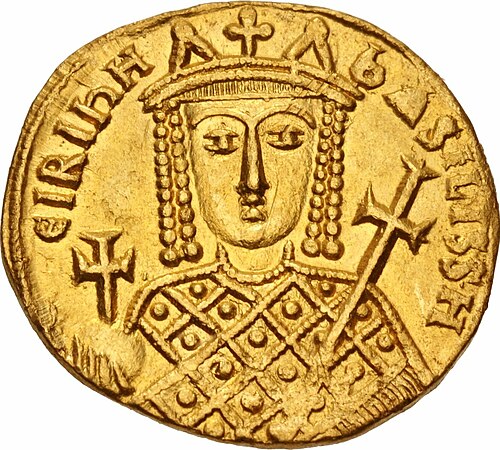
Her surviving gold coins make a different kind of statement. On examples struck during her sole rule, her crowned bust appears on both sides, holding a cross-topped globe and a sceptre. The legend identifies her as basilissa, empress. These are conventional signs of authority, not an unmediated portrait of her personality. Coins circulated an official claim about who ruled, and they now let us compare image, lettering and title. Their inscriptions use historical spelling and letter forms that need explanation for a Modern Greek learner. The name Ειρήνη also means peace in Modern Greek, but the meaning of a name is not a description of its bearer’s actions. Reading the coin alongside a dated account keeps language, representation and political history in view.
Legacy in Greece today
Begin with the Numismatic Museum’s online entry Νόμισμα Ειρήνης της Αθηναίας (Coin of Irene of Athens), available through SearchCulture. Look at the two faces and identify the crown, globe and sceptre. In Modern Greek, try Το νόμισμα είναι χρυσό and Η αυτοκράτειρα κρατά μια σφαίρα. Find her name in the historical lettering, then compare the title on the coin with our modern rendering Ειρήνη, βασίλισσα. Here basilissa is an imperial title; its modern everyday meaning can also be queen. Finally make a four-date timeline: 780, 787, 797 and 802. Use πρώτα, μετά and τέλος to explain the changes in government. The exercise links a real museum object to description and chronological narration.
Did you know?
- Irene’s sole-rule gold coins can show her portrait on both faces.
- The 787 council and the restoration of 843 belong to different reigns.
- The name Ειρήνη also means peace in Modern Greek.
Key works
| Greek title | Title | Year |
|---|---|---|
| Στέψη και γάμος με τον Λέοντα Δ΄ | Coronation and marriage to Leo IV | 769 |
| Αντιβασιλεία για τον Κωνσταντίνο ΣΤ΄ | Regency for Constantine VI | 780 |
| Β΄ Σύνοδος της Νίκαιας | Second Council of Nicaea | 787 |
| Μοναρχία και χρυσά νομίσματα | Sole rule and gold coinage | 797–802 |
A line to remember
ΕΙΡΙΝΗ ΒΑΣΙΛΙΣΣΗ
In today's GreekΕιρήνη, βασίλισσα.
Eirini basilissi
Irene, empress.