Life
Kolokotronis was born on 3 April 1770 at Ramovouni in Messenia, in the south-western Peloponnese, into a family of klephts, the armed outlaws of the Ottoman mountains, who had fought in the failed Orlov revolt that same year. His father Konstantinos was killed by Ottoman forces in 1780, when the boy was ten; he grew up with a gun in his hand and by his twenties was a klepht captain himself. In 1806 the Ottomans hunted down the klephts of the Peloponnese and he escaped to Zakynthos in the Ionian Islands, where he served as an officer in a Greek regiment of the British army and learned something of regular warfare. There, in 1818, he joined the Filiki Etaireia, the secret society planning the revolution.
In January 1821 he landed in the Mani, and when the revolt broke out in March he became the leader of the Peloponnesian irregulars. After the victories of 1821–22 he was made commander-in-chief, but the civil wars of 1824 set him against the government, and in 1825 he was imprisoned in a monastery on Hydra, released only because Ibrahim Pasha's Egyptian army had invaded the Peloponnese. He supported Kapodistrias, and after the governor's murder opposed the Bavarian regency of young King Otto; in 1834 he was tried for treason and sentenced to death. Two of the judges, Polyzoidis and Tertsetis, refused to sign the verdict. Otto pardoned him in 1835 and made him a general and counsellor of state. He died in Athens on 4 February 1843, after returning home from a ball at the palace.
Works

Kolokotronis won the War of Independence on land in its first two years. At Valtetsi in May 1821 his men repelled the Ottoman garrison of Tripolitsa, and on 23 September 1821 the town itself, the Ottoman capital of the Peloponnese, fell to the Greeks, followed by a massacre he could not or did not stop. The next summer an Ottoman army of some 25,000 under Dramali Pasha marched into the Peloponnese to crush the revolt; Kolokotronis let it advance, burned the plain of Argos behind it, and when it tried to withdraw through the mountain passes at Dervenakia on 26–28 July 1822 he destroyed it. The Peloponnese was never seriously threatened again until Ibrahim arrived in 1825. Against Ibrahim's disciplined Egyptian troops he fought a guerrilla war and answered the Greeks who were submitting to the invader with his famous «φωτιά και τσεκούρι στους προσκυνημένους» (fire and axe to those who have bowed).
His other weapons were words. In 1836 he dictated his memoirs to Georgios Tertsetis, the judge who had refused to condemn him; published in 1846 as Διήγησις συμβάντων της ελληνικής φυλής (Narrative of Events of the Greek Race), they are the voice of an unschooled man of genius, blunt, funny and shrewd, and the best single account of 1821 from inside. On 8 October 1838 he spoke to the pupils of the Athens gymnasium on the Pnyx, the hill where the ancient assembly met, telling them how the revolution had begun without soldiers, money or arms, and urging them to learn, to stay united and to love their country. The speech, printed in a newspaper a month later, is read in Greek schools to this day.
Legacy in Greece today
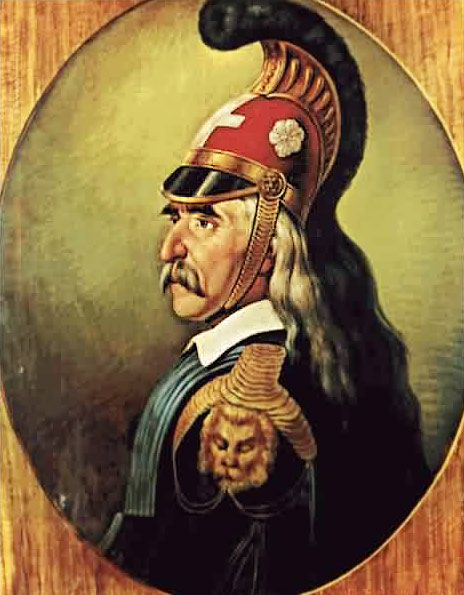
Every Greek knows his face: the bronze equestrian statue by Lazaros Sochos (1904) in front of the Old Parliament on Stadiou Street in Athens, with a copy in the main square of Nafplio, and the famous helmet from his years in British service, kept at the National Historical Museum in the Old Parliament building. He was on the 5,000-drachma note until the euro. Streets called Κολοκοτρώνη run through almost every town, and his Pnyx speech, with the opening «Εις τον τόπο τούτο, οπού εγώ πατώ σήμερα», is in the school anthologies alongside extracts from the memoirs, which a learner can read in the original on Greek Wikisource. On 25 March, Independence Day, schoolchildren still dress up as him, with the helmet and the white φουστανέλα. The nickname Γέρος του Μοριά needs no explanation to anyone in Greece.
Did you know?
- He was sentenced to death by a Greek court in 1834, thirteen years after taking Tripolitsa; the two judges who refused to sign the sentence became national heroes themselves.
- He could barely write; his memoirs were dictated to Georgios Tertsetis, one of those two judges, in 1836.
- His famous helmet is not Greek at all: it is from the uniform of the Greek regiment he served in under the British in the Ionian Islands.
- He died the night he came home from a ball at King Otto's palace, in February 1843.
Key works
| Greek title | Title | Year |
|---|---|---|
| Μάχη του Βαλτετσίου | Battle of Valtetsi | 1821 |
| Άλωση της Τριπολιτσάς | Fall of Tripolitsa | 1821 |
| Μάχη στα Δερβενάκια | Battle of Dervenakia | 1822 |
| Αντίσταση στον Ιμπραήμ | Guerrilla resistance to Ibrahim Pasha | 1825–1827 |
| Λόγος στην Πνύκα | Speech on the Pnyx to the students of Athens | 1838 |
| Διήγησις συμβάντων της ελληνικής φυλής | Narrative of Events of the Greek Race (memoirs, dictated 1836) | 1846 |
From the works


Public-domain pictures from Wikimedia Commons.
A line to remember
Εις τον τόπο τούτο, οπού εγώ πατώ σήμερα, επατούσαν και εδημηγορούσαν τον παλαιό καιρό άνδρες σοφοί…
Eis ton topo touto, opou ego pato simera, epatousan kai edimigorousan ton palaio kairo andres sofoi…
On this spot where I stand today, in the old days wise men stood and spoke to the people…
From the original
The text as Theodoros Kolokotronis wrote it, out of copyright, with our own translation beside it.
«Λόγος στην Πνύκα»Speech on the Pnyx
The opening of the speech the old general gave on the Pnyx hill in Athens on 8 October 1838 to the pupils of the city's gymnasium. He goes on to tell them the story of the War of Independence and to warn them against discord.
Speech to the pupils of the Athens gymnasium on the Pnyx, 8 October 1838, opening · Public-domain text, source: el.wikisource.org