Life
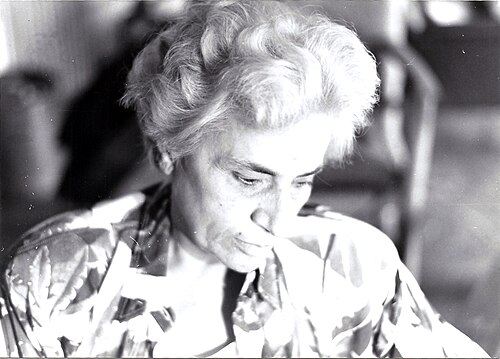
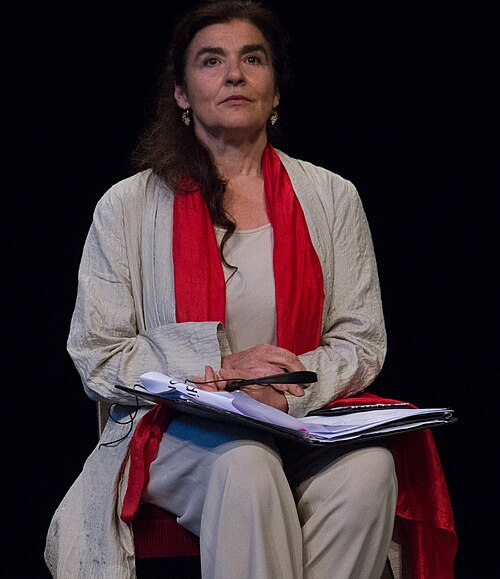
Romanos studied at the Athens School of Fine Arts with Yannis Moralis and Andreas Georgiadis. Her early movement towards abstraction brought colour and form beyond conventional representation. She received an award at the Zygos gallery’s first Young Artists’ Salon in 1958 and held her first solo exhibition there in 1960. These beginnings connected her with a changing Greek art scene before she moved to Paris in 1961.
She remained in France until 1981, working among artists and critics exploring new materials and methods of reproduction. Her relationship with Nikos Kessanlis included artistic exchange and the Paris workshop Mec Art Graphic, associated with screenprinting. The wider setting included Pierre Restany’s circle and debates about art, everyday life and mass-produced images. Her international participation included the Paris and Ljubljana biennials in 1961 and São Paulo in 1965 and 1994. After returning to Athens in 1981, she exhibited at Desmos and continued developing her work. She died in Athens in 2006. Her professional trajectory crosses places and media, with an individual artistic enquiry running through changes of technique. She explored how the arrangement of printed images could reveal contradictions in the world around her.
Works

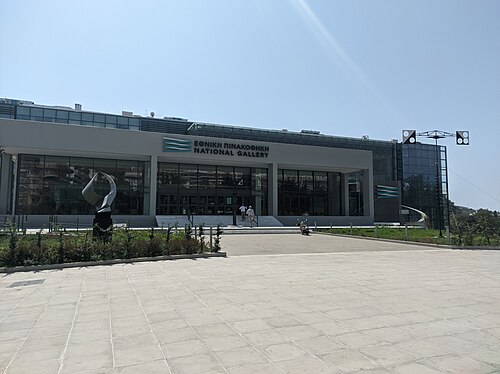
Summer No. 1 (1960), an oil painting in the National Gallery, belongs to her early abstract work. The Myths series followed in 1962, while monotypes and repeated forms opened other ways of organising a surface. In Luna Park International (1965), reproduced in the National Museum of Contemporary Art’s educational material, collage brings printed images into charged relationships. Contrasts between consumer abundance and violence or deprivation turn familiar visual language towards social questions.
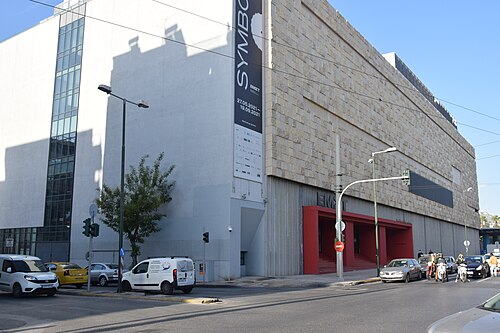
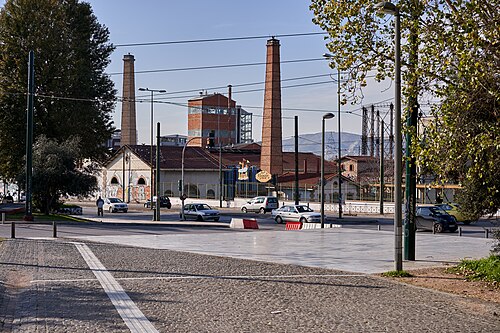
From 1968, her Meccano constructions extended assembly into large wooden structures. The name refers to the construction toy, but these works were artistic investigations of combinations and play. Later prints also carried related titles. Screenprinting provided another route into multiplication and circulation: La Tour Eiffel, dated 1973 in the MOMus collection, is one example. Later Maps-Labyrinths used décollage on transparent plexiglass, making removal, overlapping and visibility part of the work. Across these changes, images could be combined, repeated or partly erased. The viewer encounters relations between fragments rather than a single fixed story. The 2023–2024 EMST survey brought these different bodies of work together within their historical and social settings.
Legacy in Greece today
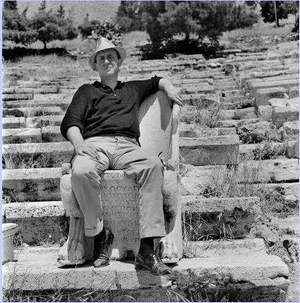
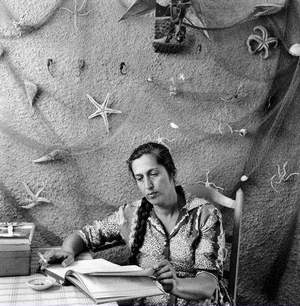
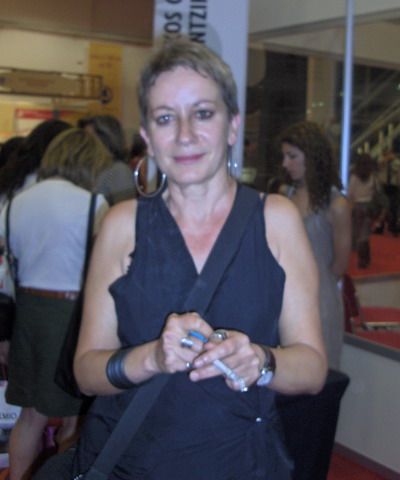
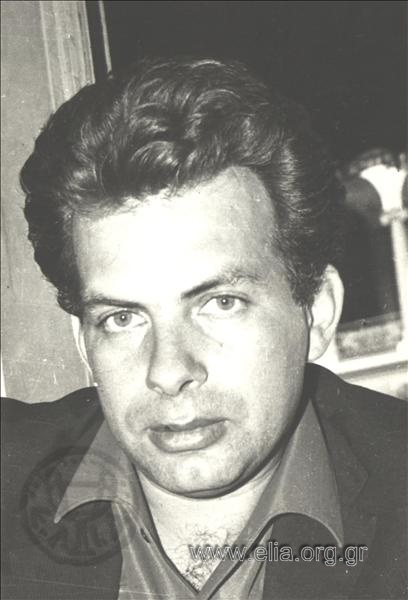
Her work connects Greek art with international experiments in mass imagery, reproduction and open visual narratives. Museum collections and the EMST retrospective offer ways to explore that contribution. The short quotation records photographer Penelope Masouri’s recollection of Romanos speaking about being discovered; it is a personal remark about recognition.
Make a small collage with your own coloured paper. In Greek, describe three actions using κόβω, κολλάω and αφαιρώ, ordered with πρώτα, έπειτα and τέλος. Move one piece and explain whether its new position changes the νόημα. Compare adding a fragment with removing it. B1 refers to the supported Modern Greek passage and this practical explanation of making.
Did you know?
- She lived in Paris from 1961 to 1981.
- Her work ranges from oil painting to transparent layered compositions.
- The Meccano constructions began in 1968.
Key works
| Greek title | Title | Year |
|---|---|---|
| Καλοκαιρινό νο. 1 | Summer No. 1 | 1960 |
| Μύθοι — σειρά | Myths — series | 1962 |
| Luna Park International | Luna Park International | 1965 |
| Μεκανό — σειρά κατασκευών | Meccano — construction series | 1968– |
| La Tour Eiffel — μεταξοτυπία | La Tour Eiffel — screenprint | 1973 |
A line to remember
Τώρα άρχισαν να με ανακαλύπτουν.
Tóra árchisan na me anakalýptoun.
Now they have begun to discover me.