Life
Kavvadias was born on 11 January 1910 in a small town near Harbin in Manchuria, where his father, from Kefalonia, ran a trading business supplying the Russian army. The family returned to Greece in 1914, lived in Argostoli on Kefalonia and settled in Piraeus in 1921. The boy grew up in the great port, among ships and sailors, and began publishing poems in magazines in 1928 under the pen name Petros Valhalas. He wanted to study medicine, but his father's illness and death forced him to work, first in a shipping office and then, from 1929, at sea as a deckhand.
In 1939 he obtained his diploma as a wireless operator, and for the rest of his life that was his job: the ασυρματιστής, alone in the radio cabin, tapping out messages on cargo ships and liners between Piraeus, the Red Sea, the Indian Ocean, the Americas and the Far East. He fought on the Albanian front in 1940–41, spent the occupation in Athens, where he joined the resistance, and went back to sea in 1944. His last voyage ended in late 1974.
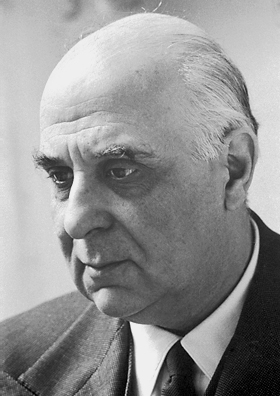
He never married and lived with his sister's family in Athens between voyages. Short, bald and gentle, he was known to friends as «Marabou» after his first book, or «ο Κόλιας». He died suddenly of a stroke in Athens on 10 February 1975, a few weeks before his third collection appeared.
Works

Kavvadias published only three books of poetry in his lifetime, and each is short. Μαραμπού (Marabou, 1933), named after an ugly African stork, is a gallery of sailors, stokers, ports and exotic tattoos, told in rhymed quatrains with a strong, rolling rhythm: a stoker from Djibouti who dies of his habit, a knife bought in Algiers, Kuro Siwo, the warm current of Japan. Πούσι (Fog, 1947) is darker and denser, shaped by the war and years on dangerous seas: the poem «Θεσσαλονίκη», written during a night watch, remembers a lost love back home; «Federico García Lorca» mourns the murdered Spanish poet. Τραβέρσο (Traverso, 1975) collects the last poems. In all of them the sea is not a holiday but a job, a prison and a fate, and the sailor knows that he will never again be at home on land.
His only novel, Η βάρδια (The Watch, 1954), follows one night on the bridge of a rusty freighter in the China Sea, where the men keep watch and talk, in sailors' slang, about women, disease, death and the ports behind them; it is now considered one of the finest Greek novels of the century. He also left a handful of short prose pieces. His language mixes nautical and foreign words, place names from five continents and the plain speech of the crew, which makes his poems unusually physical: you can smell the engine oil and the fog. The famous lines of «Mal du départ», about the ideal and unworthy lover of distant voyages, sum up his whole life.
Legacy in Greece today
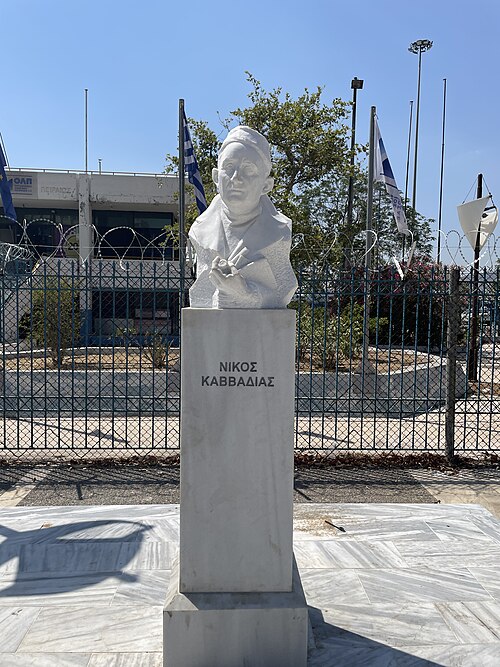
The way into Kavvadias is through the songs. Thanos Mikroutsikos' album Ο Σταυρός του Νότου (The Southern Cross, 1979), sung by Giannis Koutras and others, turned «Θεσσαλονίκη», «Kuro Siwo», «Ένας νέγρος θερμαστής από το Τζιμπουτί» and «Mal du départ» into songs that are played at every Greek gathering where someone has a guitar; a second album, Γραμμές των οριζόντων (Lines of the Horizons), followed in 1991. His poems are in the school anthologies, «Θεσσαλονίκη» is one of the best-known songs about the city, and Η βάρδια has been translated into many languages. Kefalonia and Piraeus both claim him as their poet, and the merchant marine, whose radio operators he made immortal, counts him as one of its own.
Did you know?
- He was born in Manchuria, in a town near Harbin, where his Kefalonian father was supplying the Russian army with goods.
- From 1939 until 1974 he worked as a ship's radio operator; poetry was written in the radio cabin between messages.
- His third and last collection, Τραβέρσο, came out in 1975, weeks after his death.
- The album The Southern Cross (1979), with his poems set to music, is one of the best-selling records in the history of Greek music.
Key works
| Greek title | Title | Year |
|---|---|---|
| Μαραμπού | Marabou (poems) | 1933 |
| Πούσι | Fog (poems) | 1947 |
| Η βάρδια | The Watch (novel) | 1954 |
| Τραβέρσο | Traverso (poems) | 1975 |
| Ο Σταυρός του Νότου (δίσκος, Θάνος Μικρούτσικος) | The Southern Cross (album by Thanos Mikroutsikos) | 1979 |
A line to remember
Θα μείνω πάντα ιδανικός κι ανάξιος εραστής / των μακρυσμένων ταξιδιών και των γαλάζιων πόντων
Tha meino panta idanikos ki anaxios erastis / ton makrysmenon taxidion kai ton galazion ponton
I shall always remain the ideal and unworthy lover / of far-off voyages and of blue seas