Life
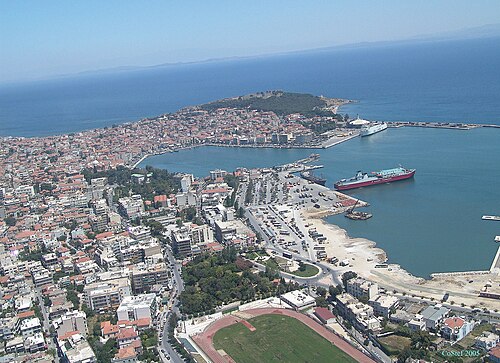
Erinna belongs to the history of Greek poetry through a small, damaged body of writing and the admiration of later readers. She is commonly placed in the fourth century BCE, but the surviving evidence does not establish a secure life story. Ancient sources disagree about her home, and the later claim that she was Sappho’s companion cannot settle her date. The tradition that she died at nineteen may draw on the poetic voice rather than independent biography. Her name also appears in different spellings. These uncertainties make the surviving poems and their transmission especially important.
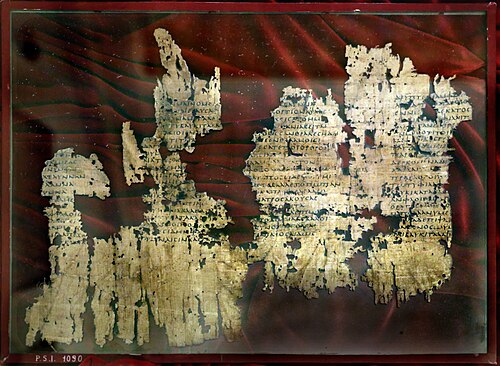
Her best-known work is Ἠλακάτη (The Distaff), traditionally described as a poem of three hundred hexameter lines. A substantial but incomplete fragment preserves a speaker remembering Baucis, childhood play and loss. In 1928 excavations at Oxyrhynchus recovered the papyrus now catalogued as PSI IX 1090; it was first published in 1929. The archive currently dates that physical copy to the late second century CE, many centuries after the poem’s usual proposed date. Its damaged lines transformed modern knowledge of Erinna’s poetry. Three epigrams in the Greek Anthology are also transmitted under her name, though their authorship remains disputed. Together these texts reveal a literary reception richer than the few secure biographical facts.
Works

The poem Ἠλακάτη (The Distaff) brings remembered childhood into a lament for Baucis. Games, shared work and frightening childhood figures give the loss a concrete world. Its title names the implement that holds fibre for spinning, placing domestic activity beside the learned form of hexameter. The surviving language mixes dialectal and epic features. Broken papyrus lines require editorial judgement, so a continuous modern translation necessarily involves decisions about gaps. The speaker’s intimate memories are part of a crafted poem; they do not by themselves prove every detail of the author’s life.
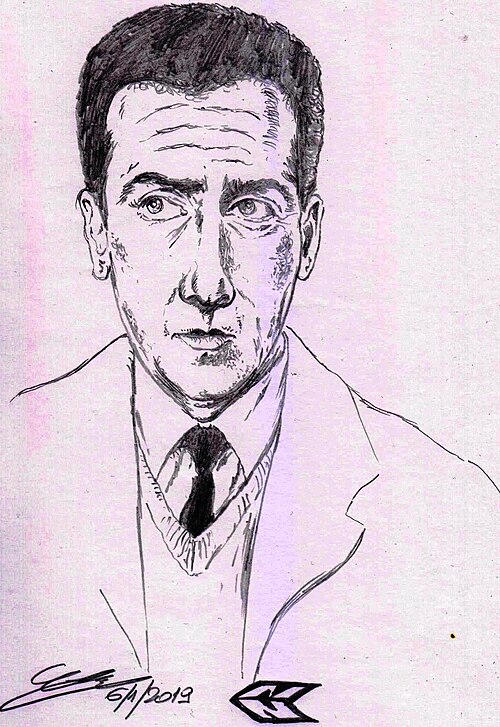
The three attributed epigrams explore related questions of presence and absence. Greek Anthology 7.710 gives Baucis a voice addressing the memorial objects at her tomb; 7.712 makes the tomb speak and turns wedding celebration towards mourning. Neither is evidence that an identified inscribed monument survives. The epigram 6.352 praises a portrait of Agatharchis: the likeness seems complete except for speech. The poem lets readers imagine its subject through words. Our quotation comes from that epigram’s opening, with its disputed attribution clearly stated. The contrast between painted appearance and living voice inspires a fresh Modern Greek exercise using βλέπω (I see), μιλώ (I speak) and the negative particle δεν (not).
Legacy in Greece today
Read Greek Anthology 6.352 in the Anthologia Graeca digital edition alongside our adapted Modern Greek passage. Notice the idea that a portrait could be complete if it had speech. Make a simple new drawing of a friend or an invented person. Describe its face and hands, then write Η ζωγραφιά δεν μιλά (The drawing does not speak). Say Η φίλη μου μιλά (My friend speaks) and add Γεια σου (Hello) as the imagined greeting. Compare the affirmative verb μιλά (speaks) with δεν μιλά (does not speak). You practise present-tense description and negation through an ancient artistic idea; the original dialectal epigram needs its rendering and is not itself A2 Modern Greek.
Did you know?
- The papyrus PSI IX 1090 is held in Florence’s Biblioteca Medicea Laurenziana.
- The Distaff was traditionally said to have three hundred lines; it survives in fragments.
- The attributed epigrams give voices to a dead girl and a tomb, while the portrait poem imagines the speech a picture lacks.
Key works
| Greek title | Title | Year |
|---|---|---|
| Ἠλακάτη (αποσπάσματα) | The Distaff (fragmentary poem) | ? |
| Ἑλληνικὴ Ἀνθολογία 6.352 | Portrait of Agatharchis (attributed epigram) | ? |
| Ἑλληνικὴ Ἀνθολογία 7.710 | Baucis addresses her memorial (attributed epigram) | ? |
| Ἑλληνικὴ Ἀνθολογία 7.712 | Baucis’s speaking tomb (attributed epigram) | ? |
A line to remember
ἐξ ἁπαλᾶν χειρῶν τάδε γράμματα:
In today's GreekΑυτή η ζωγραφιά έγινε από απαλά χέρια.
Ex apalán chirón táde grámmata.
This drawing came from delicate hands.