Life
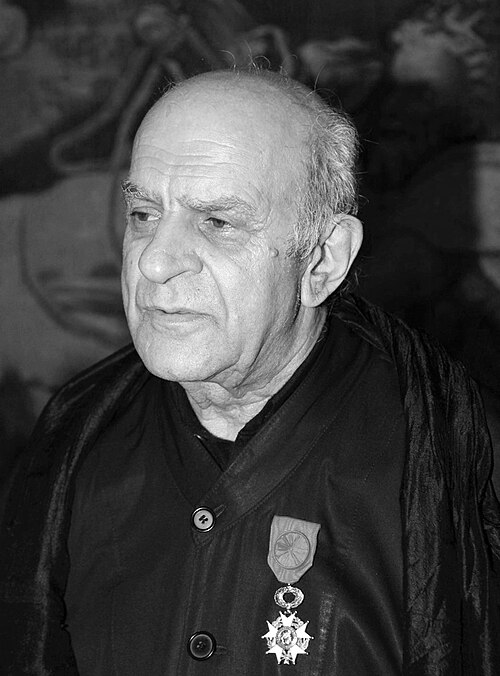
Mytaras was born in 1934 in Chalkida, the main town of the island of Euboea, on the narrow strait of the Euripus. He moved to Athens to study painting at the Ανωτάτη Σχολή Καλών Τεχνών (Athens School of Fine Arts) in the 1950s, at a time when Greek artists were trying to combine modern European art with a Greek tradition of their own. With a state scholarship he then went to Paris (1960–1964), where he studied stage design at the École des Arts Décoratifs, and the experience of the great French museums and of modern art shaped him for life.
Back in Greece, he exhibited regularly in Athens and abroad, and in 1969 he began a long career as a teacher at the School of Fine Arts, where he became a full professor in 1977 and rector in 1982–1985. In 2008 he was elected a member of the Academy of Athens. Teaching became a central part of his life, alongside his own painting, and through the studio he passed on to young artists his belief that colour itself can carry emotion. He remained a familiar figure in Greek cultural life: a painter people recognised in the street, interviewed on television, quoted in newspapers. He kept painting into old age. He died in Athens in February 2017, at eighty-two, and his death was reported across the Greek media as the loss of one of the country's most popular artists.
Works

The first thing anyone notices in a painting by Mytaras is the colour. Faces are green, blue, orange or violet; backgrounds are flat fields of red or yellow; the brushstrokes are fast and visible, as if the painting had been made in one breath. This way of painting, in which colour and line express feeling rather than describe reality, is called εξπρεσιονισμός (expressionism), and Mytaras is the Greek painter most often associated with it after the Second World War.
His subjects were few and he returned to them again and again. There are faces, often seen close up, with large eyes that look straight at the viewer. There are women, alone or in pairs, seated, lying down, waiting, painted with tenderness and a certain melancholy. And there are dogs, perhaps his most loved subject: thin, alert street dogs, drawn with a few lines and full of character. He also made drawings, prints and works for public spaces. In all of them the human figure is at the centre, never quite realistic and never fully abstract. His pictures are about people rather than ideas, and they are immediately readable: you do not need to know art history to feel what a Mytaras face is feeling.
Legacy in Greece today
Works by Mytaras hang in the Εθνική Πινακοθήκη (National Gallery) in Athens and in many public and private collections in Greece, and they appear often in exhibitions and in the press. Through his long teaching at the School of Fine Arts he influenced a whole generation of Greek painters. For a learner, his pictures are a perfect exercise: look at a Mytaras face or dog and describe it in Greek, using the colours (πράσινο, μπλε, κόκκινο), the parts of the face and simple feelings (λυπημένος, ήρεμος). If you are in Euboea, Chalkida, his birthplace on the Euripus strait, is an easy trip from Athens.
Did you know?
- He was born in Chalkida, the town on the Euripus strait, where the sea current famously changes direction several times a day.
- Dogs are one of his favourite subjects: he painted them throughout his career.
- He spent decades teaching at the Athens School of Fine Arts, the same school where he had studied.
- He was rector of the Athens School of Fine Arts from 1982 to 1985 and was elected to the Academy of Athens in 2008.
Key works
| Greek title | Title | Year |
|---|---|---|
| Πρόσωπα | Faces (recurring subject) | |
| Γυναικείες μορφές | Female figures (recurring subject) | |
| Σκυλιά | Dogs (recurring subject) | |
| Διδασκαλία στην Ανωτάτη Σχολή Καλών Τεχνών | Decades of teaching at the Athens School of Fine Arts | from 1969 |
A line to remember
Ανωτάτη Σχολή Καλών Τεχνών
Anotati Scholi Kalon Technon
The Athens School of Fine Arts