Life
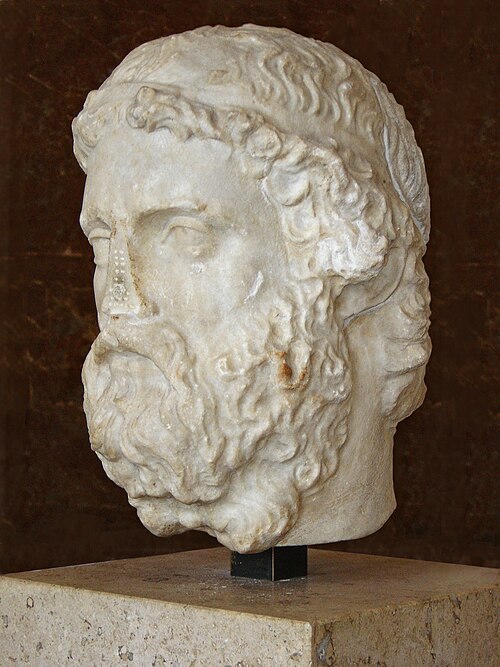
Anacreon came from Teos, an Ionian Greek city on the western coast of Asia Minor. He was active in the later sixth and early fifth centuries BCE; the familiar dates around 570–485 BCE remain approximate. His career connects several centres of the Greek-speaking world. He belonged to the circle of Polycrates, ruler of Samos: Herodotus places the poet with him in the Histories. Ancient testimony also connects Anacreon with Hipparchus and the ruling family at Athens. Court patronage provided occasions and audiences for poetry performed as song, within a world where music, social gatherings and political prestige overlapped.
His life is much less fully documented than his later reputation suggests. Ancient editors arranged his work in books of lyric songs, iambic verse and elegies. Those complete collections have not survived. Instead, later authors preserve quotations that modern editors identify by fragment numbers. Stobaeus transmits the poem now numbered 395 Page, which gives an ageing speaker grey temples and a white head. The later Ανακρεόντεια (Poems in the Manner of Anacreon) shows the influence of his poetic image but is a collection by other poets. Reading his genuine fragments separately reveals a voice that moves between pleasure, teasing, uncertainty and the fear of time passing.
Works

Anacreon's surviving poetry was made for performance, with rhythm and musical accompaniment. The symposium, a gathering for drinking and conversation, is an important setting. Fragment 356a+b Page considers wine, water and the manner of drinking. Fragment 358 Page makes desire visible through Eros throwing a purple ball. Fragment 428 Page compresses emotional uncertainty into loving and not loving at once. These modern reference numbers identify surviving pieces whose precise composition dates are unknown. Their numbering helps readers locate each piece in a modern edition.
Fragment 395 Page opens with grey temples and a white head. The voice then turns to lost youth, limited time and fear of the descent to Hades. The images make ageing physical and the passing of time immediate. Its ancient Ionic Greek needs explanation and is more demanding than the adapted Modern Greek reading. For a small contemporary task, take the colours into your own description: Τα μαλλιά του είναι γκρίζα (His hair is grey) and Τα μαλλιά της είναι λευκά (Her hair is white). The ancient λευκόν describes a head; the Modern Greek plural μαλλιά takes λευκά. Draw two invented faces and match each sentence with the right drawing. Poetry becomes a prompt for useful words and careful observation.
Legacy in Greece today
The Centre for the Greek Language makes Anacreon's genuine fragments available with their ancient text and Modern Greek translations. Open fragment 395 Page in its Anthology of Archaic Lyric Poetry, then compare the first two lines with this page's own modern rendering. Draw two invented faces, one with grey hair and one with white hair. Label them Τα μαλλιά του είναι γκρίζα (His hair is grey) and Τα μαλλιά της είναι λευκά (Her hair is white). Read a label aloud and ask a partner Ποια ζωγραφιά ταιριάζει; (Which drawing matches?). Change the colour and repeat. This turns a specific poetic image into a useful contemporary description while keeping the ancient Ionic original distinct from the A2 reading.
Did you know?
- His ancient Greek poetic language is Ionic, unlike the adapted Modern Greek reading.
- Stobaeus preserves the poem now numbered 395 Page.
- The later Anacreontea are poems by other authors writing in his tradition.
Key works
| Greek title | Title | Year |
|---|---|---|
| Απόσπασμα 356a+b Page | Wine, water and the symposium | 6th–5th c. BCE |
| Απόσπασμα 358 Page | Eros and the purple ball | 6th–5th c. BCE |
| Απόσπασμα 395 Page | Grey temples and old age | 6th–5th c. BCE |
| Απόσπασμα 428 Page | Loving and not loving | 6th–5th c. BCE |
A line to remember
πολιοὶ μὲν ἡμὶν ἤδη κρόταφοι κάρη τε λευκόν,
In today's GreekΤα μαλλιά στους κροτάφους μου γκρίζαραν κιόλας· το κεφάλι μου είναι λευκό.
polioì mèn hēmìn ḗdē / krótaphoi kárē te leukón
My temples are already grey, and my head is white.