Life
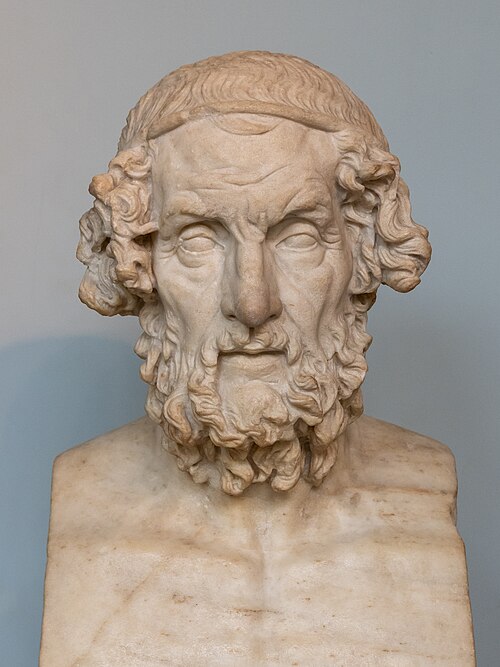
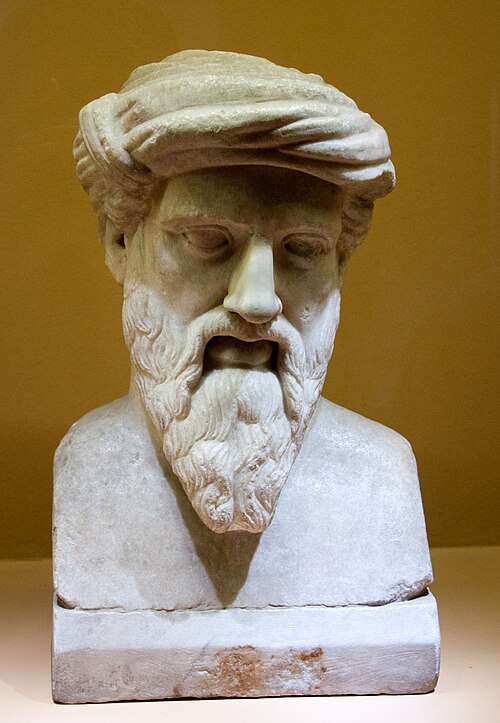
Pythagoras was born on Samos, the large island off the coast of Asia Minor, around 570 BC, the son of Mnesarchus, a gem-engraver or merchant. Later writers say he travelled widely in his youth and studied with the priests of Egypt and the astronomers of Babylon; the stories are late, but Samos in his time was a rich trading island with contacts across the eastern Mediterranean, so some of it may be true. Around 530 BC, while the tyrant Polycrates ruled Samos, he left the island for good and sailed west to Croton (Κρότων), a Greek city on the sole of Italy.
In Croton he founded something between a philosophical school, a religious brotherhood and a political club. Members shared property, followed rules of silence and diet, and were divided into inner and outer circles; unusually for the age, women were admitted, and tradition names Theano, his wife, among the Pythagoreans. The community gained great influence over Croton and neighbouring cities, and that influence made enemies. A revolt led by a Crotoniate named Cylon drove the Pythagoreans out and burned their meeting house. Pythagoras withdrew to Metapontum, further along the coast, where he died around 495 BC.
Everything we know comes from others, and most of it from much later: Aristotle speaks cautiously of «the so-called Pythagoreans», while the biographies by Porphyry and Iamblichus, written eight centuries after his death, make him a miracle-worker with a golden thigh. Already in his lifetime he was famous: his contemporary Xenophanes mocks him for stopping a man beating a puppy because he recognised in its yelp the voice of a dead friend.
Works

The heart of Pythagorean teaching was that the world is built on number. The followers discovered that the pleasant musical intervals correspond to simple ratios of string lengths: the octave is 2:1, the fifth 3:2, the fourth 4:3. If harmony is number, they reasoned, perhaps everything is, from the movements of the planets, which they imagined producing a music of the spheres, to justice and the soul. They revered the τετρακτύς, the triangle of ten dots made of 1+2+3+4, and swore oaths by it. The theorem that carries his name, that in a right-angled triangle the square on the hypotenuse equals the sum of the squares on the other two sides, was known in practice to the Babylonians a thousand years earlier; what the Pythagoreans probably added was the idea of proving it.
The second pillar was the soul. Pythagoras taught μετεμψύχωση, the passage of the soul after death into another body, human or animal, which is why his followers would not eat meat and treated animals with care. The famous ban on eating beans belongs to the same body of rules, the ἀκούσματα (things heard), short sayings that members learned and obeyed without question; the phrase «αὐτὸς ἔφα», he himself said it, was their final argument. According to a tradition going back to the fourth century BC, Pythagoras also coined the word φιλόσοφος, lover of wisdom, saying that only the gods are wise. His school lived on for generations: Philolaus wrote down its cosmology, Archytas of Tarentum built machines and governed his city, and Plato absorbed Pythagorean ideas about number and the immortal soul into his own philosophy.
Legacy in Greece today
Every Greek pupil learns the Πυθαγόρειο θεώρημα in the second year of gymnasium, usually in the formula «το τετράγωνο της υποτείνουσας ισούται με το άθροισμα των τετραγώνων των δύο κάθετων πλευρών», and it stays with people for life. On Samos the harbour town of Tigani was renamed Πυθαγόρειο (Pythagoreio) in 1955; a tall statue of Pythagoras holding a right angle stands at the end of its harbour mole, and the ancient town, with the tunnel of Eupalinos from his own century, is a UNESCO World Heritage site. In every souvenir shop on the island you can buy the «δίκαιη κούπα του Πυθαγόρα» (Pythagorean cup), which empties itself completely if you fill it too greedily: a lesson in moderation the ancients attributed to him. The Greek word for a vegetarian used to be «πυθαγόρειος», and musicians still speak of the Pythagorean tuning.
Did you know?
- The theorem named after him was used by Babylonian surveyors more than a thousand years before he was born; his school's contribution was probably the proof.
- Tradition says he was the first to call himself a φιλόσοφος, a lover of wisdom, rather than a σοφός, a wise man.
- His followers were not allowed to eat beans, and several ancient writers offer competing explanations why.
- Not a single sentence written by Pythagoras survives; even the ancients disagreed about whether he had written anything at all.
Key works
| Greek title | Title | Year |
|---|---|---|
| Η πυθαγόρεια κοινότητα του Κρότωνα | The Pythagorean community at Croton | c. 530 BC |
| Η μετεμψύχωση | The doctrine of the transmigration of souls | |
| Οι μουσικές αναλογίες (2:1, 3:2, 4:3) | The musical ratios of the octave, fifth and fourth | |
| «Τα πάντα είναι αριθμός» | «All things are number» | |
| Το Πυθαγόρειο θεώρημα | The Pythagorean theorem | |
| Χρυσά Έπη | The Golden Verses (attributed to his school) | Hellenistic period |
From the works


Public-domain pictures from Wikimedia Commons.
A line to remember
Μηδ’ ὕπνον μαλακοῖσιν ἐπ’ ὄμμασι προσδέξασθαι, / πρὶν τῶν ἡμερινῶν ἔργων τρὶς ἕκαστον ἐπελθεῖν· / πῇ παρέβην; τί δ’ ἔρεξα; τί μοι δέον οὐκ ἐτελέσθη;
In today's GreekΜη δεχτείς τον ύπνο στα απαλά σου μάτια, / πριν περάσεις τρεις φορές από τον νου σου κάθε πράξη της ημέρας: / πού έσφαλα; τι έκανα; τι χρέος μου έμεινε ανεκπλήρωτο;
Mid’ ypnon malakoisin ep’ ommasi prosdexasthai, / prin ton imerinon ergon tris ekaston epelthein: / pi parevin? ti d’ erexa? ti moi deon ouk etelesthi?
Do not let sleep onto your soft eyes / before you have gone three times over each deed of the day: / where did I go wrong? what did I do? what duty did I leave undone?
From the original
The text as Pythagoras wrote it, out of copyright, with our own translation beside it.
«Πυθαγόρου βίος (Πορφύριος)»Life of Pythagoras (Porphyry)
Pythagoras left no writings; this is Porphyry's Life reporting his rule of the day. The two sets of verses the disciple recites at night and on waking, including the lines quoted on this page, are the ones later gathered into the school's Golden Verses.
Πορφύριος, Πυθαγόρου βίος 39–40 (3rd c. AD), reporting Pythagoras’ precepts and quoting the Golden Verses · Public-domain text, source: el.wikisource.org