Life
Maria Anna Sofia Cecilia Kalogeropoulou was born in New York on 2 December 1923, to a Greek pharmacist from the Peloponnese. In 1937 her mother took the two daughters back to Athens, and the plump, short-sighted teenager entered the National Conservatory and then the Athens Conservatory, where the Spanish soprano Elvira de Hidalgo trained her in the bel canto technique that became her trademark. She made her professional debut with the Greek National Opera in 1941, during the German occupation, and sang her first Tosca in Athens in 1942, before she was nineteen.
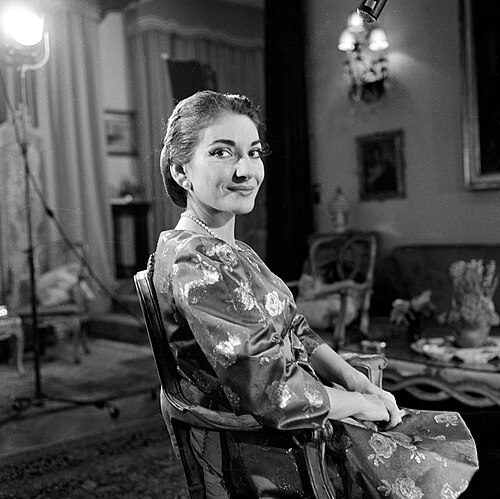
In 1945 she went back to America, found no work, and in 1947 was engaged for La Gioconda at the Arena di Verona, where she met the conductor Tullio Serafin and the industrialist Giovanni Battista Meneghini, whom she married in 1949. The 1950s were her great decade: La Scala from 1950, Covent Garden in 1952, the Metropolitan Opera in 1956, productions with Luchino Visconti and Franco Zeffirelli, and a famous loss of some thirty kilos that turned her into the elegant figure of the photographs.
In 1959 she left Meneghini for the shipowner Aristotle Onassis, and the affair, followed by his marriage to Jacqueline Kennedy in 1968, filled the newspapers for a decade. Her voice declined early; her last opera performance was Tosca at Covent Garden in 1965. She taught master classes at the Juilliard School in 1971–72, made a last concert tour in 1973–74 and died alone in her Paris apartment on 16 September 1977, aged 53. In 1979 her ashes were scattered in the Aegean.
Works

Callas did not have the most beautiful voice of her time, and she knew it. What she had was a huge range, a technique that let her sing Wagner's Brünnhilde and Bellini's Elvira in the same week, as she did in Venice in 1949, and above all the gift of acting with her voice, so that every phrase meant something. She brought back to life the forgotten operas of the early nineteenth century, by Bellini, Donizetti and Cherubini, and showed that they were dramas, not just displays of vocal fireworks.
Her signature role was Bellini's Νόρμα (Norma), the Druid priestess torn between duty and love, which she sang about ninety times; her Tosca, recorded in 1953 under Victor de Sabata, is still the reference recording of the opera; her Violetta in Visconti's La Traviata at La Scala in 1955 and her Λουτσία ντι Λάμερμουρ (Lucia di Lammermoor) made the mad scene a study in grief rather than a vocal exercise. For Greeks the great moments are the two summers she sang at the ancient theatre of Epidaurus with the Greek National Opera, Norma in 1960 and Cherubini's Μήδεια (Medea) in 1961, the role of the Greek sorceress that she made her own. In 1969 she played Medea once more, without singing, in Pier Paolo Pasolini's film Medea, her only cinema role. Her recordings for EMI, made mostly in Milan in the 1950s, remain the core of her legacy.
Legacy in Greece today
Athens has reclaimed her. In 2023 the city opened the Maria Callas Museum on Mitropoleos Street, with her dresses, letters, recordings and the piano from her Paris flat, and the municipal Olympia Theatre on Akadimias Street, where she sang as a young woman, now bears her name. The conservatory classrooms where de Hidalgo taught her are pointed out to visitors, and the theatre of Epidaurus still advertises its Callas summers. Her birthday, 2 December, brings concerts and tributes, and her name is given to streets and music schools across Greece. For a learner the first step is simple: listen to her «Casta diva» from Norma or her 1953 Tosca, then watch the Pasolini film in which a Greek Medea walks through the landscape of Cappadocia without singing a note.
Did you know?
- In January 1949 in Venice she sang Brünnhilde in Wagner's Die Walküre and, a few days later, Elvira in Bellini's I Puritani, two roles almost no soprano attempts in the same career.
- She was extremely short-sighted and could barely see the conductor, so she learned every score by heart.
- Her only film role, Pasolini's Medea (1969), contains no singing at all.
- Her ashes were scattered in the Aegean Sea in 1979, two years after her death in Paris.
Key works
| Greek title | Title | Year |
|---|---|---|
| Τόσκα (Αθήνα) | Tosca, first performances in Athens | 1942 |
| Νόρμα | Norma (Bellini), her signature role | 1948 |
| Λουτσία ντι Λάμερμουρ | Lucia di Lammermoor (Donizetti) | 1952 |
| Τραβιάτα (Σκάλα του Μιλάνου, Βισκόντι) | La Traviata at La Scala, directed by Visconti | 1955 |
| Μήδεια στην Επίδαυρο | Medea (Cherubini) at Epidaurus | 1961 |
| Μήδεια (ταινία του Παζολίνι) | Medea, film by Pasolini | 1969 |
From the works


Public-domain pictures from Wikimedia Commons.
A line to remember
Υπάρχουν δύο άνθρωποι μέσα μου. Θα ήθελα να είμαι η Μαρία, αλλά υπάρχει και η Κάλλας, που πρέπει να τη σηκώσω στους ώμους μου.
Yparchoun dyo anthropoi mesa mou. Tha ithela na eimai i Maria, alla yparchei kai i Kallas, pou prepei na ti sikoso stous omous mou.
There are two people in me. I would like to be Maria, but there is the Callas that I have to live up to.