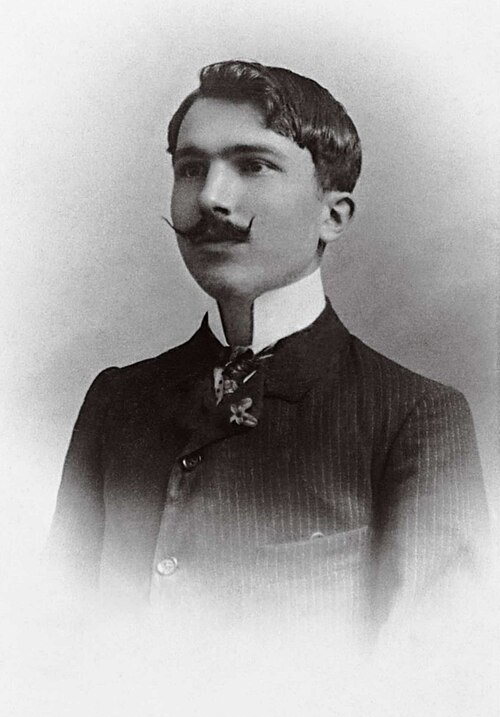
Life
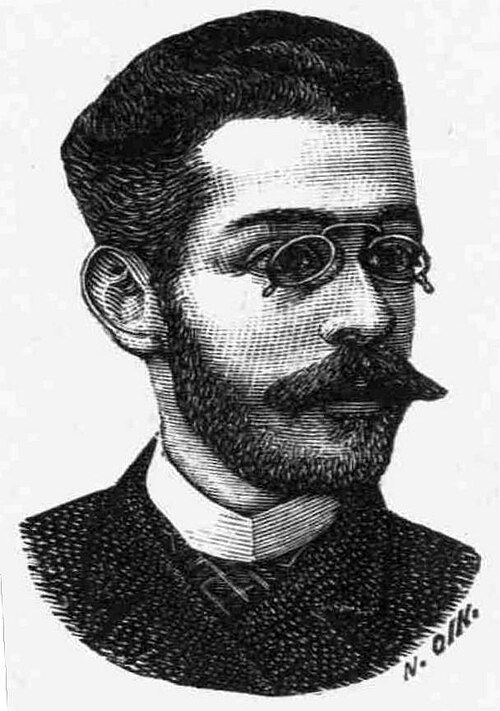
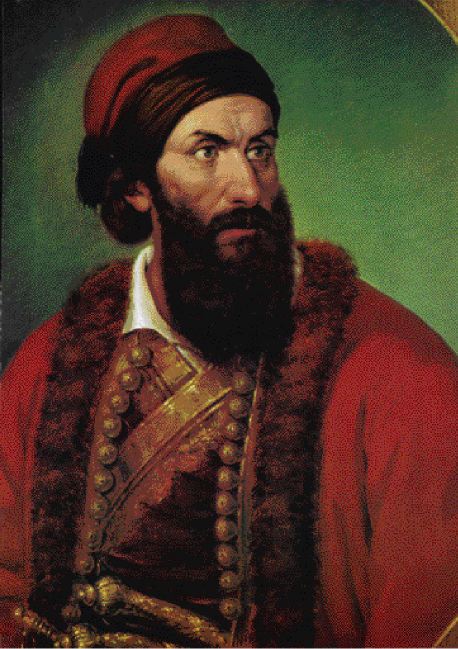
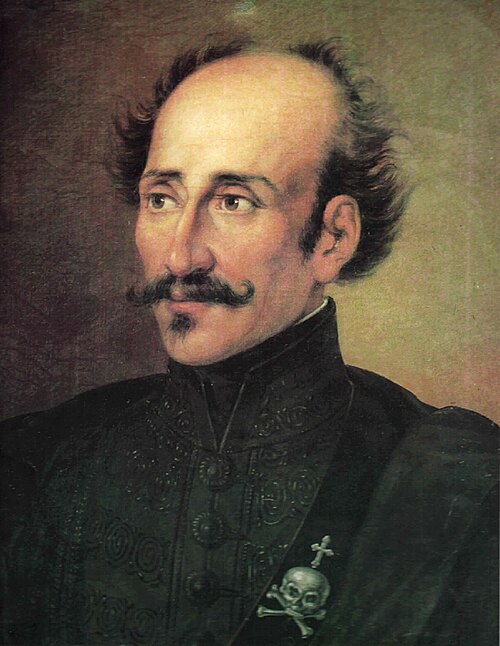
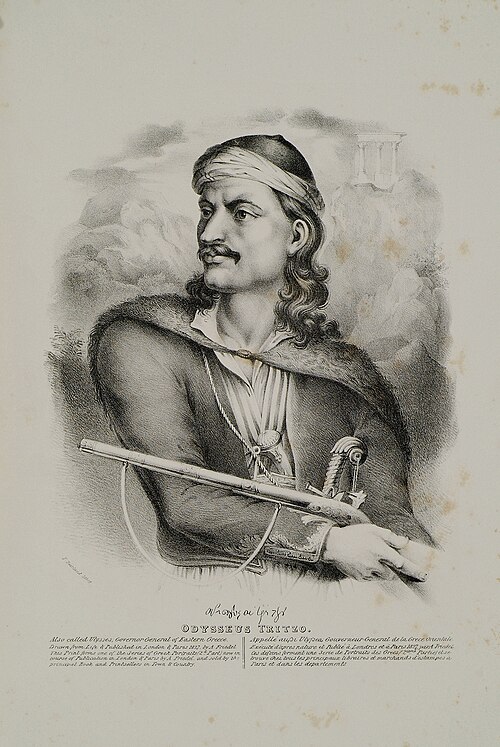
Androutsos was born around 1790, in Preveza or on Ithaca, where he was baptised; his father, Andreas Androutsos, was a well-known klepht and armatolos of Roumeli, the mountains of Central Greece, and the name Odysseas was a nod to the island. His father, who had fought in the revolt of Lambros Katsonis, was executed in Constantinople in 1797, when the boy was still a child, and Odysseas grew up at the court of Ali Pasha in Ioannina, the powerful Albanian ruler of Epirus. There he learned war and politics, and Ali made him armatolos, the Christian captain responsible for order, of the region of Livadeia.
When the Revolution broke out in 1821, Androutsos took up arms in Roumeli. On 8 May 1821 he shut himself into the inn of Gravia, a stone building on the road to the south, with about 120 men, against the army of Omer Vrioni. They fought all day, caused heavy losses, and escaped in the night. The battle made him a hero, and in the following years he became the most powerful leader of eastern Roumeli, and his men held the Acropolis of Athens. But he was proud and independent, distrusted the politicians of the provisional government, and in 1825 he negotiated with the Ottomans. Declared a traitor, he surrendered to his former lieutenant Giannis Gouras, who imprisoned him in the medieval tower on the Acropolis. On 5 June 1825 his body was found at the foot of the tower. The official story was that he had fallen while trying to escape; almost everyone believed he had been murdered.
Works

Androutsos's great achievement is the battle of the Inn of Gravia, Το Χάνι της Γραβιάς. In May 1821 the Revolution in the Peloponnese was only weeks old, and a large Ottoman army was marching south from Thessaly to crush it. In the inn of Gravia, a village between the mountains Parnassus and Oiti, a small band of fighters held the road for a whole day. The army was delayed, its morale was hurt, and the rebels in the south gained time. For Greeks the battle stands beside Alamana, where Athanasios Diakos fell a few weeks earlier, as one of the first great moments of 1821 in Roumeli.
His later years are more complicated. As leader of eastern Roumeli he defended the region and controlled the Acropolis, but he also acted like an independent lord and made enemies in the government. In 1824 the young Englishman Edward Trelawny, a friend of Byron, joined him and lived in his fortified cave on Mount Parnassus, which is still called the cave of Odysseas. Historians still argue about him: a hero betrayed by politicians, or a captain who put his own power first. Both sides agree that his death in the tower of the Acropolis was a crime, and that it shows how divided the Greeks were in the middle of their war. Folk songs about him, and about Gravia, were sung in Roumeli long after his death.
Legacy in Greece today
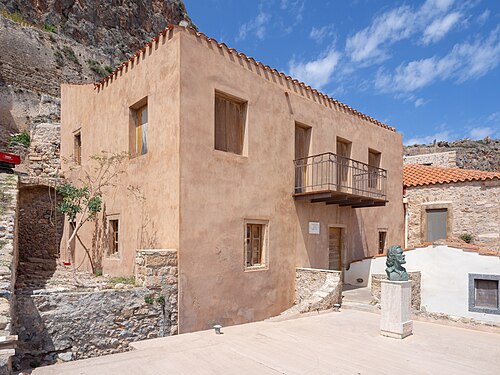
The Inn of Gravia still stands on the old road in the village of Gravia, in the region of Fokida, and it is kept as a monument to the battle; it is an easy stop on the drive from Athens to Delphi or the north. Children read the story of Το Χάνι της Γραβιάς in their history books, and on 25 March his name is heard with those of Kolokotronis, Karaiskakis and Diakos. Streets named Οδυσσέως Ανδρούτσου exist in Athens and many other towns. On Ithaca the islanders remember him as one of their own. For a learner, the battle of Gravia is a good first story to read in Greek about 1821.
Did you know?
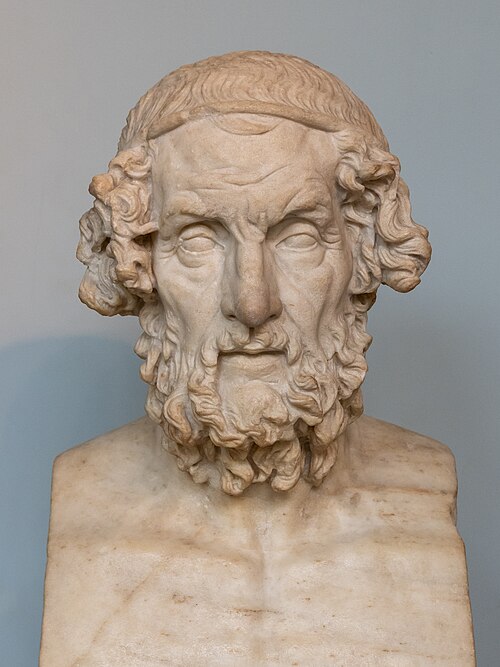
- He was baptised on Ithaca, the island of Homer's Odysseus, and carried the hero's name.
- He grew up at the court of Ali Pasha of Ioannina, the ruler the Greeks would later fight.
- His prison, a medieval tower on the Acropolis, was pulled down in 1875.
- The Englishman Edward Trelawny, a friend of Byron, lived with his men in a cave on Mount Parnassus.
Key works
| Greek title | Title | Year |
|---|---|---|
| Αρματολός της Λιβαδειάς | Armatolos (captain) of Livadeia under Ali Pasha | before 1821 |
| Η μάχη στο Χάνι της Γραβιάς | The battle of the Inn of Gravia | 1821 |
| Αρχηγός της Ανατολικής Ρούμελης | Leader of eastern Roumeli, holding the Acropolis of Athens | 1822–1824 |
| Η σπηλιά του Οδυσσέα στον Παρνασσό | The fortified cave of Odysseas on Mount Parnassus | 1824 |
From the works


Public-domain pictures from Wikimedia Commons.
A line to remember
Εγώ είμαι στο ποδάρι με τα παλληκάρια μου.
Ego eimai sto podari me ta pallikaria mou.
I am on my feet with my lads.