Life
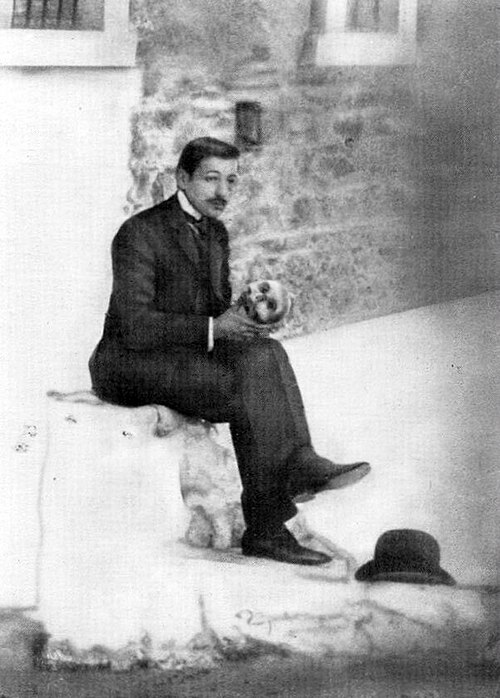
Hadjidakis was born in Xanthi, in Thrace, on 23 October 1925, to a father from Crete and a mother from Adrianople. The family moved to Athens in 1932, and his father died in a plane crash in 1938, which left them poor. During the German Occupation he worked at whatever came along, as a docker, an ice seller and an assistant in a photographer's shop, studied philosophy briefly at the university and taught himself much of what he knew about music. In 1944 he met the director Karolos Koun and began composing for his Art Theatre (Θέατρο Τέχνης), the start of a collaboration that lasted for decades.
On 31 January 1949, aged twenty-three, he gave a lecture at the Art Theatre on rebetiko, the music of the urban poor, the hashish dens and the refugees from Asia Minor, which respectable Athens despised. He argued that it was the true popular music of Greece and compared it to the blues. The lecture caused a scandal and changed Greek music. In the 1950s he wrote for the cinema, including Michael Cacoyannis's Στέλλα (1955) with Melina Mercouri, and in 1960 Jules Dassin's Never on Sunday brought him the Academy Award for best song; he did not travel to Hollywood to collect it.
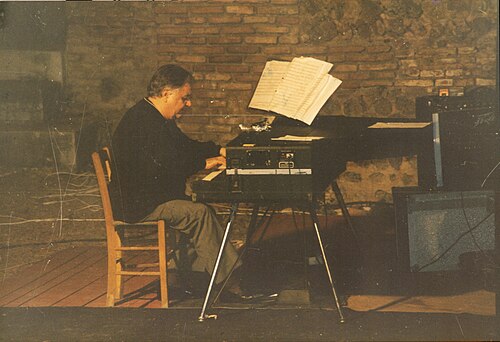
From 1966 to 1972 he lived in New York. Back in Athens he directed the Third Programme of Greek state radio from 1975 to 1982, turning it into a school of good music for a whole generation, ran a record label and a magazine, and in 1989 founded the Orchestra of Colours (Ορχήστρα των Χρωμάτων). He died in Athens on 15 June 1994.
Works

Hadjidakis's first major work, «Έξι λαϊκές ζωγραφιές» (Six Popular Paintings, 1951), was a piano suite built on rebetiko tunes: the manifesto of his lecture put into practice. His song cycle for Lorca's «Ματωμένος γάμος» (Blood Wedding, 1948) and dozens of scores for the Art Theatre made him the composer of the Greek stage, and the film songs of the 1950s and 1960s made him the composer of the Greek street: «Αγάπη που 'γινες δίκοπο μαχαίρι» from Στέλλα, «Τα παιδιά του Πειραιά» from Never on Sunday, the songs of the 1962 revue «Οδός Ονείρων» (Dream Street).
His great partner was the poet Nikos Gatsos. Together they wrote songs that every Greek can sing, from «Χάρτινο το φεγγαράκι» (Little Paper Moon, 1949) to the album «Αθανασία» (Immortality, 1976). In «Ο Μεγάλος Ερωτικός» (The Great Erotic, 1972) he set love poems from Sappho and the Song of Songs to Solomos, Kavafis and Elytis, sung by Fleury Dadonaki and Dimitris Psarianos; many Greeks consider it his masterpiece. In New York he recorded «Reflections» (1970) with a rock band, and «Το χαμόγελο της Τζοκόντας» (Gioconda's Smile, 1965) is his best-known purely orchestral work.
His music is instantly recognisable: a clear, singable melody, often in a gentle waltz or a 9/8 rhythm from folk dance, harmonies that are more French than Greek, and an air of melancholy even in the happiest songs. He also wrote children's radio music, including the series «Λιλιπούπολη» (Lilliput-town), which Greeks who were children in the late 1970s still hum.
Legacy in Greece today
Start with «Τα παιδιά του Πειραιά», which exists in a hundred versions in many languages, and then with «Χάρτινο το φεγγαράκι» and «Ο Μεγάλος Ερωτικός». Greek radio plays Hadjidakis every day, his songs are sung at school festivals and in tavernas, and «Αγάπη που 'γινες δίκοπο μαχαίρι» is a phrase people use about any painful love. The Third Programme he built still broadcasts, and his Orchestra of Colours still gives concerts in Athens. The site has an A2 vocabulary exercise on music to go with him. With Mikis Theodorakis he is one of the two composers every Greek names first, and the two men, friends and rivals, are usually mentioned in the same breath.
Did you know?
- «Τα παιδιά του Πειραιά» was the first song in a language other than English to win the Academy Award for best original song, in April 1961.
- His 1949 lecture on rebetiko was given when he was twenty-three; many musicians consider it the birth of modern Greek popular music.
- He never studied formally at a conservatory for long and was largely self-taught as a composer.
- As director of the Third Programme (1975–1982) he broadcast everything from Bach to rebetiko and created a children's musical world, Lilliput-town, that became a cult.
Key works
| Greek title | Title | Year |
|---|---|---|
| Έξι λαϊκές ζωγραφιές | Six Popular Paintings | 1951 |
| Στέλλα (μουσική ταινίας) | Stella (film score) | 1955 |
| Τα παιδιά του Πειραιά | The Children of Piraeus (Never on Sunday) | 1960 |
| Το χαμόγελο της Τζοκόντας | Gioconda's Smile | 1965 |
| Ο Μεγάλος Ερωτικός | The Great Erotic | 1972 |
| Αθανασία | Immortality (with Nikos Gatsos) | 1976 |
From the works


Public-domain pictures from Wikimedia Commons.
A line to remember
Απ' το παράθυρό μου στέλνω ένα, δύο και τρία και τέσσερα φιλιά
Ap' to parathyro mou stelno ena, dyo kai tria kai tessera filia
From my window I send one, two and three and four kisses