grecfacilegrecfacile
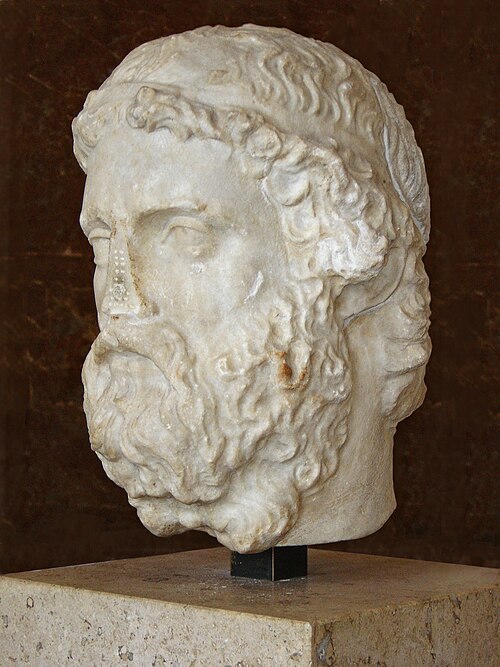
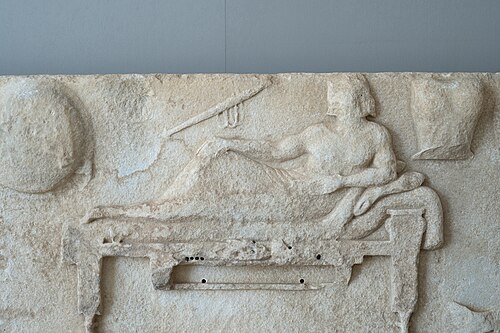
Relief from Archilochus’s monument, around 500 BCE, Paros Archaeological Museum; later commemoration of the poet.
Relief from Archilochus’s monument, around 500 BCE, Paros Archaeological Museum; later commemoration of the poet. · Zde · CC BY-SA 4.0 · Wikimedia Commons

A2Antiquity · Archaic lyric poet

Archilochus

Αρχίλοχος

Paros · Thasos

Archilochus of Paros wrote Greek poetry in the seventh century BCE. His surviving fragments bring war, desire, grief and self-questioning into sharply voiced scenes. In fragment 5, a speaker survives after leaving a shield behind and challenges the value placed on the lost weapon. A Modern Greek rendering supports a practical exercise describing where an object was before and where it is now.

Life

Archilochus was an ancient Greek poet from Paros, active in the seventh century BCE. Paros and Thasos form the geographical background to his poetry and later accounts of his life. Herodotus identifies the Parian poet as a contemporary of Gyges, king of Lydia. Such ancient testimony helps locate his period, but exact birth and death dates remain uncertain. His verse belongs to a world of islands, migration, warfare and social competition. The first person that makes it vivid needs careful reading: Aristotle explains that the speaker in the poem about Gyges, fragment 19, is a carpenter named Charon. A poetic voice does not automatically establish an event in the author’s life.

His work reaches us through fragments preserved by ancient quotations and manuscript or papyrus transmission. Modern editors number these pieces; West’s numbers identify the selections used here. They are not ancient book titles or a securely dated sequence. Paros also remembered him through commemorative monuments and inscriptions. The third-century BCE inscription of Mnesiepes tells a story about his poetic calling, centuries after his lifetime. It shows later remembrance rather than eyewitness biography. His enduring place in Greek literature rests on the force of voices that question honour, wealth, grief and human resilience.

Works

Fragments 1 and 2 place military life beside poetic skill and ordinary sustenance. In the first, a speaker serves the war god while knowing the gift of the Muses. In the second, bread and wine are repeatedly linked to a spear. The compact images allow several kinds of identity to share a voice. Fragment 5, conventionally described as the shield poem, makes survival more valuable to its speaker than a lost piece of equipment. He imagines obtaining another shield. The provocation lies in how casually he challenges a powerful expectation of martial honour.

Fragment 19 speaks of indifference to Gyges’ gold and great power through the carpenter Charon. Fragment 128 addresses the speaker’s own heart and considers how to meet success and suffering without excess. These selections are identified by modern fragment numbers and descriptive labels; their order is numerical, with individual composition dates unknown. The surviving language is ancient Greek, largely Ionic and shaped by poetic metre. A Modern Greek rendering gives learners access to the situation before they examine difficult original forms. From the abandoned object in fragment 5, our separate everyday exercise moves to είχα (I had) and έχω (I have), describing a pencil’s earlier and present position.

Legacy in Greece today

Archilochus remains available through Greek educational anthologies that place the original beside Modern Greek translations and notes. Open the Centre for the Greek Language’s entry for fragment 5 West and first read the Modern Greek translation and notes about the shield episode. Then move to your own tabletop: hold one pencil, put it beside a notebook, and say Πριν είχα το μολύβι στο χέρι (Before, I had the pencil in my hand) and Τώρα το έχω στο τραπέζι (Now I have it on the table). Keep είχα (I had) and έχω (I have) visible while you change the object’s position. A partner describes another change. This practises ordinary Modern Greek; the ancient poem’s Ionic forms still require separate explanation.

Did you know?

  • West’s fragment numbers are modern reference tools, not ancient titles.
  • The four-line shield text may be a complete short poem despite being called a fragment.
  • Aristotle names the carpenter Charon as the speaker of the Gyges poem.

Key works

Greek titleTitleYear
Απόσπασμα 1 West — πολεμιστής και ΜούσεςFragment 1 — warrior and Muses7th c. BCE
Απόσπασμα 2 West — το δόρυFragment 2 — the spear7th c. BCE
Απόσπασμα 5 West — η ασπίδαFragment 5 — the shield7th c. BCE
Απόσπασμα 19 West — ο ΓύγηςFragment 19 — Gyges7th c. BCE
Απόσπασμα 128 West — προς την καρδιάFragment 128 — to the heart7th c. BCE

A line to remember

αὐτὸν δ᾽ ἐξεσάωσα. τί μοι μέλει ἀσπὶς ἐκείνη;

In today's GreekΤον εαυτό μου όμως τον έσωσα. Τι με νοιάζει εκείνη η ασπίδα;

aftón d’ exesáosa. ti mi méli aspís ekíni?

Yet I saved myself. What do I care about that shield?
Archilochus, fragment 5 West, line 3 (poetic speaker)
A2

Read about Archilochus in Greek (A2)

Words from the passage

  • shield
  • pencil
  • notebook
  • bush
  • I have
  • I leave
  • I find
  • safe

Try a free A2 lessonNo account needed for the first three exercises.

Others at level A2

Modern Greece · PoetKonstantinos Kavafis1863 – 1933Modern Greece · PoetYannis Ritsos1909 – 1990Modern Greece · Novelist (children's literature)Penelope Delta1874 – 1941Antiquity · Epic poetHomerc. 8th century BCModern Greece · NovelistNikos Kazantzakis1883 – 1957Antiquity · Cynic philosopherDiogenes the Cynicc. 412 BC – 323 BCAntiquity · Philosopher and mathematicianThales of Miletusc. 624 BC – c. 546 BCAntiquity · Philosopher and mathematicianPythagorasc. 570 BC – c. 495 BCRenaissance · PainterEl Greco1541 – 1614Modern Greece · PainterNikolaos Gyzis1842 – 1901Modern Greece · SopranoMaria Callas1923 – 1977Modern Greece · ComposerManos Hadjidakis1925 – 1994Modern Greece · ActorThanasis Veggos1927 – 2011Modern Greece · PoetGeorgios Drosinis1859 – 1951Modern Greece · PoetNikiforos Vrettakos1912 – 1991Modern Greece · Singer, lyra playerNikos Xylouris1936 – 1980Modern Greece · PhysicianGeorgios Papanikolaou1883 – 1962Modern Greece · Priest and fighter of 1821Papaflessasc. 1788 – 1825Modern Greece · Satirical poetGeorgios Souris1853 – 1919Modern Greece · SculptorYannoulis Chalepas1851 – 1938Modern Greece · PainterAlekos Fassianos1935 – 2022Modern Greece · ComposerSpyridon Samaras1861 – 1917Modern Greece · Rebetiko singerSotiria Bellou1921 – 1997Modern Greece · Rebetiko singerMarika Ninou1922 – 1957Modern Greece · Bouzouki virtuoso, composerManolis Chiotis1921 – 1970Modern Greece · ActressKatina Paxinou1900 – 1973Modern Greece · Rebetiko singerRosa Eskenazic. 1895 – 1980Modern Greece · ActorManos Katrakis1908 – 1984Modern Greece · PainterDimitris Mytaras1934 – 2017Modern Greece · ComposerManos Loizos1937 – 1982Modern Greece · Laïko singerDimitris Mitropanos1948 – 2012Modern Greece · General of 1821Odysseas Androutsosc. 1790 – 1825Modern Greece · Leader of the Filiki EtaireiaAlexandros Ypsilantis1792 – 1828Modern Greece · PhotographerNelly's (Elli Souyioultzoglou-Seraidari)1899 – 1998Modern Greece · Mezzo-sopranoAgnes Baltsa1944Modern Greece · Lied singer and benefactorAlexandra Trianti1896/1901 – 1977Modern Greece · Actor · DirectorAlekos Alexandrakis1928 – 2005Modern Greece · SingerAlkistis Protopsalti1954Modern Greece · Singer · songwriterAmanda TenfjordAntiquity · Lyric poetAnacreonc. 570 BCE – c. 485 BCEModern Greece · Novelist and journalistAndreas Frangias1921 – 2002Modern Greece · Singer · songwriterAndromacheModern Greece · SingerAnna Vissi1957Modern Greece · Poet · EditorAntonis Fostieris1953Antiquity · Epic poet · ScholarApollonius of RhodesModern Greece · NovelistChristos Chomenidis1966Modern Greece · Short-story writerChristos Ikonomou1970Modern Greece · Singer · musical performerDemy1991Modern Greece · SingerDespina Vandi1969Modern Greece · Singer · composerDimitra Galani1952Modern Greece · Playwright · TranslatorDimitris Dimitriadis1944Modern Greece · Singer-songwriterDionysis Savvopoulos1944 – 2025Modern Greece · Singer · popular song and poetryEleftheria Arvanitaki1957Modern Greece · SingerEleftheria Eleftheriou1989Modern Greece · Pop singerElena Tsagrinou1994Modern Greece · SingerEleni Foureira1987Modern Greece · Singer · Greek song and international repertoireElli Paspala1957Modern Greece · Novelist · PuppeteerEvgenia Fakinou1945Modern Greece · Singer · SongwriterGianna Terzi1980Modern Greece · Composer · ConductorGiannis Markopoulos1939 – 2023Modern Greece · Classical pianistGina Bachauer1910 – 1976Modern Greece · Singer · guitaristGeorge Dalaras1949Modern Greece · SculptorGiorgos Zongolopoulos1903 – 2004Modern Greece · SingerGlykeria1953Modern Greece · Singer · songwriterHaris Alexiou1950Modern Greece · Pop singerHelena Paparizou1982Modern Greece · Poet and librettistIoulita IliopoulouModern Greece · SingerIvi Adamou1993Modern Greece · Pop · laïko singerKaiti Garbi1961Modern Greece · Singer · songwriterKaterine Duska1989Modern Greece · Poet and travel writerKostas Ouranis1890 – 1953Modern Greece · Composer · pianistLena Platonos1951Modern Greece · Tennis playerMaria Sakkari1995Modern Greece · Singer · producerMarina Satti1986Modern Greece · SingerMarinella1938 – 2026Modern Greece · NovelistMaro Douka1947Modern Greece · Singer · contemporary Greek songMelina Kana1966Modern Greece · Poet and lyricistMichalis Ganas1944 – 2024Modern Greece · Composer · PianistMimis Plessas1924 – 2024Modern Greece · SingerNatassa Bofiliou1983Modern Greece · Actor · screenwriterNia Vardalos1962Modern Greece · Writer and essayistNikos Dimou1935Modern Greece · PainterNikos Nikolaou1909 – 1986Modern Greece · Singer-songwriter · ProducerNikos Papazoglou1948 – 2011Modern Greece · Poet and illustratorPavlina Pampoudi1948Modern Greece · Pianist and composerRena Kyriakou1917 – 1994Modern Greece · Singer · dancerSilia Kapsis2006Modern Greece · Singer-songwriter · GuitaristSokratis Malamas1957Modern Greece · Composer · SongwriterStavros Kougioumtzis1932 – 2005Modern Greece · Composer and conductorStavros Xarchakos1939Modern Greece · SingerTamta1981Modern Greece · Soprano · Opera and filmTeresa Stratas1938Modern Greece · Painter · visual chroniclerThalia Flora-Karavia1871 – 1960Modern Greece · Songwriter · SingerThanasis Papakonstantinou1959Antiquity · Bucolic poetTheocritusModern Greece · SingerVicky Leandros1952Modern Greece · Composer · keyboardistYanni1954

All personalities →