Life
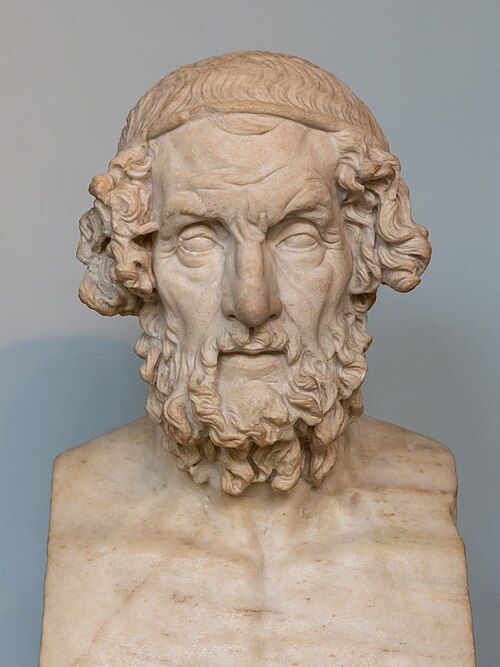
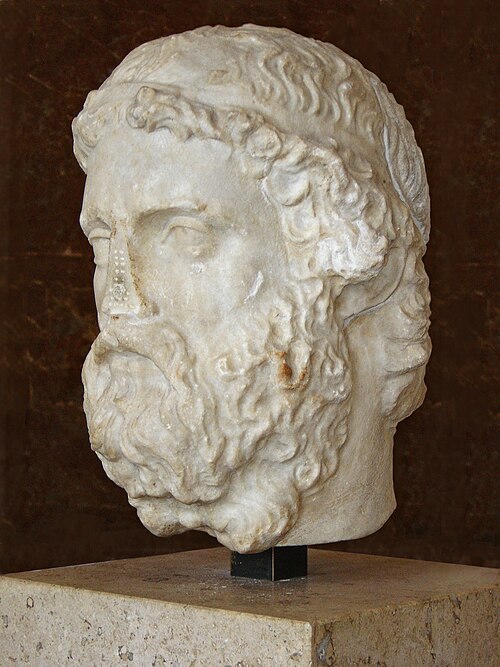
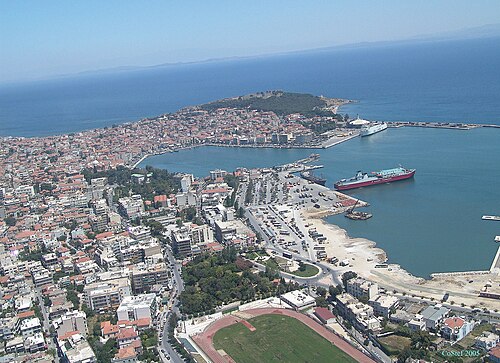
Alcaeus of Mytilene, also written Alkaios, belonged to the aristocratic world of Lesbos around 600 BCE. He was Sappho’s contemporary, and their poetry belongs to the island’s Aeolic lyric tradition. Political conflict and exile formed part of his experience. His poems name rivals and former allies, especially Pittacus, and express the anger of a partisan group. They are valuable evidence for that struggle, but their accusations are interested speech rather than neutral reports. The precise sequence of events and his exact lifetime remain uncertain.
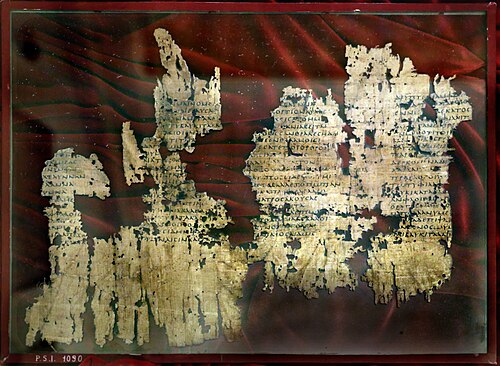
His poetry was made for performance, including the symposium, where a group gathered to drink, converse and hear song. Political loyalties, myth and responses to the weather could all enter that setting. Alexandrian scholars later arranged his poems into at least ten books by subject; the original collection does not survive intact. Modern knowledge depends on quotations by ancient writers and damaged papyri, whose fragments editors identify and sometimes join. A fragment number is therefore an editorial reference, not a title chosen by the poet. What survives still shows a voice able to make shared danger vivid through objects, movement and address. Reading that voice closely gives us both a historical encounter and a lesson in how an image can carry an argument.
Works

Alcaeus’s surviving range is wider than the storm image alone. Fragment 42 Lobel–Page retells myth by setting Helen’s destructive consequences beside the marriage of Peleus and Thetis. Fragment 129 joins sanctuary, prayer, exile and the bitterness of a broken political oath. In fragment 338, winter weather gives way to a scene of fire, wine and bodily comfort. Fragment 346 sets up a drinking song with cups and the remaining daylight. These are distinct fragments with different situations; their numbers identify an edition, not the order in which Alcaeus composed them.
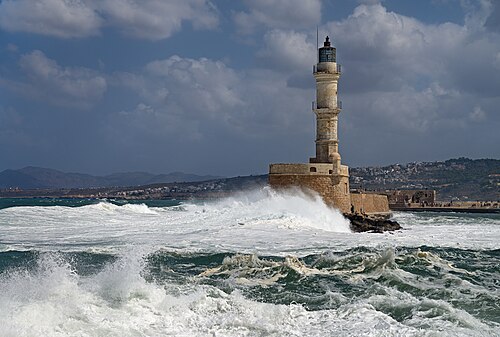
Fragment 326 opens with a speaker unable to make sense of conflicting winds. Waves roll from opposite sides, the ship takes water and its sail is torn. Ancient interpretation already connected such sea imagery with political struggle. The scene can therefore be read as a shared crisis made visible through a battered vessel, rather than a verified shipwreck diary. The Aeolic forms, missing text and allusive political background call for support. Our Modern Greek diagram keeps only the movement from two sides: Το κύμα έρχεται από αριστερά (The wave comes from the left) and Το κύμα έρχεται από δεξιά (The wave comes from the right). Those are original practice sentences, not translations of individual ancient words.
Legacy in Greece today
Find fragment 326 Lobel–Page in the Centre for the Greek Language’s lyric anthology. Read our Modern Greek rendering of its opening, then use a fuller translation to locate the waves from opposite sides. On a blank page draw one small ship in the centre and two arrows approaching it from opposite sides. Say Το κύμα έρχεται από αριστερά (The wave comes from the left). Then say Το κύμα έρχεται από δεξιά (The wave comes from the right). Point from your own left and right, keeping the page in the same position. Describe the wind with Ο άνεμος είναι δυνατός (The wind is strong). You practise direction and weather through an original diagram while treating the ancient storm as a poetic image.
Did you know?
- Alexandrian scholars arranged Alcaeus’s poems in at least ten books.
- The storm fragment describes water in the ship and a torn sail.
- Fragment numbers are editorial references; they do not date a poem.
Key works
| Greek title | Title | Year |
|---|---|---|
| Ἀπόσπασμα 42 Lobel–Page | Helen and Thetis (mythic contrast) | ? |
| Ἀπόσπασμα 129 Lobel–Page | Sanctuary, exile and oath | ? |
| Ἀπόσπασμα 326 Lobel–Page | A ship in conflicting winds | ? |
| Ἀπόσπασμα 338 Lobel–Page | Winter and the fireside | ? |
| Ἀπόσπασμα 346 Lobel–Page | Cups before the lamps | ? |
A line to remember
ἀσυννέτημμι τὼν ἀνέμων στάσιν·
In today's GreekΔεν καταλαβαίνω τη σύγκρουση των ανέμων.
Asinnétimmi tòn anémon stásin.
I cannot make sense of the winds’ conflict.