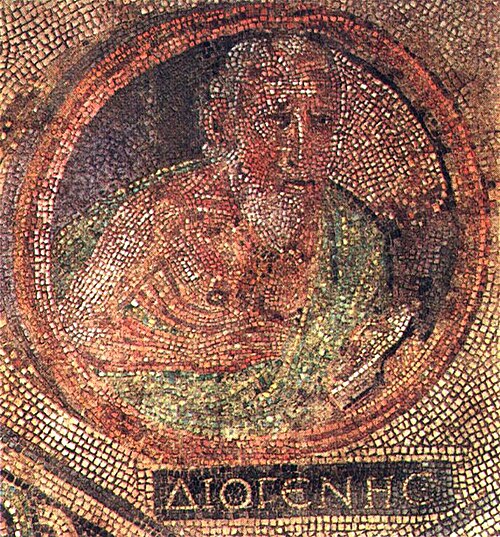
Life
Almost everything we know about Diogenes comes from the sixth book of Diogenes Laertius, written some five centuries later and full of anecdotes rather than dates. He was born in Sinope, a Greek colony on the Black Sea coast of today's Turkey, around 412 BC. His father Hicesias was involved with the city's mint, and father and son were accused of «defacing the currency», which is why Diogenes left Sinope in exile. He turned the charge into a motto: his life's work would be to «deface the currency» of custom and convention.
In Athens he attached himself to the philosopher Antisthenes, a pupil of Socrates, and took the simple life further than anyone before him. He wore one rough cloak, carried a staff and a bag, slept in a large storage jar (a πίθος, pithos) by the temple of the Mother of the Gods in the Agora, and ate, washed and did everything else in public. He begged, he argued, and he insulted the famous. Plato, the story goes, called him «a Socrates gone mad».
Later, on a sea voyage, he was captured by pirates and sold as a slave in Crete to a Corinthian named Xeniades, whose sons he educated. He spent his last years in Corinth, where he met Alexander, and died there in 323 BC, very old, according to tradition on the same day as Alexander himself. The Corinthians set a marble dog on a pillar over his grave.
Works

Diogenes wrote nothing that survives, though Diogenes Laertius lists dialogues and even a «Republic» under his name. His work is his life, and it comes to us as stories. Asked why he walked through Athens in broad daylight holding a lit lamp, he answered «Άνθρωπον ζητώ» (I am looking for a human being), a line Greeks still quote. Seeing a child drink water from his hands, he threw away his wooden cup, saying a child had beaten him in simplicity. When Plato defined man as «a featherless two-legged animal», Diogenes plucked a chicken, brought it into the school and announced: «Here is Plato's man».
The most famous story is the meeting at Corinth, around 336 BC. Alexander, the young king of Macedon, came to see the celebrated philosopher, found him sunning himself and asked whether he could do anything for him. Diogenes replied: «Stand a little out of my sun». Alexander's companions laughed, but the king said that if he were not Alexander he would choose to be Diogenes.
Behind the jokes is a serious idea. Happiness, Diogenes taught, comes from living according to nature with as few needs as possible, free from the fear of poverty, shame or public opinion. He called himself a κοσμοπολίτης, a citizen of the world, when asked where he came from, which is the first recorded use of the word. Because he and his followers lived «like dogs» (κύνες, kynes) they were called Cynics, and his example led, through his pupil Crates, to the Stoic school and to a long tradition of plain-living philosophers.
Legacy in Greece today
Diogenes is a stock figure of Greek culture: the man in the jar is proverbial, and «Άνθρωπον ζητώ» is still said, half in jest, when someone searches in vain for an honest person. The Modern Greek word κυνικός (cynical) and the international word cynic both come from his school, though their meaning has drifted. The meeting with Alexander is read in every Greek school, in the Ancient Greek anthology of the gymnasium, and Alexander's reply has become a byword for admiration. In Sinop, the modern Turkish town on the site of Sinope, a statue of Diogenes with his lamp and dog stands by the harbour, and the lamp and jar appear in paintings from Jean-Léon Gérôme to Greek cartoons. Doctors even speak of «Diogenes syndrome» for extreme self-neglect, a label the philosopher, who chose his poverty freely, would have found unfair.
Did you know?
- He is the first person recorded as calling himself a «citizen of the world» (κοσμοπολίτης).
- According to tradition he died on the same day in 323 BC as Alexander the Great, the king he had told to get out of his sunlight.
- When asked what wine he liked best, he reportedly answered «other people's».
- His grave at Corinth was marked with a dog on a column, the animal that gave the Cynics their name.
Key works
| Greek title | Title | Year |
|---|---|---|
| Το πιθάρι στην Αγορά της Αθήνας | The jar in the Athenian Agora | c. 380s BC |
| «Άνθρωπον ζητώ»: το λυχνάρι μέρα μεσημέρι | «I am looking for a human being»: the lamp in daylight | |
| Ο κοσμοπολίτης | The citizen of the world | |
| Η συνάντηση με τον Αλέξανδρο στην Κόρινθο | The meeting with Alexander at Corinth | c. 336 BC |
| Πολιτεία (χαμένη) | Republic (lost) |
From the works


Public-domain pictures from Wikimedia Commons.
A line to remember
Μικρὸν ἀπὸ τοῦ ἡλίου μετάστηθι.
In today's GreekΚάνε λίγο πιο πέρα, μου κρύβεις τον ήλιο.
Mikron apo tou iliou metastithi.
Stand a little out of my sun.