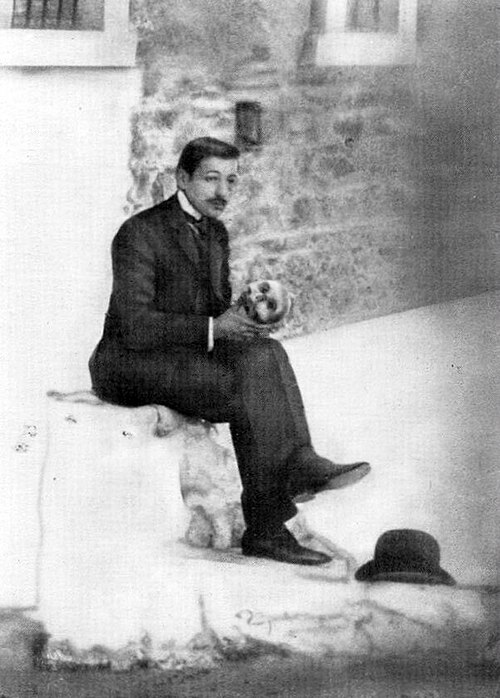
Life
Vrettakos was born on 1 January 1912 in Krokees (Κροκεές), a village in Laconia a few kilometres from Sparta, at the foot of Taygetos; his family also owned land at Ploumitsa, a hamlet in the olive groves, which he loved all his life. He finished school in Gytheio and in 1929, aged seventeen, went to Athens with the manuscript of his first poems; the collection Κάτω από σκιές και φώτα (Under Shadows and Lights) appeared the same year. The capital was hard on him. He earned his living in offices, in journalism and in publishing, and knew poverty well.
He fought on the Albanian front in the winter of 1940–41 and lived through the German occupation in Athens. Like many Greek writers of his generation he joined the Left, and the civil war years cost him his job and friends; he later distanced himself from the Communist Party while keeping his socialist convictions. The poems of those years, such as 33 ημέρες (33 Days, 1945) on the December 1944 fighting in Athens, are his darkest. During the military dictatorship of 1967–74 he spent several years abroad, in Switzerland and in Italy, and returned to Greece after the fall of the colonels.
In the last decades of his life he was widely honoured, and in 1987 he was elected a member of the Academy of Athens. He died on 4 August 1991 at Ploumitsa, in the Laconian countryside where he had been born, and is buried there, under the mountain he had written about all his life.
Works

Vrettakos published more than twenty collections of poetry, as well as novels and essays, and his collected Τα ποιήματα (The Poems) fill several volumes. Early on, under the influence of the symbolists and of Palamas, he wrote long, rhetorical poems; the war and the occupation stripped his language down. From Ο Ταΰγετος και η σιωπή (Taygetos and the Silence, 1949) onward he found the voice people know: short lines, concrete images, sun, snow on the mountain, olive trees, birds, a mother's hands, and a faith in human goodness that survived everything he had seen. Critics called him the poet of light; he called himself a man who had been given poetry in order to have something to live on.
His recurring subjects are three. The landscape of Laconia, above all Taygetos, which he treats as a living presence, almost a parent. His mother, to whom he dedicated some of his tenderest poems. And peace: in the Cold War decades he wrote constantly against war and the atomic bomb, and Οδύνη (Pain, 1969), written in exile, is a long lament for a wounded Greece. The late works are the broadest: Ο Προμηθέας ή το παιχνίδι μιας μέρας (Prometheus, or the Game of a Day, 1978) is a dramatic poem about the Titan who loved humankind, and Λειτουργία κάτω από την Ακρόπολη (Liturgy under the Acropolis, 1981) is a poem-cantata in which the poet celebrates Greece and humanity as a kind of church service. His prose includes Το αγρίμι (The Wild One) and essays on Palamas and on poetry.
Legacy in Greece today
Vrettakos is a schoolbook poet in the best sense: short poems of his appear in the primary-school Ανθολόγιο and in gymnasium readers, and generations of pupils have learned verses of his about the sun, the mother and peace by heart. Several poems have been set to music by Greek composers and are sung at school celebrations. In Sparta a street carries his name, and his village of Krokees and the hamlet of Ploumitsa, where his grave lies in the olive groves, are the places to go for anyone who wants to see the landscape behind the poems. The Academy of Athens, which elected him in 1987, holds his archive. A learner can start with the poem that opens «Αν δε μου 'δινες την ποίηση, Κύριε» (If you had not given me poetry, Lord), one of the most quoted lines of modern Greek verse, and with the short poems about Taygetos, which use the simplest Greek there is.
Did you know?
- His first collection was published in 1929, when he was seventeen, the year he arrived in Athens from Laconia.
- He spent part of the dictatorship of 1967–74 in exile in Switzerland and Italy, and wrote some of his best-known late poems there.
- He was elected to the Academy of Athens in 1987, four years before his death.
- He died in the same corner of Laconia where he was born, under Mount Taygetos, the mountain that appears in his poems for sixty years.
Key works
| Greek title | Title | Year |
|---|---|---|
| Κάτω από σκιές και φώτα | Under Shadows and Lights | 1929 |
| 33 ημέρες | 33 Days | 1945 |
| Ο Ταΰγετος και η σιωπή | Taygetos and the Silence | 1949 |
| Οδύνη | Pain | 1969 |
| Ο Προμηθέας ή το παιχνίδι μιας μέρας | Prometheus, or the Game of a Day | 1978 |
| Λειτουργία κάτω από την Ακρόπολη | Liturgy under the Acropolis | 1981 |
From the works

Public-domain pictures from Wikimedia Commons.
A line to remember
Αν δε μου 'δινες την ποίηση, Κύριε, / δε θα 'χα τίποτα για να ζήσω.
An de mou 'dines tin poiisi, Kyrie, / de tha 'cha tipota gia na ziso.
If you had not given me poetry, Lord, / I would have nothing to live on.