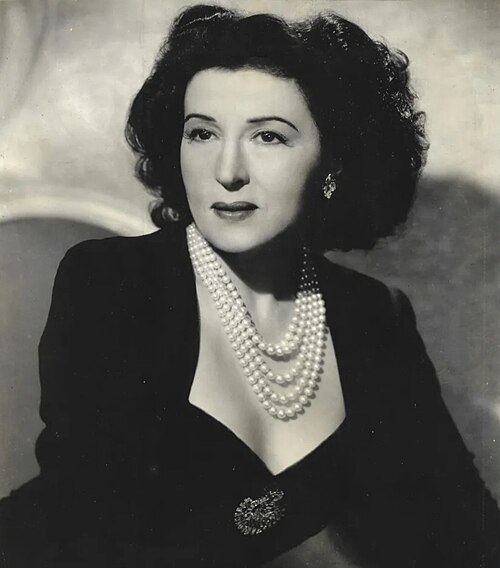
Life
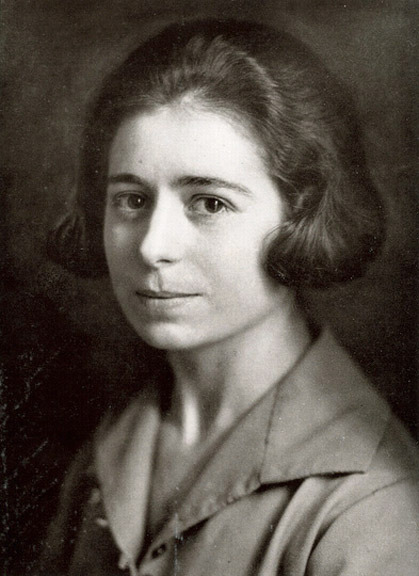
Katina Paxinou was born in Piraeus on 17 December 1900, into a well-off family; Paxinou was the name of her first husband. She trained first as a singer, studying music in Geneva, and made her debut on the opera stage in 1920, at the Municipal Theatre of Piraeus, in Sister Beatrice, an opera Dimitri Mitropoulos wrote for her. Soon, however, she moved to the spoken theatre, and in the late 1920s she was acting in Athens, where her low, powerful voice and her intensity marked her out at once.
When the Greek National Theatre was founded in 1932, she became one of its leading actresses, together with the actor and director Alexis Minotis, whom she had met in 1931 and who became her husband and lifelong partner on stage. In the 1930s she played the great women of ancient tragedy, and took Greek productions abroad. The outbreak of the Second World War found her outside Greece; she went on to the United States, acted in English on Broadway and was cast by Paramount as Pilar, the fierce guerrilla woman of For Whom the Bell Tolls (1943). The role won her the Academy Award and a Golden Globe in 1944.
After a few more films in Hollywood and Europe she returned to Greece after the war, and with Minotis she led the National Theatre's productions of ancient drama for two decades, many of them at the theatre of Epidaurus. She died in Athens on 22 February 1973.
Works

On stage Paxinou was above all a tragic actress. Her great roles came from Sophocles and Euripides: Electra, mourning her father and waiting for her brother; Hecuba, the queen of fallen Troy; Medea, the abandoned wife who kills her children; Jocasta in Οιδίπους Τύραννος (Oedipus the King). She acted with her whole body and with a voice that could fill an open-air theatre of fourteen thousand seats without effort, and critics compared her with the great actresses of Europe.
She also loved modern drama and introduced Greek audiences to plays by Ibsen, Eugene O'Neill and Federico García Lorca, whose The House of Bernarda Alba was one of her best-known roles.
Her film career was short but famous. As Pilar in For Whom the Bell Tolls, from Hemingway's novel about the Spanish Civil War, she played a rough, wise, frightening woman next to Gary Cooper and Ingrid Bergman, and stole many scenes. She went on to appear in Mourning Becomes Electra (1947), from O'Neill's version of the Greek myth, in Orson Welles's Mr. Arkadin (1955) and in Luchino Visconti's Rocco and His Brothers (1960), as the mother of the brothers. Her work with Minotis at Epidaurus helped make the summer festival of ancient drama what it is today.
Legacy in Greece today
Every summer, when the National Theatre plays a tragedy at Epidaurus, Greek newspapers remember Paxinou and Minotis, who gave the festival its early fame. Her Oscar is still a point of pride: Greeks name her together with the composers Manos Hadjidakis and Vangelis as winners of the prize. In 1955 her Hecuba opened the first Epidaurus Festival. For a learner, a good way in is to watch the scenes of Pilar in For Whom the Bell Tolls and then read about Electra or Hecuba in simple Greek: the same strong, grieving woman appears in both.
Did you know?
- She was the first Greek to win an Academy Award, in 1944, for Best Supporting Actress.
- She started her career as an opera singer before becoming an actress.
- She and her husband Alexis Minotis led the National Theatre's ancient drama productions at Epidaurus for many years.
Key works
| Greek title | Title | Year |
|---|---|---|
| Ηλέκτρα (Σοφοκλής), Εθνικό Θέατρο | Electra by Sophocles, National Theatre | 1930s |
| Για ποιον χτυπά η καμπάνα | For Whom the Bell Tolls (film, Oscar 1944) | 1943 |
| Το πένθος ταιριάζει στην Ηλέκτρα | Mourning Becomes Electra (film) | 1947 |
| Κύριος Αρκάντιν | Mr. Arkadin (film) | 1955 |
| Ο Ρόκο και τα αδέλφια του | Rocco and His Brothers (film) | 1960 |
From the works

Public-domain pictures from Wikimedia Commons.
A line to remember
Η μεγάλη τραγωδός
I megali tragodos
The great tragic actress