Life
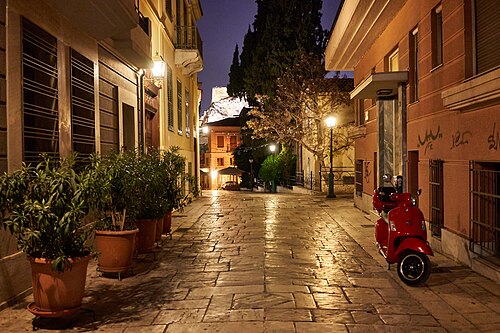
Mariza Koch was born in Athens on 14 March 1944 to a Greek mother from Santorini and a German father, an officer she never came to know. Her earliest years were spent in Anafiotika, the small whitewashed quarter of Plaka beneath the Acropolis. At school age she was sent to her mother’s village on Santorini, where she lived until her teens; her 2018 memoir Το ξανθό κορίτσι της Σαντορίνης (The Blonde Girl of Santorini) tells the story of this post-war childhood. Her first musical memories were the Asia Minor songs sung by refugees in Athens, followed by Byzantine chant and the island songs of Santorini and the Cyclades. In a 2024 interview she recalled learning to sing Cretan mantinades from a Cretan who came to the island after the 1956 earthquake.
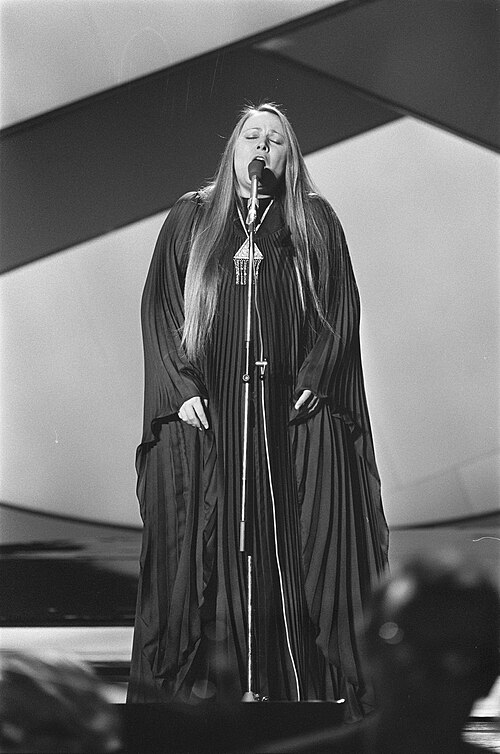
Her career began in the mid-1960s: in October 2015 the University of Patras marked fifty years of her work in music with a tribute and an honorary diploma. The album Αραμπάς made her name in 1971. At the request of Manos Hadjidakis she wrote a protest ballad against the 1974 Turkish invasion of Cyprus and sang it at Eurovision in The Hague on 3 April 1976. From the 1970s she toured Western Europe, Russia, the Americas, Australia, India, the Middle East and Africa; her biography records that in 1980 she was the first Western singer to appear in China. In 1996 she founded the label VERSO MUSIC and began teaching children, and in 2004 she opened a centre for experiential music, movement and speech.
Works
Koch’s sound starts from tradition. Αραμπάς (Arabas, 1971) set traditional songs against unusual rhythms and electronic textures, sometimes leaving her voice almost unaccompanied; her Ionian University biography describes it as the first gold record on the Greek market. Later albums such as Αιγαίο (Aegean, 1979) returned to traditional instruments. For most of her songs she writes both words and music, and she has set poetry by Sappho, Kostas Varnalis, Nikos Kavvadias and Giorgos Sarantaris; in 2020 she published a cycle of five poems by Kiki Dimoula. Her song Φάτα Μοργκάνα (Fata Morgana) is heard on the soundtrack of Marco Ferreri’s 1983 film Storia di Piera.
Παναγιά μου, Παναγιά μου is a lament in the spirit of a folk μοιρολόι (dirge). Eurovision records credit the music to Koch and the lyrics to Michalis Fotiadis; the song received 20 points and finished thirteenth of eighteen. As she recounted to To Vima in 2025, Hadjidakis telephoned her one evening with the request, and amid protests she signed a statement agreeing to perform at her own risk. Her later work turned to children: albums of traditional singing games, stage shows such as Η Γοργόνα ταξιδεύει τον μικρό Αλέξανδρο (The Mermaid Takes Little Alexander on a Journey), and books with CDs, including Με τη Μαρίζα τραγουδώ, ελληνικά μαθαίνω (With Mariza I Sing, I Learn Greek, 2010), written for children learning the Greek language and its musical tradition.
Legacy in Greece today
Koch’s educational work is now housed at the Department of Music Studies of the Ionian University, where her repertoire notebook is used in undergraduate and postgraduate teaching. The free website Τραγουδώντας ελληνικά με τα τραγούδια της Μαρίζας Κωχ (Singing Greek with Mariza Koch’s Songs) sorts her songs by theme, age and language level, with one theme devoted to the Greek language itself. Try this: open the site, choose the theme Ελληνική γλώσσα (Greek language) and listen to one song, noting three words you recognise. Then reread her sentence in A line to remember. Her biography continues: Καμαρώνω το ίδιο και για το ένα και για το άλλο (I am equally proud of the one and the other). Write your own sentence on that pattern about two very different places that matter to you. The songs were made for young learners; at C1 the challenge lies in your own sentence.
Did you know?
- She learned Cretan mantinades on Santorini from a Cretan who arrived after the 1956 earthquake.
- Her 1976 Eurovision song began with an evening telephone call from Manos Hadjidakis.
- Her song Φάτα Μοργκάνα (Fata Morgana) is heard in Marco Ferreri’s film Storia di Piera (1983).
- In 2009 she won a Best Singer award at the International Country Music Week festival in China.
Key works
| Greek title | Title | Year |
|---|---|---|
| Αραμπάς | Arabas (The Cart) | 1971 |
| Παναγιά μου, Παναγιά μου | My Holy Virgin, My Holy Virgin — Eurovision 1976 | 1976 |
| Αιγαίο | Aegean | 1979 |
| Η Γοργόνα ταξιδεύει τον μικρό Αλέξανδρο | The Mermaid Takes Little Alexander on a Journey — album | 1997 |
| Με τη Μαρίζα τραγουδώ, ελληνικά μαθαίνω | With Mariza I Sing, I Learn Greek — book with CD | 2010 |
| Το ξανθό κορίτσι της Σαντορίνης | The Blonde Girl of Santorini — memoir | 2018 |
A line to remember
Αξιώθηκα να τραγουδήσω σε πολλά από τα μεγαλύτερα θέατρα του κόσμου, αλλά και σε αμέτρητα σχολεία, καφενεία, αγροτικές αποθήκες και των πιο μικρών χωριών της πατρίδας μας.
Axióthika na tragoudíso se pollá apó ta megalýtera théatra tou kósmou, allá kai se amétrita scholeía, kafeneía, agrotikés apothíkes kai ton pio mikrón chorión tis patrídas mas.
I was granted the honour of singing in many of the world’s greatest theatres, but also in countless schools, coffee houses and farm storehouses of even the smallest villages of our homeland.