Life
Epicurus was born in 341 BC on Samos, where his father Neocles, an Athenian citizen, had settled as a colonist and taught school. At eighteen he went to Athens for his two years of military service; by the time he returned, the Athenian settlers had been expelled from Samos and his family had moved to Colophon on the Asian coast. There and at Teos he studied with Nausiphanes, a follower of Democritus, from whom he took the theory of atoms. In his early thirties he began to teach, first at Mytilene on Lesbos, then at Lampsacus on the Hellespont, where he gathered the friends who would follow him for the rest of their lives.
Around 306 BC he returned to Athens and bought a house and a garden outside the city walls. The Garden gave the school its name and its character: not a public lecture hall but a community living together, eating simply, writing and talking. Its membership scandalised Athens, because it included women, among them the hetaira Leontion, and slaves, such as Epicurus' own slave Mys. Epicurus himself rarely left the Garden and took no part in politics, in keeping with his advice to live unnoticed.
He suffered for years from a painful disease of the bladder and kidneys, and died in 270 BC at the age of seventy-two. In a letter written on his last day he said that the pain was as great as it could be, but that the joy of remembering his conversations with his friends outweighed it. His will freed his slaves, provided for the children of his followers and left the Garden to the school, which survived in Athens for centuries.
Works

Epicurus wrote more than any philosopher before him, some three hundred rolls according to Diogenes Laertius, including a treatise Περὶ φύσεως (On Nature) in thirty-seven books, of which charred fragments were recovered from a villa at Herculaneum buried by Vesuvius. What survives whole is small: three letters summarising his system, preserved by Diogenes Laertius, the Ἐπιστολὴ πρὸς Ἡρόδοτον (Letter to Herodotus) on physics, the Ἐπιστολὴ πρὸς Πυθοκλέα (Letter to Pythocles) on the heavens and the Ἐπιστολὴ πρὸς Μενοικέα (Letter to Menoeceus) on how to live; the forty Κύριαι Δόξαι (Principal Doctrines); and a collection of sayings found in a Vatican manuscript in 1888. The Roman poet Lucretius put the whole system into Latin verse in De rerum natura.
The system has three parts that hold each other up. In physics, everything is atoms moving in the void, and the soul, too, is made of atoms that scatter at death; there is no afterlife, no punishment, nothing to fear. The gods exist, blessed and far away, and take no interest in us. In ethics, pleasure is the beginning and end of the happy life, but Epicurus means by it chiefly ἀπονία, freedom from bodily pain, and ἀταραξία, freedom from disturbance of mind. The desires that matter are the natural and necessary ones, food, shelter, company; luxury adds nothing, and wanting it adds anxiety. Friendship, he says in the Principal Doctrines, is the greatest of the goods that wisdom provides for a whole life. The famous second Doctrine, that death is nothing to us because what has dissolved has no sensation, is meant not as a shrug but as a cure: remove the fear of death and most of the other fears collapse with it.
Legacy in Greece today
Epicurus' name survives in Modern Greek mostly as a misunderstanding: επικούρειος means a lover of good food and comfort, the opposite of the man who asked a friend to send him a little pot of cheese so that he could feast when he wished. His real doctrines are taught in the third-year lyceum philosophy course, and the Letter to Menoeceus, with its opening advice that no one is too young or too old to philosophise, is widely read in Greek translation. The phrases «λάθε βιώσας» (live unnoticed) and «ο θάνατος ουδέν προς ημάς» are quoted in everyday Greek, and a modern association, the Friends of Epicurean Philosophy, holds an annual symposium in Athens. Samos remembers him as a native son. A learner can read the Letter to Menoeceus in a facing-page edition: it is short, calm and surprisingly modern.
Did you know?
- The Garden admitted women and slaves as full members, which no other Athenian school did, and its enemies spread stories about it for centuries.
- Of his roughly three hundred books, only three letters and two collections of sayings survive complete; parts of his great treatise On Nature were recovered from papyri carbonised by the eruption of Vesuvius in AD 79.
- In the second century AD a wealthy Epicurean named Diogenes had the philosophy carved on a wall in his home town of Oenoanda in Asia Minor, the largest ancient inscription known.
- He asked that his birthday be celebrated every year, and his followers kept doing so for hundreds of years after his death.
Key works
| Greek title | Title | Year |
|---|---|---|
| Η ίδρυση του Κήπου στην Αθήνα | The founding of the Garden in Athens | c. 306 BC |
| Περὶ φύσεως | On Nature (37 books, fragments) | c. 300 BC |
| Ἐπιστολὴ πρὸς Ἡρόδοτον | Letter to Herodotus (physics) | |
| Ἐπιστολὴ πρὸς Μενοικέα | Letter to Menoeceus (ethics) | |
| Κύριαι Δόξαι | Principal Doctrines (40 maxims) | |
| Ἐπικούρου προσφώνησις | Vatican Sayings |
From the works


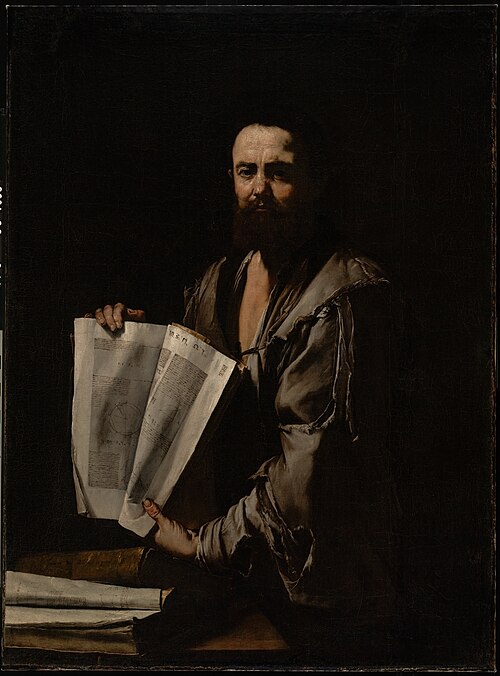
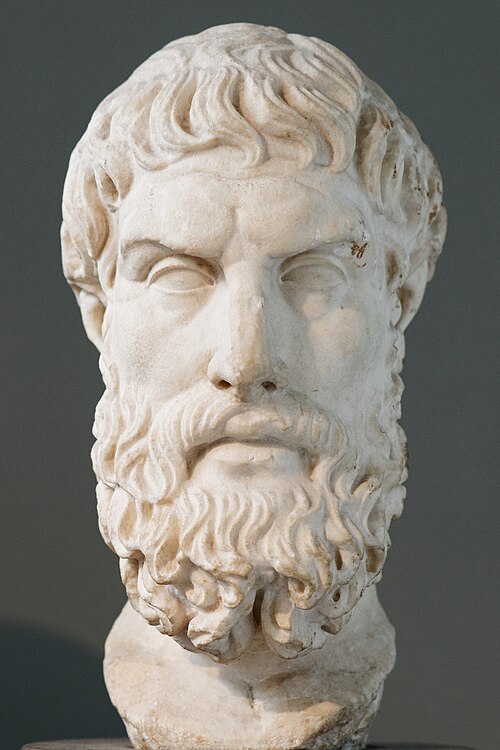
Public-domain pictures from Wikimedia Commons.
A line to remember
Ὁ θάνατος οὐδὲν πρὸς ἡμᾶς· τὸ γὰρ διαλυθὲν ἀναισθητεῖ, τὸ δ’ ἀναισθητοῦν οὐδὲν πρὸς ἡμᾶς.
In today's GreekΟ θάνατος δεν είναι τίποτα για μας· γιατί ό,τι έχει διαλυθεί δεν αισθάνεται, και ό,τι δεν αισθάνεται δεν είναι τίποτα για μας.
O thanatos ouden pros imas: to gar dialythen anaisthitei, to d’ anaisthitoun ouden pros imas.
Death is nothing to us; for what has dissolved has no sensation, and what has no sensation is nothing to us.
From the original
The text as Epicurus wrote it, out of copyright, with our own translation beside it.
«Ἐπιστολὴ πρὸς Μενοικέα»Letter to Menoeceus
From the Letter to Menoeceus, Epicurus' own summary of his ethics, preserved by Diogenes Laertius: the argument that death cannot harm us, which the Principal Doctrines compress into the page's quote.
Ἐπιστολὴ πρὸς Μενοικέα 124–125 (preserved in Diogenes Laertius 10.124–125) · Public-domain text, source: el.wikisource.org