Life
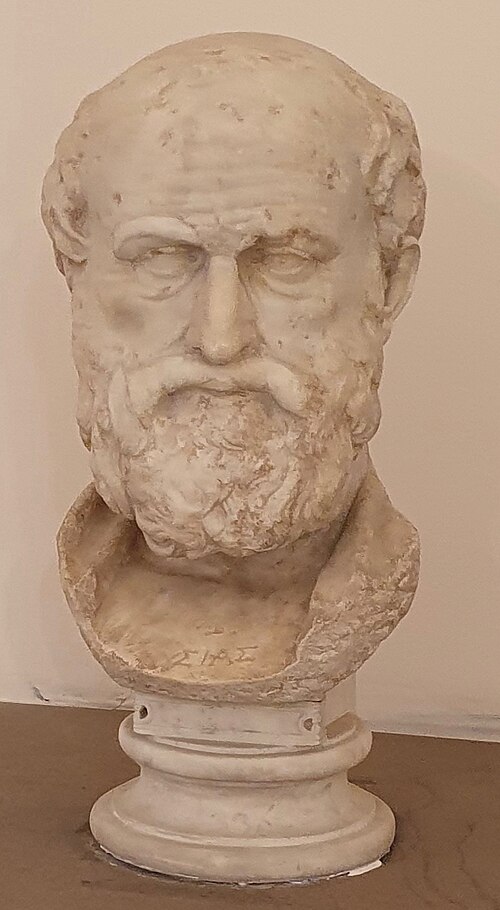
Lysias was the son of Cephalus, a Syracusan who, in Lysias’s own words, came to Athens at the invitation of Pericles. The family lived there as metics, free foreign residents without citizen rights. Modern scholars usually date Lysias to about 445–380 BC, although ancient biographers placed his birth earlier. As a young man he went to Thurii, a Greek colony in southern Italy, where he may have studied rhetoric with Tisias. Around 412 BC, expelled with other supporters of Athens, he returned to Athens. In Against Eratosthenes he says the Thirty later seized 700 of the family’s shields and 120 enslaved people, evidence of a large shield workshop.
In 404 BC, after Athens lost the Peloponnesian War, the Thirty Tyrants targeted wealthy metics. Lysias describes being arrested while entertaining guests, promising one of the Thirty, Peison, a talent of silver for his life, then slipping away through open doors and sailing to Megara by night. His brother Polemarchus was ordered to drink hemlock without a trial. From exile Lysias supported the democrats; later tradition says he gave money and shields and paid soldiers. A decree making him a citizen was annulled on procedural grounds, so he remained a metic with tax equality, isoteleia. He then earned his living writing speeches for others.
Works

Athenian law expected litigants to speak for themselves, so a logographer (λογογράφος, speechwriter) wrote words that a client delivered in court. Ancient lists counted about 425 speeches under Lysias’s name, and critics such as Dionysius of Halicarnassus accepted more than 230 as genuine. About 35 survive, some of disputed authorship. Dionysius praised his plain Attic vocabulary and his ēthopoiia (ἠθοποιία), the art of making each speaker sound like a believable person. Later Atticist writers treated him as a model of clear prose.
In Κατὰ Ἐρατοσθένους (Against Eratosthenes), 403 BC, Lysias spoke in person against a former member of the Thirty, whom he blamed for Polemarchus’s death. In the defence of Euphiletus, accused of killing his wife’s lover, and in the speech for a disabled man defending his small state allowance, ordinary Athenians speak in vivid everyday terms. Κατὰ τῶν σιτοπωλῶν (Against the Grain Dealers) is delivered by a member of the Council, not by Lysias. He accuses grain dealers of buying up more than the legal limit of fifty measures; they reply that officials told them to. An official named Anytus testifies that he had only advised them not to bid against each other. The case could carry the death penalty.
Legacy in Greece today
In Greece, Lysias is read in secondary-school Ancient Greek classes; teaching scenarios published by the Institute of Educational Policy use Ὑπὲρ Μαντιθέου (For Mantitheus) in the second year of lyceum. The Centre for the Greek Language offers several of his speeches online with Modern Greek translations. Plato keeps him in view too: the Republic opens in Polemarchus’s house, and the Phaedrus discusses a speech attributed to Lysias. The C1 level here describes our adapted reading, not independent reading of Attic Greek. Try this: write a three-line exchange at a market using αγοράζω (I buy), πουλάω (I sell) and η τιμή (price). Then label each line with Ποιος μιλάει; (Who is speaking?) and decide whether the words belong to the speaker or to the person who wrote them.
Did you know?
- Lysias spent most of his life in Athens without becoming a citizen.
- Plato’s Republic places him among the people in his brother Polemarchus’s house.
- In Against Eratosthenes he says the Thirty seized 700 shields from his family.
- The same speech ends with a burst of short verbs: you have heard, seen, suffered, you have it all; judge.
Key works
| Greek title | Title | Year |
|---|---|---|
| Κατὰ Ἐρατοσθένους (12) | Against Eratosthenes — speech 12, delivered by Lysias himself | 403 BC |
| Ὑπὲρ τοῦ Ἐρατοσθένους φόνου ἀπολογία (1) | On the Murder of Eratosthenes — speech 1, written for Euphiletus | ? |
| Ὑπὲρ Μαντιθέου (16) | For Mantitheus — speech 16 | ? |
| Ὑπὲρ τοῦ ἀδυνάτου (24) | For the Disabled Man — speech 24 | ? |
| Κατὰ τῶν σιτοπωλῶν (22) | Against the Grain Dealers — speech 22, delivered by a council member | after 403 BC |
| Ὀλυμπιακός (33) | Olympic Speech — speech 33, only the opening survives | c. 388 BC |
A line to remember
Παύσομαι κατηγορῶν. ἀκηκόατε, ἑωράκατε, πεπόνθατε, ἔχετε· δικάζετε.
In today's GreekΘα σταματήσω να κατηγορώ. Ακούσατε, είδατε, πάθατε, τα έχετε μπροστά σας· δικάστε.
Paúsomai katēgorō̂n. akēkóate, heōrákate, pepónthate, échete; dikázete.
I will stop accusing. You have heard, you have seen, you have suffered, you have the facts: judge.