Life
Kyveli was born in 1888. Her full name is recorded as Kyveli Adrianou or Andrianou, but Greek audiences knew her simply by her first name. As a girl she took diction lessons and, before turning fifteen, enrolled in the newly founded drama school of the Royal Theatre in Athens, which soon closed. She was then hired by the Nea Skini (New Stage) of Konstantinos Christomanos, a company that staged modern European and Greek drama. In December 1901 she played young Hedvig in Ibsen’s The Wild Duck; the actor Mitsos Myrat, with whom she later had a daughter, the actress Miranda Myrat, played Hedvig’s father.
By 1908 she was heading her own company, the Θίασος Κυβέλης Αδριανού (Kyveli Adrianou Company), which performed in Athens, in other Greek cities and in Greek communities abroad, including Constantinople and Egypt. She and Marika Kotopouli were the leading actresses of their era and competed for every new play by Grigorios Xenopoulos. In 1917, during the National Schism, royal authorities barred her from the Royal Theatre because of her support for Eleftherios Venizelos. Her relationship with the politician Georgios Papandreou brought a child and, in the late 1920s, a marriage that ended in separation in the late 1940s.
After the Second World War she joined the National Theatre, where she played leading roles from 1951 to 1967. She died on 26 May 1978.
Works
Kyveli’s art lived on the stage, so her work survives in programmes, photographs, reviews and performance records rather than in books. The IbsenStage database of the University of Oslo lists her in forty-eight Ibsen performances between 1901 and 1930. After Hedvig she played Thea Elvsted and later Hedda herself in Hedda Gabler, Regine in Ghosts and, above all, Nora in A Doll’s House, a role she performed from 1907 to 1930 in Athens, Piraeus, Volos and elsewhere. Greek plays were just as central: the 1978 obituary in To Vima names Xenopoulos’s Φωτεινή Σάντρη (Fotini Sandri) and Πειρασμός (Temptation) among her successes.
Her late career is documented in detail by the National Theatre’s digital archive. In 1951 she played Lady Pitts in James Bridie’s Daphne Laureola, translated by Nikos Gatsos. On 4 March 1953 she opened as the countess in Xenopoulos’s Το μυστικό της κοντέσσας Βαλέραινας (The Secret of Countess Valerena), directed by Alexis Solomos. Staged as a tribute to the playwright, who had died in 1951, the production became a major success. She returned to the role in 1961, on tour to Lamia, Patras, Volos, Ioannina and Rhodes, and in Nicosia in 1967. She was also Arkadina in Chekhov’s The Seagull (1957), the Aunt in Lorca’s Doña Rosita (1959), with music by Manos Hadjidakis, and the old prioress Madame de Croissy in Bernanos’s Dialogues of the Carmelites (1962).
Legacy in Greece today
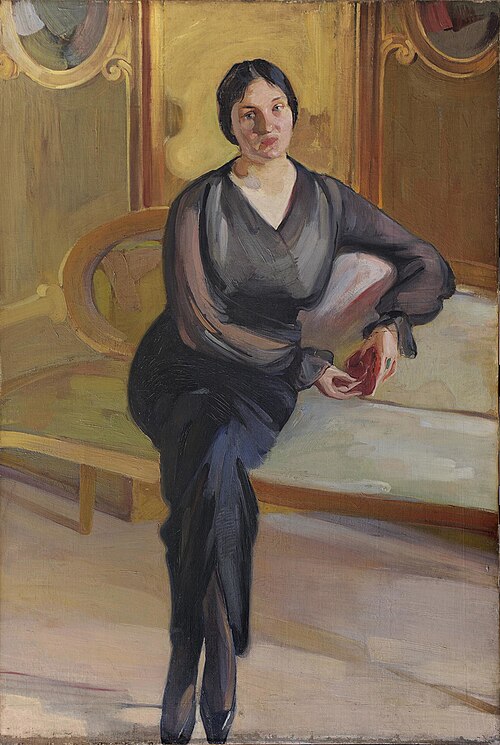
Kyveli is remembered as one of the actresses who shaped modern Greek acting. A statue by the sculptor Natalia Mela (1992) stands in Athens, and Nikolaos Lytras’s painting The Actress Kyveli (c. 1920) belongs to the National Gallery. In Ermoupoli on Syros, the Kyveli Institute, guided by her great-granddaughter Valentini Potamianou, keeps her clothes, letters and photographs, and ERT’s series Φλόγα και Άνεμος (Flame and Wind) has brought her story to television. For practice, open the 1910 programme of her company on Wikimedia Commons. Read ΘΙΑΣΟΣ ΚΥΒΕΛΗΣ ΑΔΡΙΑΝΟΥ and ΤΙΜΗΤΙΚΗ ΠΑΡΑΣΤΑΣΙΣ, then rewrite the old form in today’s Greek: τιμητική παράσταση (benefit performance). Next, find the 1953 cast list (διανομή) in the National Theatre archive and say who plays whom: Η Κυβέλη υποδύεται την κοντέσσα Βαλέραινα (Kyveli plays Countess Valerena).
Did you know?
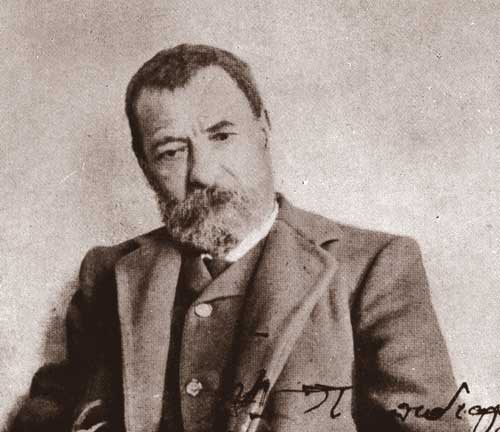
- Angelos Sikelianos, later a celebrated poet, appeared in a small role in the same 1901 Wild Duck in which she played Hedvig.
- In March 1904 the Nea Skini took that production, with her as Hedvig, to the Apollon Theatre in Ermoupoli, the Syros town that now houses the Kyveli Institute.
- Her last recorded National Theatre performances as Countess Valerena took place in Nicosia, Cyprus, in March 1967.
Key works
| Greek title | Title | Year |
|---|---|---|
| Η αγριόπαπια | The Wild Duck — Hedvig, Nea Skini | 1901 |
| Το κουκλόσπιτο | A Doll’s House — Nora | 1907 |
| Το μυστικό της κοντέσσας Βαλέραινας | The Secret of Countess Valerena — the countess, National Theatre | 1953 |
| Ο γλάρος | The Seagull — Arkadina | 1957 |
| Δόνα Ροζίτα | Doña Rosita — the Aunt | 1959 |
| Διάλογοι καρμηλιτισσών | Dialogues of the Carmelites — Madame de Croissy | 1962 |
A line to remember
Η ζωή είναι χαρά. Δεν είναι χρέος.
I zoí íne chará. Den íne chréos.
Life is joy. It is not a duty.