Life
Anna Tabaki (also spelled Tampaki) was born in Piraeus. She attended the Greek-French school Jeanne d’Arc and graduated in Greek and French philology from the Faculty of Philosophy in Athens. A French government scholarship took her to postgraduate studies at Clermont-Ferrand and at the Sorbonne, where she was a student of the literary historian K. Th. Dimaras at the Institute of Modern Greek Studies. She also held a scholarship from the Alexander S. Onassis Foundation and earned her doctorate at the École des Hautes Études en Sciences Sociales in Paris. Her thesis on Modern Greek theatre, dated 1995 in the university’s bibliography, became the French book Le théâtre néohellénique in 2001.
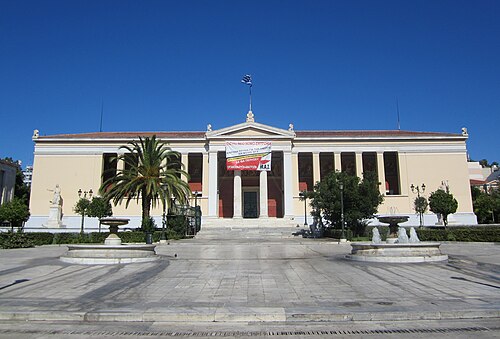
From 1980 to 2000 she was a researcher at the Centre for Neohellenic Research of the National Hellenic Research Foundation, and from 1997 to 2012 she was scientific director of the research project Νεοελληνικές Μεταφράσεις (Modern Greek Translations). She taught the history of Modern Greek theatre at the University of Patras from 1995 to 2000. In 1999 the Department of Theatre Studies at the University of Athens elected her associate professor, and in 2004 professor. There she taught Modern Greek theatre history, European drama and, at postgraduate level, theatre translation in theory and practice. She directed the department’s postgraduate programme from 2009 to 2014 and chaired the department from 2015 to 2017. She is now professor emerita.
Works

Tabaki’s research joins comparative literature, the history of ideas and the study of translation. Her first book, Ο Μολιέρος στη φαναριώτικη παιδεία (Molière in Phanariot Education, 1988), examines three manuscript translations of Molière made in Phanariot circles. Η νεοελληνική δραματουργία και οι δυτικές της επιδράσεις (Modern Greek Drama and Its Western Influences, 1993) and Το νεοελληνικό θέατρο (18ος–19ος αι.) (Modern Greek Theatre, 18th–19th Centuries, 2005) follow how plays, ideas and stage models moved between Western Europe and Greek audiences.
Περί νεοελληνικού Διαφωτισμού (On the Modern Greek Enlightenment, 2004) gathers her studies of that movement; a Romanian translation appeared in Bucharest in 2015. She wrote the entries on the Modern Greek Enlightenment for the Encyclopedia of Greece and the Hellenic Tradition (2000) and for the Oxford Encyclopedia of the Enlightenment (2003). Her later work extends into the 20th century, with a focus on reception and theatre translation; in 2020 she edited a volume on the director and actor Lefteris Vogiatzis. With colleagues she also wrote open-access university textbooks for the Kallipos programme: one on European theatre from the Renaissance to the 18th century (2015), and Ιστορία και δραματολογία του νεοελληνικού θεάτρου, 16ος–20ός αιώνας (History and Dramaturgy of Modern Greek Theatre, 16th–20th Centuries, 2023), which she coordinated. Across these books, translation appears as a creative act through which new ideas and new models for the stage reached Greek readers.
Legacy in Greece today
Tabaki’s research gives students of Greek theatre a map of how European plays entered Greek through translation, and her 2023 Kallipos textbook makes that history freely available in Modern Greek. She has given about eighty lectures and seminars, including an online lecture on the theatre of the European Enlightenment at the University of Crete in April 2025. Try a task based on her first book’s full title, Ο Μολιέρος στη φαναριώτικη παιδεία. Τρεις χειρόγραφες μεταφράσεις (Molière in Phanariot Education: Three Manuscript Translations). Molière is the συγγραφέας (author); those who rendered his plays into Greek are μεταφραστές (translators); a σκηνοθέτης (director) stages a play. Then open any Greek theatre programme and write three original sentences, for example: Το έργο το έγραψε ο Μολιέρος. Τη μετάφραση την έκανε… Τη σκηνοθεσία την υπογράφει… (Molière wrote the play. The translation is by… The direction is by…).
Did you know?
- She is a member of the Société Voltaire, a learned society devoted to Voltaire.
- She is a founding member of the Seminar of Comparative Literature and History of Ideas, set up in 2000.
- She has taken part in around 130 international conferences.
- Besides scholarly journals, she has written for Greek newspapers such as Το Βήμα and Η Καθημερινή.
Key works
| Greek title | Title | Year |
|---|---|---|
| Ο Μολιέρος στη φαναριώτικη παιδεία. Τρεις χειρόγραφες μεταφράσεις | Molière in Phanariot Education: Three Manuscript Translations | 1988 |
| Η νεοελληνική δραματουργία και οι δυτικές της επιδράσεις (18ος–19ος αι.) | Modern Greek Drama and Its Western Influences (18th–19th c.) | 1993 |
| Le théâtre néohellénique. Genèse et formation | Modern Greek Theatre: Genesis and Formation (in French) | 2001 |
| Περί νεοελληνικού Διαφωτισμού | On the Modern Greek Enlightenment | 2004 |
| Το νεοελληνικό θέατρο (18ος–19ος αι.). Ερμηνευτικές προσεγγίσεις | Modern Greek Theatre (18th–19th c.): Interpretative Approaches | 2005 |
| Ιστορία και δραματολογία του νεοελληνικού θεάτρου, 16ος–20ός αιώνας | History and Dramaturgy of Modern Greek Theatre, 16th–20th Centuries (coordinator, co-author) | 2023 |
A line to remember
Η μετάφραση συντάσσεται επομένως με τη μάχη της πολιτισμικής ανανέωσης.
I metáfrasi syntássetai epoménos me ti máchi tis politismikís ananéosis.
Translation therefore joins the battle for cultural renewal.