Life
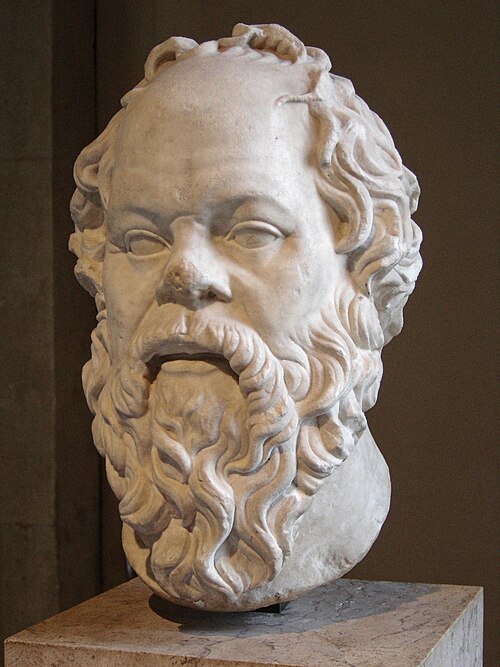
Socrates was born around 470 BC in the Athenian deme of Alopeke, the son of Sophroniscus, a stonemason, and Phaenarete, a midwife; he liked to say that he practised his mother's art, helping others give birth to ideas. He served as a hoplite in the Peloponnesian War, at Potidaea, Delium and Amphipolis. He was poor by choice, famously ugly, with a snub nose and bulging eyes, and married to Xanthippe, whose sharp tongue became proverbial; they had three sons.
He never founded a school or took fees. His days were spent in the agora and the wrestling grounds, in conversation with generals, craftsmen, sophists and the young men who followed him for the pleasure of watching their elders squirm; among them were Alcibiades, Critias and Plato. When the oracle at Delphi declared that no one was wiser than Socrates, he concluded that his only wisdom was knowing the limits of his knowledge, and set out to test the god by questioning everyone reputed wise. In 423 BC Aristophanes put him on stage in Νεφέλαι (The Clouds) as a crank in a basket teaching young men to cheat their fathers.
In 399 BC, with the democracy restored after the Thirty Tyrants and nerves raw, three citizens, Meletus, Anytus and Lycon, charged him with not recognising the city's gods, introducing new divinities and corrupting the young. A jury of 501 found him guilty by a narrow majority; when he proposed as his «penalty» free meals for life in the Prytaneum, the majority for death grew. He spent a month in prison while a sacred ship was away at Delos, refused Crito's plan of escape, and drank the hemlock among his friends.
Works

Socrates' work is a way of talking. He begins by professing ignorance and asking a simple question, what is courage, what is piety; his partner answers with confidence; Socrates draws out the consequences until the answer contradicts itself, and the partner is left in ἀπορία, a dead end, which Socrates presents as progress, since a man who knows he does not know has at least stopped believing a falsehood. This cross-examination, the ἔλεγχος, with its feigned humility, the famous Socratic irony, is the first systematic method in philosophy. Behind it lay convictions: that virtue is knowledge, that no one does wrong willingly, that it is better to suffer injustice than to commit it, and that the care of one's soul matters more than money, reputation or life itself.
Because he wrote nothing, every «work» of Socrates is someone else's. Plato's Απολογία Σωκράτους (Apology) gives his speech at the trial; the Κρίτων (Crito) his refusal to escape, because a citizen who has accepted the laws all his life cannot break them when they turn against him; the Φαίδων (Phaedo) his last day, discussing the immortality of the soul until the jailer brings the cup. In the Συμπόσιον (Symposium) he speaks of love as the ladder from beautiful bodies to beauty itself. Xenophon's Απομνημονεύματα (Memorabilia) show a plainer, more practical Socrates giving advice on household management and friendship. What all the sources agree on is the man: the questions, the courage, the refusal to flatter a jury, and the strange inner voice, the δαιμόνιον, that warned him when he was about to do wrong.
Legacy in Greece today
In Athens the so-called Prison of Socrates, three chambers cut into the rock of the Philopappos hill, is a romantic misattribution, but the agora where he talked, and the Royal Stoa where he was indicted, have been excavated and can be walked. His marble statue by Leonidas Drosis sits beside Plato's in front of the Academy of Athens on Panepistimiou Street, and Σωκράτης remains an everyday Greek first name. Greek pupils meet him in the lyceum through Plato's dialogues in the Ancient Greek classroom and in the philosophy textbook, and the sayings have become proverbs: «ἓν οἶδα ὅτι οὐδὲν οἶδα» (I know one thing, that I know nothing), a later condensation of the Apology, and «σωκρατική ειρωνεία» for pretended ignorance. «Σωκρατική μέθοδος» is what Greek teachers call teaching by questions. A learner can go on to the site's pages on Plato, Xenophon and Aristophanes, his three witnesses.
Did you know?
- Not a word of his survives in his own hand; everything we have comes from Plato, Xenophon and Aristophanes, who agree on almost nothing except that he asked questions.
- He fought as a heavy infantryman in three battles of the Peloponnesian War and was said to have saved the life of Alcibiades at Potidaea.
- The famous «I know that I know nothing» is nowhere in the sources in that form; the Apology says only that he does not think he knows what he does not know.
- According to Plato, his last words were that he owed a cock to Asclepius, the god of healing, and his friends should pay the debt.
Key works
| Greek title | Title | Year |
|---|---|---|
| Νεφέλαι (Αριστοφάνης) | The Clouds, Aristophanes' caricature of Socrates | 423 BC |
| Η δίκη του Σωκράτη | The trial of Socrates | 399 BC |
| Απολογία Σωκράτους (Πλάτων) | Apology of Socrates, by Plato | c. 390s BC |
| Κρίτων (Πλάτων) | Crito, by Plato | c. 390s BC |
| Φαίδων (Πλάτων) | Phaedo, by Plato | c. 380s BC |
| Απομνημονεύματα (Ξενοφών) | Memorabilia, by Xenophon | c. 370s BC |
From the works


Public-domain pictures from Wikimedia Commons.
A line to remember
ἔοικα γοῦν τούτου γε σμικρῷ τινι αὐτῷ τούτῳ σοφώτερος εἶναι, ὅτι ἃ μὴ οἶδα οὐδὲ οἴομαι εἰδέναι.
In today's GreekΦαίνεται λοιπόν πως είμαι σοφότερος από αυτόν τον άνθρωπο σε ένα μικρό πράγμα: ότι όσα δεν ξέρω, ούτε νομίζω πως τα ξέρω.
eoika goun toutou ge smikro tini afto touto sofoteros einai, oti a mi oida oude oiomai eidenai.
It seems, then, that I am wiser than this man in just one small thing: that what I do not know, I do not think I know.
From the original
The text as Socrates wrote it, out of copyright, with our own translation beside it.
«Ἀπολογία Σωκράτους»The Apology of Socrates
Socrates, on trial, explains where his bad name came from: the Delphic oracle had said no one was wiser than he, and he set out to test it by questioning a politician. The passage holds the famous admission of ignorance.
Plato, Ἀπολογία Σωκράτους 21b–d (c. 390s BC) · Public-domain text, source: el.wikisource.org