Life
Almost everything known about Myron comes from authors who lived centuries after him. The Roman writer Pliny the Elder, in the first century AD, says that Myron was born at Eleutherae, a town on the border between Attica and Boeotia, and calls him a pupil of Hageladas, a bronze sculptor of Argos. The Greek travel writer Pausanias, in the second century AD, calls him Myron of Athens; Eleutherae had joined the Athenians. Modern reference works place his career roughly between 480 and 440 BC. Pliny’s own list of bronze workers puts him in the 90th Olympiad (420–417 BC), a date that fits the rest of the evidence poorly, so his exact dates remain uncertain.
Myron worked mainly in bronze, the prestige material for statues of gods and athletes. Pausanias saw works by him in several places: a Perseus who had just beheaded Medusa on the Athenian Acropolis, a wooden image of Hecate on Aegina, and statues of athletic victors at Olympia, including the pancratiast Timanthes of Kleonai. His son Lykios also became a sculptor; Pausanias saw his bronze boy holding a sprinkler on the Acropolis. Nothing is known about Myron’s private life, and no portrait of him survives. The Latin spelling Myron and the Greek Μύρων name the same artist, who should not be confused with later men called Myron, such as the historian Myron of Priene.
Works

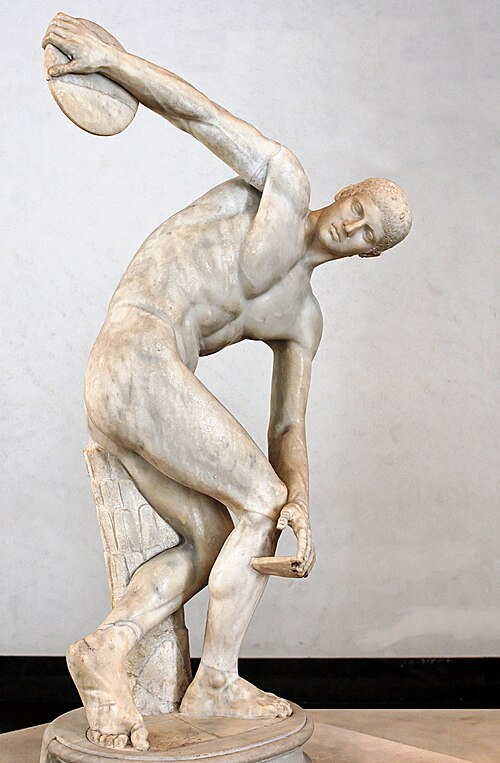
Myron’s bronzes are lost. What survives are Roman marble copies made centuries later and identified with the help of ancient descriptions. The best known is the Δισκοβόλος (Discus-thrower), whose original is dated to about 460–450 BC. In his dialogue Φιλοψευδής (The Lover of Lies), Lucian describes a statue of a discus-thrower bent over in the posture of the release, turned towards the hand holding the discus and gently bending one knee; his host confirms that it is one of Myron’s works. This description helped scholars recognise copies such as the Lancellotti Discobolus, found in Rome in 1781 and now in the National Roman Museum, and the Townley Discobolus, found at Hadrian’s Villa near Tivoli and now in the British Museum.
Pliny also lists a satyr admiring the flutes, together with Athena. It is usually identified with the bronze group of Athena and Marsyas that stood on the Athenian Acropolis around 450 BC; a marble copy of the Athena is in the Liebieghaus in Frankfurt. Most famous in antiquity was a bronze heifer, praised in many Greek epigrams as if it were alive. Pliny judged that Myron seems to have been the first to multiply realism, that he was more varied than Polykleitos and more careful about proportion, but that he did not express the feelings of the mind. His Discobolus catches a body in the instant between two movements.
Legacy in Greece today
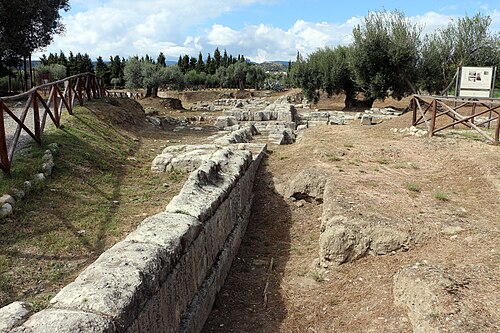
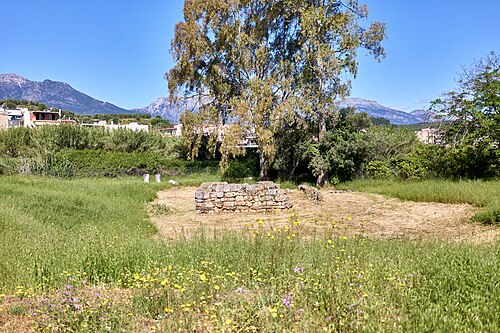
Myron’s bronzes are lost, but Greece keeps traces of his world. His birthplace Eleutherae lies near the Kaza pass, beside the old Athens–Thebes road, where visitors can walk to a later Athenian fortress of the fourth century BC. The word δισκοβόλος (discus-thrower) is still ordinary Modern Greek. Try this with a photograph of the Lancellotti Discobolus, a Roman copy: describe it in three Greek sentences, Σκύβει μπροστά (He bends forward), Λυγίζει το δεξί γόνατο (He bends his right knee) and Γυρίζει το κεφάλι προς τον δίσκο (He turns his head towards the discus). Then look at the Townley copy in the British Museum and add a fourth sentence: its head looks down because it was added later and does not belong to the statue.
Did you know?
- Pliny calls Myron a native of Eleutherae, while Pausanias calls him Myron of Athens.
- The Townley Discobolus in the British Museum carries a head that does not belong to it, restored looking down instead of back towards the discus.
- In one Greek epigram by Marcus Argentarius, Myron’s bronze heifer speaks and says the sculptor tied her up there.
- Myron’s son Lykios was also a sculptor whose bronze boy stood on the Acropolis.
Key works
| Greek title | Title | Year |
|---|---|---|
| Δισκοβόλος | Discobolus, the Discus-thrower (lost bronze; Roman marble copies) | c. 460–450 BC |
| Αθηνά και Μαρσύας | Athena and Marsyas, bronze group on the Acropolis (lost; Roman copies) | c. 450 BC |
| Δάμαλις | Bronze heifer, praised in Greek epigrams (lost) | 5th c. BC |
| Περσεύς | Perseus after killing Medusa, on the Acropolis (lost; seen by Pausanias) | 5th c. BC |
| Τιμάνθης ο Κλεωναίος | Statue of the pancratiast Timanthes of Kleonai at Olympia (lost) | 5th c. BC |
A line to remember
τὸν ἐπικεκυφότα κατὰ τὸ σχῆμα τῆς ἀφέσεως, ἀπεστραμμένον εἰς τὴν δισκοφόρον, ἠρέμα ὀκλάζοντα τῷ ἑτέρῳ
In today's GreekΑυτόν που σκύβει στη στάση της ρίψης, γυρισμένο προς το χέρι που κρατά τον δίσκο, και λυγίζει ελαφρά το ένα γόνατο.
ton epikekyphóta katá to schêma tês aphéseōs, apestramménon eis tēn diskophóron, ēréma okládzonta tôi hetérōi
The one bent over in the posture of the release, turned towards the hand that holds the discus, gently bending one knee.