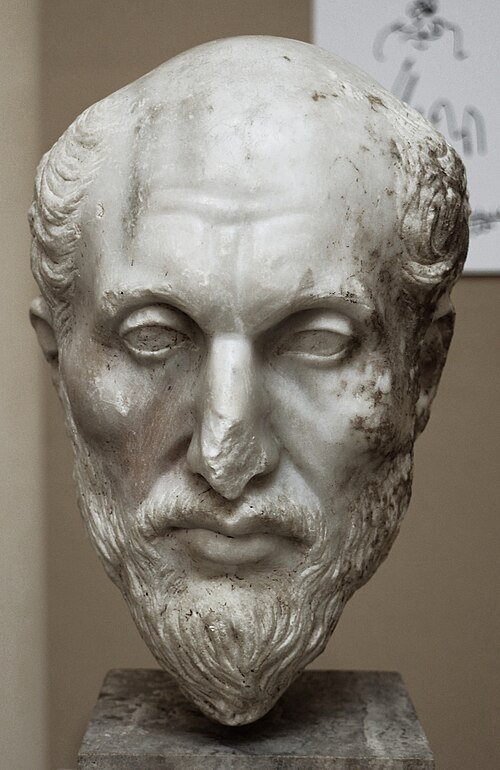
Life
Plotinus lived approximately from 204 or 205 to 270 AD. Much of his biography comes from Porphyry, a pupil who knew him in Rome and later wrote about his life and the ordering of his books. Porphyry reports that Plotinus avoided discussing his origins. An exact birthplace should therefore not be presented as an uncontested fact. What emerges more clearly is a career moving between centres of Greek intellectual life within the Roman Empire.
In Alexandria he studied with Ammonius Saccas. After joining the unsuccessful eastern expedition of Emperor GordianIII, he settled in Rome in 244 and taught there for many years. His circle discussed philosophical questions and earlier authors, especially Plato. Writing grew out of this teaching environment, rather than following a modern university timetable. Porphyry's account also explains why the books need an editor's history: individual discussions became a corpus that readers now encounter in a deliberately arranged sequence. Plotinus died in Campania in 270. We should distinguish the philosopher's own arguments from the admiring pupil's portrait. That portrait is invaluable evidence, but it selects incidents and gives the life a philosophical shape; it is not a neutral recording of every conversation.
Works

Plotinus understood himself as an interpreter of Plato. “Neoplatonism” is a later scholarly label, not the name he gave a new school. His philosophy distinguishes the One, Intellect and Soul: these are not three objects placed side by side, but principles used to explain unity, thought and the life of the world. Reading them requires attention to how an argument moves from visible things to what makes understanding possible.
In Περὶ τοῦ καλοῦ (On Beauty), he asks whether beauty can be explained simply by bodily proportion. He moves toward beauty of action and character, then asks the reader to examine the self, using the image of a sculptor shaping a statue. Περὶ εἱμαρμένης (On Fate) examines causation and responsibility; Περὶ ἀρετῶν (On Virtues) considers kinds of excellence. The final treatise, Περὶ τοῦ πρώτου ἀγαθοῦ καὶ τῶν ἄλλων ἀγαθῶν (On the Primary Good and Other Goods), returns to the good. Porphyry arranged 54 treatises in six groups of nine, the Enneads. Their published order differs from their order of composition. The selected works follow Porphyry's chronological list; the first three precede 263, while the last belongs to the final period. Precise individual dates should not be invented.
Legacy in Greece today
Plotinus is useful for learning how a familiar Greek word can carry a technical argument. Read the short quotation beside its modern rendering, then find σαυτόν and the modern εαυτό. In a paragraph from On Beauty, mark words of seeing and distinguish literal eyesight from intellectual understanding. Write two Greek sentences describing a beautiful object, then two explaining what makes an action admirable. This tests the passage's movement without reducing it to a slogan. A Greek edition with a modern translation lets you compare ψυχή and νους across registers. Consult the treatise numbers when borrowing a book: an Ennead number identifies the editorial arrangement, not necessarily the time of writing.
Did you know?
- Porphyry was both his pupil and the editor of his writings.
- The Enneads contain six groups of nine treatises.
- Their published order differs from chronological order.
- The surviving passage on beauty uses the image of a sculptor.
Key works
| Greek title | Title | Year |
|---|---|---|
| Περὶ τοῦ καλοῦ | On Beauty | before 263; no. 1 |
| Περὶ εἱμαρμένης | On Fate | before 263; no. 3 |
| Περὶ ἀρετῶν | On Virtues | before 263; no. 19 |
| Περὶ τοῦ πρώτου ἀγαθοῦ καὶ τῶν ἄλλων ἀγαθῶν | On the Primary Good and Other Goods | 269–270; no. 54 |
A line to remember
ἄναγε ἐπὶ σαυτὸν καὶ ἰδέ
In today's GreekΣτρέψου ξανά προς τον εαυτό σου και κοίτα.
anage epi sauton kai ide
Turn back toward yourself and look.