Life
Demosthenes was born in 384 BC in the Athenian deme of Paeania. His father owned a workshop of slaves making swords and couches and left a large estate when the boy was seven; the guardians, led by a relative named Aphobus, squandered most of it. The young man studied rhetoric, with the speech-writer Isaeus among his teachers, and at twenty sued his guardians in speeches that still survive. He won, recovered little money, and had found his profession: for years he earned his living as a logographer, writing speeches for clients to deliver in court.
Plutarch tells the stories every Greek child knows: that his first attempts in the assembly were laughed down for a weak voice and a stammer; that he built an underground study, shaved half his head so that shame would keep him indoors, practised with pebbles in his mouth and declaimed against the roar of the sea at Phaleron. By 354 BC he was speaking on public finance, and from 351, with the First Philippic, he had found his great subject: the rise of Philip II of Macedon.
He fought as a hoplite at Chaeronea in 338 BC, where Philip crushed Athens and Thebes. In 324 he was convicted of taking money from Alexander's fugitive treasurer Harpalus, imprisoned, and escaped into exile. Recalled after Alexander's death in 323, he saw the revolt of the Greek cities fail the next year. Hunted by the Macedonian regent Antipater, he took refuge in the temple of Poseidon on Calauria, modern Poros, and in October 322 BC took poison rather than be captured.
Works

Sixty-one speeches, some not genuine, have come down under his name, together with letters and prologues. The political speeches are the core. In the three Ολυνθιακοί (Olynthiacs, 349–348 BC) he begged Athens to save the city of Olynthus from Philip, in vain; in the four Φιλιππικοί (Philippics, 351–341 BC) he analysed, with a clarity his fellow citizens found tiresome, how the Macedonian king used money, speed and Greek disunity, and demanded that Athenians serve in person instead of hiring mercenaries. These speeches gave the word «philippic» to every European language for a fierce denunciation.
Περί του στεφάνου (On the Crown, 330 BC) is the summit. In 336 his friend Ctesiphon had proposed a golden crown for Demosthenes' services; his lifelong rival Aeschines prosecuted the proposal as illegal and, in effect, put Demosthenes' whole career on trial after the defeat it had led to. Demosthenes answered that a city with Athens' past could not have acted otherwise, swearing by the ancestors who had faced the Persians at Marathon, Salamis and Plataea that the fight for Greek freedom had been right even though it was lost. Aeschines failed to win a fifth of the votes and left Athens for good. Beside these stand the private speeches, a window onto Athenian family life, business and crime, and the Επιτάφιος for the dead of Chaeronea. His style joins long, carefully built periods with sudden short blows, questions, oaths and imagined dialogue; the ancient critics ranked him first among the ten Attic orators, and Cicero took him as his model.
Legacy in Greece today
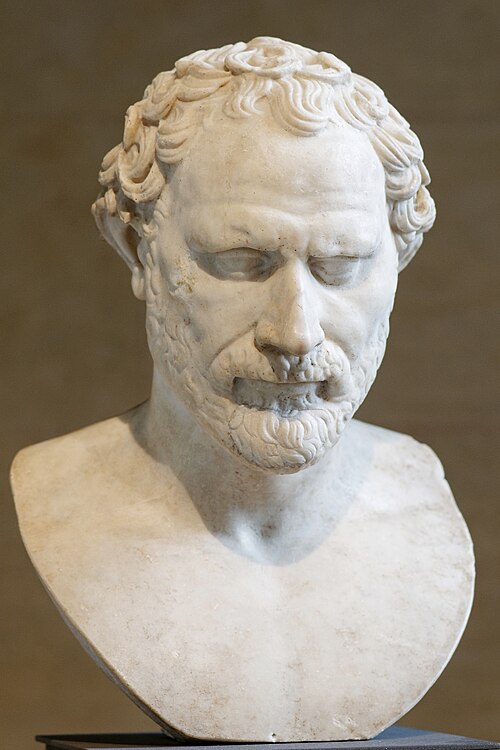
In Greek the adjective δημοσθένειος (Demosthenic) describes a speaker of overwhelming force, and «Φιλιππικός» is any violent political attack. The pebbles and the waves at Phaleron are told to every child who stammers or fears to speak in public, and his speech Υπέρ της Ροδίων ελευθερίας (For the Freedom of the Rhodians) has been a set text in the Greek lyceum. The ruins of the sanctuary of Poseidon where he died can be visited on Poros, above the town, and a street named Δημοσθένους runs through the centre of Athens. The famous standing statue of him, by Polyeuctus (280 BC), survives in Roman copies in the Vatican and Copenhagen, lips pressed together and hands clasped, the image of a man thinking before he speaks. Greek translations of On the Crown are in every bookshop, and the Greek text is free on Perseus.
Did you know?
- His first lawsuit, at the age of twenty, was against his own guardians, who had wasted the fortune his father left him; the speeches Against Aphobus survive.
- Aeschines, his great rival, lost the trial of the Crown so badly that he received less than a fifth of the votes, was fined, and left Athens to teach rhetoric on Rhodes.
- The word «philippic», a fierce denunciation, comes from his speeches against Philip; Cicero named his own attacks on Mark Antony Philippics in his honour.
- He died on the island of Poros, in the temple of Poseidon, by poison he had kept hidden in his reed pen, according to Plutarch.
Key works
| Greek title | Title | Year |
|---|---|---|
| Κατά Αφόβου | Against Aphobus (the lawsuit against his guardians) | 363 BC |
| Κατά Φιλίππου Α΄ (Α΄ Φιλιππικός) | First Philippic | 351 BC |
| Ολυνθιακοί | The Olynthiacs | 349–348 BC |
| Κατά Φιλίππου Γ΄ (Γ΄ Φιλιππικός) | Third Philippic | 341 BC |
| Περί του στεφάνου | On the Crown | 330 BC |
From the works


Public-domain pictures from Wikimedia Commons.
A line to remember
Οὐκ ἔστιν, οὐκ ἔστιν ὅπως ἡμάρτετε, ἄνδρες Ἀθηναῖοι, τὸν ὑπὲρ τῆς ἁπάντων ἐλευθερίας καὶ σωτηρίας κίνδυνον ἀράμενοι· οὐ μὰ τοὺς Μαραθῶνι προκινδυνεύσαντας τῶν προγόνων.
In today's GreekΌχι, δεν κάνατε λάθος, Αθηναίοι, που αναλάβατε τον κίνδυνο για την ελευθερία και τη σωτηρία όλων· όχι, μα τους προγόνους μας που πρώτοι κινδύνεψαν στον Μαραθώνα.
Ouk estin, ouk estin opos imartete, andres Athinaioi, ton yper tis apanton eleftherias kai sotirias kindynon aramenoi; ou ma tous Marathoni prokindynefsantas ton progonon.
No, you did not go wrong, men of Athens, when you took up the danger for the freedom and safety of all; no, by our ancestors who faced the danger first at Marathon.
From the original
The text as Demosthenes wrote it, out of copyright, with our own translation beside it.
«Περὶ τοῦ στεφάνου»On the Crown
The most famous moment of the speech. Eight years after the defeat at Chaeronea, Demosthenes defends the policy that led Athens to fight Philip: the choice was right even though it failed, and he swears it by the dead of the Persian Wars.
Περὶ τοῦ στεφάνου 207–208 (330 BC), the oath by the men of Marathon · Public-domain text, source: el.wikisource.org