Life
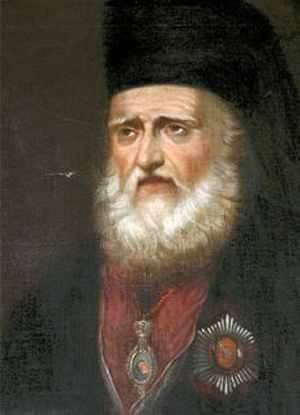
Voulgaris was born in Corfu in 1716, when the Ionian Islands were still Venetian; his baptismal name was Eleftherios, and he took the name Evgenios when he became a monk and deacon. He studied in Corfu and then at the University of Padua, where he learned Latin, Italian, mathematics and the new philosophy of Descartes, Leibniz and Locke, together with Newton's physics.
Back in the Greek world he became the most admired teacher of his time. In the 1740s he taught at the Maroutsis school in Ioannina, then at Kozani, and in 1753 the Patriarchate of Constantinople placed him at the head of the new Αθωνιάς Ακαδημία (Athonite Academy), a school founded beside the monastery of Vatopedi on Mount Athos. Students came from everywhere, among them the future missionary saint Kosmas Aitolos. But his teaching of modern philosophy alarmed conservative monks, and in 1759 he left. After a short period at the Patriarchal Academy in Constantinople he went to Germany, and in Leipzig he published his Logic in 1766.
In 1771 Catherine the Great invited him to Russia, where she was planning to support the Orthodox Greeks against the Ottomans. He served her as a scholar, translator and librarian, and from 1775 to 1779 was archbishop of the new diocese of Slaviansk and Kherson, created for Greek and Orthodox settlers in southern Ukraine. He then retired to Saint Petersburg, where he went on writing and translating until his death in 1806.
Works

Voulgaris's great contribution was to bring the European scientific revolution into Greek schools. Before him, Greek higher education rested almost entirely on Aristotle as interpreted by Byzantine and post-Byzantine commentators. Voulgaris taught Aristotle too, but beside him he placed Descartes, Leibniz, Wolff and Locke, and the physics and mathematics of Newton. His Η Λογική (Logic, 1766), printed in Leipzig, gathers the logic of the ancients and the moderns in a single systematic work, and it became a key textbook of the Greek Enlightenment.
He wrote in a learned, archaising Greek, close to the ancient language, and he was a champion of that style: in his view the dignity of the nation lay in continuity with ancient Greek. He translated Virgil's Georgics and Aeneid into Homeric hexameters, and in Russia he wrote treatises on theology, mathematics and astronomy; his Στοιχεία της Μεταφυσικής (Elements of Metaphysics) appeared in Venice in 1805, a year before his death.
He also translated an essay by Voltaire into Greek in 1768, but in later life he became a defender of Orthodox tradition and an opponent of the radical Enlightenment and the French Revolution. This double face, the modernising teacher and the conservative churchman, makes him a key figure of an age when Greeks were deciding how much of Europe they wanted.
Legacy in Greece today
Voulgaris is a name every student of Greek intellectual history meets, usually beside Nikiforos Theotokis, his fellow Corfiot, as the founders of the Greek Enlightenment, a movement continued by Rigas Velestinlis and Adamantios Korais. Corfu remembers him as one of its great sons, and Greek universities still study and republish his works. The ruins of the Athonite Academy can still be seen above the monastery of Vatopedi on Mount Athos. For a learner, reading the title page of his Logic is a quick lesson in how different the learned Greek of the eighteenth century was from today's language, and why the language question would divide Greece for two hundred years.
Did you know?
- His birth name was Eleftherios; Evgenios was the name he took as a monk.
- Among his students at the Athonite Academy was Kosmas Aitolos, later one of the best-loved saints of Greek Orthodoxy.
- He translated Virgil's Latin epics into Homeric-style Greek hexameters.
- He was archbishop of a diocese in southern Ukraine created by Catherine the Great.
Key works
| Greek title | Title | Year |
|---|---|---|
| Διευθυντής της Αθωνιάδας Ακαδημίας | Head of the Athonite Academy, Mount Athos | 1753–1759 |
| Η Λογική | Logic | 1766 |
| Μετάφραση δοκιμίου του Βολταίρου | Translation of an essay by Voltaire | 1768 |
| Αρχιεπίσκοπος Σλαβωνίου και Χερσώνος | Archbishop of Slaviansk and Kherson | 1775–1779 |
| Μεταφράσεις των Γεωργικών και της Αινειάδας του Βιργιλίου | Translations of Virgil's Georgics and Aeneid | 1786–1792 |
From the works


Public-domain pictures from Wikimedia Commons.
A line to remember
Ἡ Λογικὴ ἐκ παλαιῶν τε καὶ νεωτέρων συνερανισθεῖσα
In today's GreekΗ Λογική, συγκεντρωμένη από παλαιούς και νεότερους συγγραφείς
I Logiki ek palaion te kai neoteron syneranistheisa
Logic, gathered from the ancients and the moderns