Life
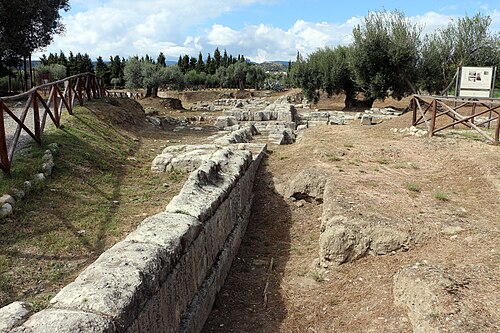
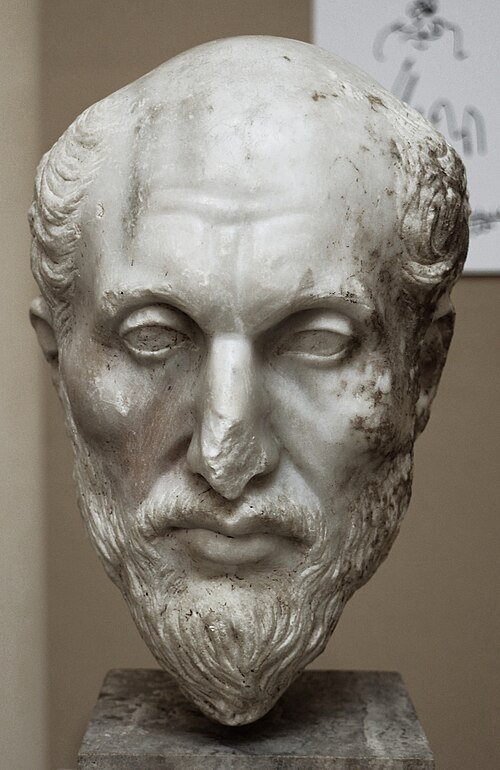
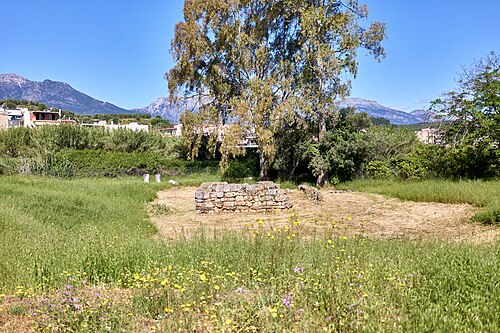
Almost nothing is known about Stobaeus apart from his book. His surname, Στοβαῖος, means “from Stobi”, an ancient city of the Roman province of Macedonia whose ruins lie near Gradsko in today’s North Macedonia. The ninth-century Byzantine scholar Photius, who read the complete work, calls him Ἰωάννης ὁ Στοβαῖος (John of Stobi) and remains our main witness. Stobaeus quotes writers of the fourth century AD, such as Iamblichus and Themistius, so he cannot be earlier than them. He is usually placed in the fifth century, but scholars disagree on whether he worked early or late in it.
According to Photius, Stobaeus addressed the collection to his own son, Septimius. He says he gathered the excerpts to shape and improve the boy’s nature, which was rather weak at remembering what he read. Some modern scholars doubt that this explains the whole work, which seems too large and learned to be only a father’s schoolbook. His first name, Ioannes, was common among Christians, yet he quotes no Christian writers, so his religion remains uncertain. Nothing reliable is known about his teachers, his career or the date of his death.
Works

Photius describes the Anthology (Ἀνθολόγιον) as four books in two volumes of “extracts, sayings and precepts”, with 208 chapters in all. Book 1 deals mostly with nature and the cosmos: God, fate, time, the stars and the senses. Book 2 begins with language, rhetoric and poetry and then turns to ethics. Books 3 and 4 cover virtues and vices, then the city, marriage, children, wealth, old age and death. Each chapter has a heading, often in the form Περὶ… (On…), and under it come the excerpts, each introduced by a short label naming the author and often the work.
Book 3, chapter 21, Περὶ τοῦ Γνῶθι σαυτόν (On “Know Thyself”), shows the method. It opens with a line by the comic poet Philemon: “Being human, know this and always remember it.” A few entries later, under the label Μενάνδρου Θρασυλέοντος (Menander, from Thrasyleon), a speaker even objects that “know others” would have been more useful advice. The words belong to Menander; Stobaeus only chose them and placed them beside the famous motto. Medieval copyists split the work into the Eclogues (Books 1–2) and the Florilegium (Books 3–4), and some parts survive only in shortened form. Even so, it preserves many lines from lost plays, especially by Euripides, and sayings of philosophers such as Democritus.
Legacy in Greece today
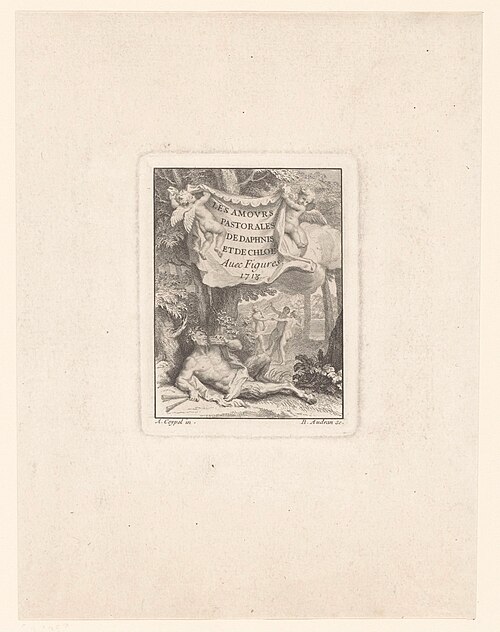
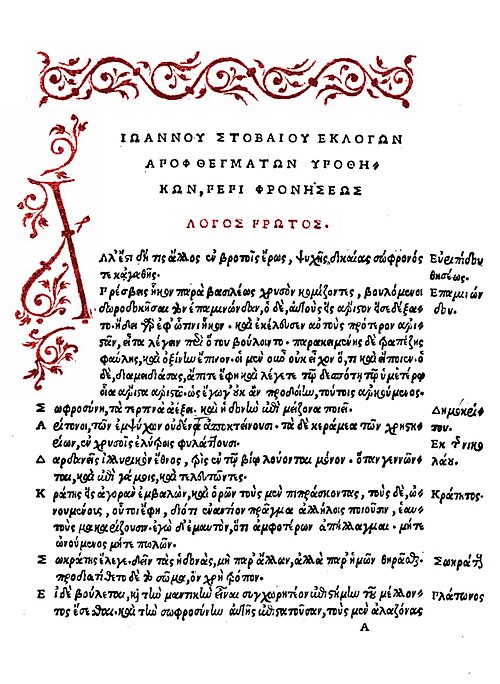
Stobaeus left Modern Greek a ready-made frame for talking about texts. Ανθολογία comes from Hellenistic ἀνθολογία, “a gathering of flowers”, and today names any collection of poems or prose, from anthologies of Modern Greek poetry to the Palatine Anthology. Γνώθι σαυτόν, the motto of his chapter 21, is still a familiar Greek saying. The ruins of Stobi, with their Roman theatre, can be visited near Gradsko in North Macedonia. Try this: look at the 1536 Venice page shown with this profile and find the source labels Εὐριπίδου (of Euripides) and Πλάτωνος (of Plato) in the right margin. Then write two Modern Greek sentences that keep the voices apart: Το απόσπασμα είναι του Μενάνδρου (The excerpt is by Menander) and Ο Στοβαίος το επέλεξε και το ταξινόμησε (Stobaeus chose it and arranged it).
Did you know?
- Photius counted 208 chapters across the four books of the Anthology.
- Conrad Gesner’s Latin translation, printed in Zurich in 1543, advertised about 250 quoted authors; later scholars counted more than 500.
- The Eclogues were first printed in Greek only in 1575, at Christophe Plantin’s press, almost forty years after the Florilegium appeared in Venice in 1536.
- Chapter 21 also retells a story from Aelian: after defeating the Athenians at Chaeronea, Philip II of Macedon had a servant remind him every morning that he was human.
Key works
| Greek title | Title | Year |
|---|---|---|
| Ἀνθολόγιον, βιβλίο Α΄ | Anthology, Book 1 — God, fate, nature and the cosmos | 5th c. AD |
| Ἀνθολόγιον, βιβλίο Β΄ | Anthology, Book 2 — language, poetry and ethics, partly shortened | 5th c. AD |
| Ἀνθολόγιον Γ΄ 21: Περὶ τοῦ Γνῶθι σαυτόν | Anthology 3.21 — On “Know Thyself”: Philemon, Menander, Aelian | 5th c. AD |
| Ἀνθολόγιον, βιβλίο Δ΄ | Anthology, Book 4 — city, marriage, family, old age and death | 5th c. AD |
A line to remember
Χρήσιμον δὲ τὸ βιβλίον τοῖς μὲν ἀνεγνωκόσιν αὐτὰ τὰ συντάγματα τῶν ἀνδρῶν πρὸς ἀνάμνησιν
In today's GreekΤο βιβλίο είναι χρήσιμο σε όσους έχουν διαβάσει τα ίδια τα έργα αυτών των ανδρών, για να τα θυμούνται.
Chrḗsimon dè tò biblíon toîs mèn anegnōkósin autà tà syntágmata tō̂n andrō̂n pròs anámnēsin
The book is useful, as a reminder, to those who have read the works of these men themselves.