Life
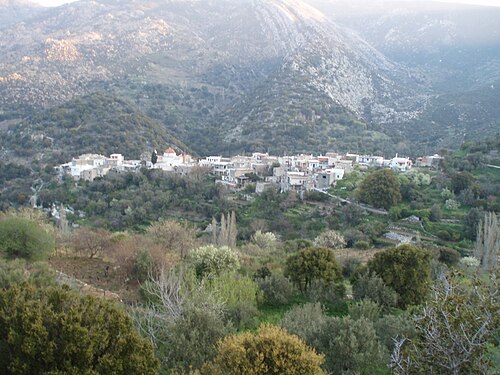
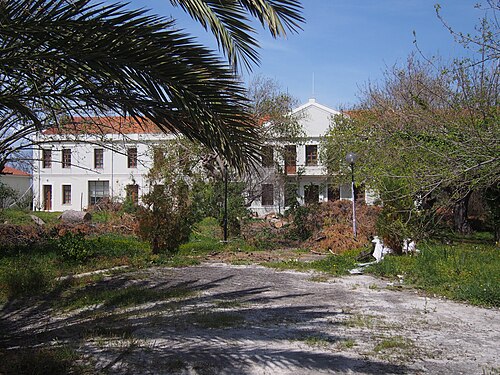
Alkyoni Papadaki was born in Nio Chorio (also written Niochori), a village just outside Chania in western Crete; her publishers’ biographies do not give a birth year. She grew up in what she calls a red house, which later gave its title to her first book. Her father was a teacher who had been wounded in the war in Albania, and her mother and grandparents were teachers too. In the tense years after the Civil War, when she was about three, her parents and grandparents were imprisoned because her mother’s brother had joined the left-wing guerrillas. As a teenager she insisted on boarding at the French school of Saint Joseph in Chania, where she read Nikos Kazantzakis.
After school she left for Athens. She passed the entrance exams for Panteion University but never attended, choosing journalism courses instead. A bold letter to the publisher Christos Lambrakis brought her an apprenticeship at the newspaper Τα Νέα (Ta Nea) under Nikos Kakaounakis. When the critic Tasos Vournas reviewed her manuscript Το κόκκινο σπίτι (The Red House), the newspaper Αυγή (Avgi) took her on as a reporter.
She worked there until the dictatorship of 1967, then spent a short time in Paris; because of a police file, she was later refused a passport. From her mid-forties she has published a novel roughly every two years, first with Kalendis and since 2018 with Dioptra.
Works

Papadaki wrote Το κόκκινο σπίτι (The Red House) at about nineteen and paid for its first printing herself; the book is openly autobiographical, drawing on the Cretan house of her childhood. Her publisher’s list dates the Kalendis edition to 1988, followed by Η μπόρα (The Storm, 1989). Her best-known novel, Το χρώμα του φεγγαριού (The Colour of the Moon), appeared in the early 1990s; catalogues give 1991 or 1995. It follows Fotis, a young man from an island, and Marouso, a girl from Athens, whose love is true but fatal once he moves to the city. It has been reissued many times, most recently by Dioptra.
Later novels include Οι κάργιες (The Jackdaws, 1997), Θα ξανάρθουν τα χελιδόνια (The Swallows Will Return, 2015) and Το χαμόγελο του δράκου (The Dragon’s Smile, 2018), a lyrical novel about the endless contest between mother and daughter and about betrayal in love. In Το τετράδιο της Αλκυόνης (Alkyoni’s Notebook) and Ξεφυλλίζοντας τη σιωπή (Leafing Through Silence), both from 2004, her prose comes closest to poetry.
Her style is personal and confessional. She writes by hand and says she must study her characters well before a story can begin. She finds the word συγγραφέας (author) too heavy: she calls herself a λογοτέχνης (literary artist) and a craftswoman of literature.
Legacy in Greece today
Papadaki belongs to the popular side of Greek fiction: her novels sell steadily and draw queues at book signings. In Τα Νέα the critic Michela Chartoulari called her the reader’s “little friend”, and Manolis Pimplis noted that readers wait patiently for her signature. In the early 2020s Dioptra reissued twelve of her books with new painted covers, so titles from the 1990s are easy to find again in Greek bookshops. In a 2018 interview she said that words have lost much of their weight and that we must keep our language alive.
Try this: take the title Το χρώμα του φεγγαριού and write three original observations of your own with το χρώμα του… or το χρώμα της… (the colour of…), such as το χρώμα της σιωπής (the colour of silence). Then explain in one Greek sentence why she prefers μαστόρισσα (craftswoman) to συγγραφέας (author).
Did you know?
- Her first manuscript, The Red House, won her a job: after the critic Tasos Vournas reviewed it, the newspaper Avgi hired her.
- Her plan to study in Paris was blocked: because she had written for Avgi, the police held a file on her and refused her a passport.
- At the French school in Chania she was the rare boarder who felt low, not happy, when it was time to go home.
- She writes her manuscripts by hand.
Key works
| Greek title | Title | Year |
|---|---|---|
| Το κόκκινο σπίτι | The Red House — autobiographical first book | 1988 |
| Η μπόρα | The Storm — novel | 1989 |
| Το χρώμα του φεγγαριού | The Colour of the Moon — novel | early 1990s |
| Οι κάργιες | The Jackdaws — novel | 1997 |
| Θα ξανάρθουν τα χελιδόνια | The Swallows Will Return — novel | 2015 |
| Το χαμόγελο του δράκου | The Dragon’s Smile — novel | 2018 |
A line to remember
Πάντα θεωρούσα τον εαυτό μου μαστόρισσα της λογοτεχνίας και ποτέ συγγραφέα.
Pánta theoroúsa ton eaftó mou mastórissa tis logotechnías ke poté syngraféa.
I have always considered myself a craftswoman of literature, and never an author.