Life
Of Euclid's life almost nothing is known, not even where he was born. The main witness is Proclus, a philosopher writing in Athens around AD 450, who says that Euclid lived in the time of Ptolemy I, the general of Alexander who ruled Egypt from 323 BC, that he was younger than the pupils of Plato and older than Eratosthenes and Archimedes, and that he gathered the work of earlier geometers into the Elements. From this his working life is placed around 300 BC, in Alexandria, the new capital where Ptolemy was founding the Museum and the Library. He probably studied in Athens with Plato's successors, and Pappus, writing in the fourth century AD, describes him as gentle and modest towards anyone who could advance mathematics.
Two anecdotes stand in for a biography. Proclus tells that Ptolemy asked Euclid whether there was a shorter way to learn geometry than the Elements, and Euclid answered that there is no royal road to geometry. Stobaeus tells that a young man who had just learned his first theorem asked what he would gain from it, and Euclid told his slave to give the boy a coin, since he had to make a profit from what he learned. The dates given for his birth and death, around 325 and 265 BC, are guesses.
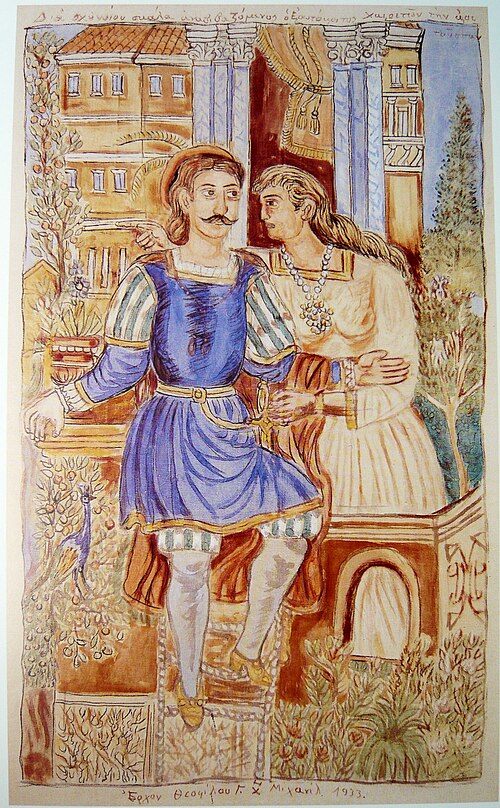
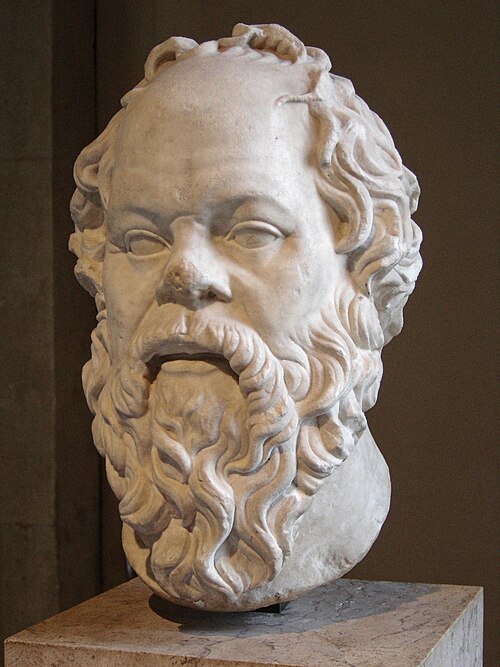
He should not be confused with Euclid of Megara, a pupil of Socrates who lived a century earlier; medieval and Renaissance editions printed the philosopher's name and biography on the mathematician's book for hundreds of years.
Works

The Στοιχεία (Elements) are thirteen books, and their method is their fame. Book I opens with twenty-three definitions («A point is that which has no part»), five postulates (a straight line can be drawn between any two points; all right angles are equal; and the famous fifth, on parallels) and five common notions (things equal to the same thing are equal to each other). From these alone, every proposition is proved from what came before, each ending with the words ὅπερ ἔδει δεῖξαι, «which was to be shown», the Latin QED. Book I ends with Pythagoras's theorem. Books II–VI treat areas, circles, polygons and proportion; Books VII–IX are number theory, with the Euclidean algorithm for the greatest common divisor and the proof, in IX.20, that there are infinitely many prime numbers; Book X is a long study of irrational quantities; Books XI–XIII are solid geometry, ending with the construction of the five regular solids.
Little of the mathematics was Euclid's own discovery; his achievement was the order. He also wrote the Δεδομένα (Data), on what follows from given quantities, the Ὀπτικά (Optics), the first geometrical treatment of perspective, the Φαινόμενα on the geometry of the heavens, and lost works on conics and porisms. The Elements were translated into Arabic in the ninth century and from Arabic into Latin in the twelfth, printed for the first time in Venice in 1482, and taught, often unchanged, until the twentieth century. The fifth postulate, which seemed less obvious than the others, was attacked for two millennia until Lobachevsky and Bolyai, in the 1820s and 1830s, showed that denying it gives consistent non-Euclidean geometries, the mathematics Einstein would later need.
Legacy in Greece today
In Greek lyceums the geometry course is still called Ευκλείδεια Γεωμετρία, and pupils prove theorems in Euclid's order, with the same words: υπόθεση, απόδειξη, όπερ έδει δείξαι. The Hellenic Mathematical Society publishes its magazines for pupils under the name Ευκλείδης and names a round of its national competition after him. There is an Ευκλείδου street in central Athens and in most Greek towns. Beyond Greece, the European Space Agency's telescope launched in 2023 to map the geometry of the universe is called Euclid, and a crater on the Moon bears his name. A learner who wants to read the first page of the Elements in the original will find the Greek of the definitions short, concrete and, with a little help, readable.
Did you know?
- Asked by King Ptolemy for a quicker way to learn geometry, he is said to have answered that there is no royal road to geometry.
- For centuries his book carried the life story of the wrong man, Euclid of Megara, a philosopher who lived a hundred years earlier.
- The Elements were first printed in Venice in 1482, with the diagrams in the margins, and have been reissued in more than a thousand editions since.
- Abraham Lincoln said he had mastered the first six books of Euclid in order to learn what it means to demonstrate something.
Key works
| Greek title | Title | Year |
|---|---|---|
| Στοιχεία | Elements (13 books) | c. 300 BC |
| Δεδομένα | Data | c. 300 BC |
| Οπτικά | Optics | c. 300 BC |
| Φαινόμενα | Phaenomena (spherical astronomy) | c. 300 BC |
| Κατατομή κανόνος | Division of the Scale (on musical intervals, attributed) | c. 300 BC |
From the works


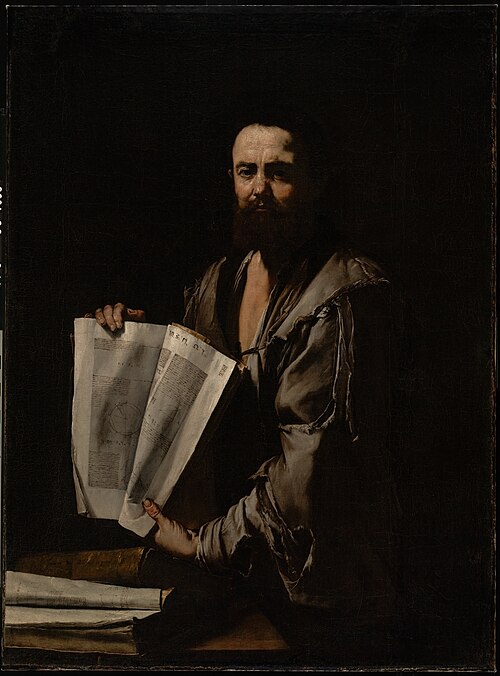
Public-domain pictures from Wikimedia Commons.
A line to remember
Σημεῖόν ἐστιν, οὗ μέρος οὐθέν. Γραμμὴ δὲ μῆκος ἀπλατές.
In today's GreekΣημείο είναι αυτό που δεν έχει μέρη. Γραμμή είναι μήκος χωρίς πλάτος.
Simeion estin, ou meros outhen. Grammi de mikos aplates.
A point is that which has no part. A line is length without breadth.
From the original
The text as Euclid wrote it, out of copyright, with our own translation beside it.
«Στοιχεῖα»Elements
The opening of Book I of the Elements: the first seven definitions and the five postulates on which the whole of Euclid's geometry is built. The fifth, the parallel postulate, was debated for two thousand years until non-Euclidean geometry was discovered.
Στοιχεῖα, Book I: Definitions 1–7 and Postulates 1–5 (c. 300 BC) · Public-domain text, source: el.wikisource.org