Life
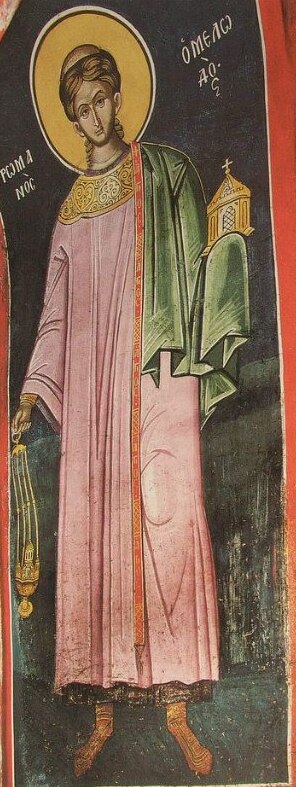
What is known of Romanos comes from a few lines in Byzantine church calendars and from his own hymns. He was born around 490 in Emesa in Syria, today's Homs, possibly to a family of Jewish origin, as some later sources say. He served as a deacon at the Church of the Resurrection in Berytus, modern Beirut, and in the reign of Anastasius I (491–518) he moved to Constantinople, where he was attached to the Church of the Theotokos in the district called τὰ Κύρου (ta Kyrou). He seems to have spent the rest of his life there, in the capital of Justinian, in the years when Hagia Sophia was being built.
The legend of his calling is told in the synaxarion for his feast day. Romanos, it says, had a poor voice and no talent for singing, and was mocked by the other clergy. On Christmas Eve he fell asleep in church and the Virgin appeared to him holding a scroll, and told him to eat it. He swallowed it, woke, mounted the ambo and sang, for the first time, «Ἡ Παρθένος σήμερον τὸν ὑπερούσιον τίκτει». The story is an image of inspiration, like Ezekiel eating the book, but it tells us how the Byzantines thought of him: as a singer first and a theologian second.
He died in the 550s and was buried in the church where he had served. Tradition credits him with a thousand kontakia; around eighty survive under his name, of which some sixty are considered genuine. The Orthodox Church honours him as a saint.
Works

The kontakion is a sermon in song. It opens with a short prelude (προοίμιον) in its own melody, then unfolds in eighteen to twenty-four long stanzas called οἶκοι (houses), all built on the same metrical pattern, each ending in the same refrain that the congregation sang back. The first letters of the stanzas form an acrostic, often «τοῦ ταπεινοῦ Ῥωμανοῦ» (of the humble Romanos). The verse is not classical: it is rhythmic, based on the stress accents of the spoken Greek of the day, and the language is the clear Greek of the Bible and the liturgy, full of dialogue and dramatic turns.
Romanos's subjects are the feasts of the church year and the stories of the Bible, but he tells them as drama. In the kontakion on the Nativity the Virgin speaks with the Magi; in the one on Mary at the Cross she argues with her son, who explains why he must die; Judas, Peter, the Prodigal Son, Lazarus, the Ten Virgins and the Three Children in the furnace all have their own poems, each a small play with voices. The prelude of the Nativity kontakion, Ἡ Παρθένος σήμερον, became and remains the hymn of Orthodox Christmas, and the short hymn «Ψυχή μου, ψυχή μου, ἀνάστα, τί καθεύδεις;» (My soul, my soul, arise, why do you sleep?), sung in Lent with the Great Canon, is also attributed to him. Whether he also wrote the Akathist Hymn, «Τῇ ὑπερμάχῳ στρατηγῷ», is debated, and many scholars think not. In the eighth century the canon displaced the kontakion in church, and only the preludes and first stanzas of his poems stayed in use; scholars recovered the full texts from manuscripts in modern times.
Legacy in Greece today
Any Greek who goes to church at Christmas hears Romanos: «Ἡ Παρθένος σήμερον» is sung on 25 December and broadcast on radio and television, and its last line, «παιδίον νέον, ὁ πρὸ αἰώνων Θεός» (a new child, the God before the ages), is as familiar as a carol. The Orthodox Church keeps his feast on 1 October, together with the Protection of the Virgin, and church singers (ψάλτες) regard him as their patron; schools of Byzantine music and choirs across Greece and Cyprus carry his name. Extracts from his hymns appear in the lyceum anthology of Modern Greek literature, whose first pages are Byzantine. A learner can listen to a recording of the Christmas kontakion and follow the Greek, which is surprisingly close to the modern language, or read the Nativity hymn in a bilingual edition.
Did you know?
- He hid his signature in his poems: the first letters of the stanzas often spell «τοῦ ταπεινοῦ Ῥωμανοῦ», «of the humble Romanos».
- Of the thousand kontakia that tradition attributes to him, only about eighty survive, and his full poems were unknown to most readers until scholars printed them from manuscripts in modern times.
- According to the legend, he could not sing until the Virgin made him swallow a scroll in a dream on Christmas Eve.
- His feast day, 1 October, is shared with the Protection of the Theotokos, one of the most popular feasts in Greece.
Key works
| Greek title | Title | Year |
|---|---|---|
| Κοντάκιον εις την Χριστού Γέννησιν («Η Παρθένος σήμερον») | Kontakion on the Nativity (Today the Virgin) | 6th century |
| Κοντάκιον εις την Μαρίαν παρά τω Σταυρώ | Kontakion on Mary at the Cross | 6th century |
| Κοντάκιον εις τον Ιούδαν | Kontakion on Judas | 6th century |
| Κοντάκιον εις τον Άσωτον υιόν | Kontakion on the Prodigal Son | 6th century |
| Κοντάκιον εις τας δέκα παρθένους | Kontakion on the Ten Virgins | 6th century |
| «Ψυχή μου, ψυχή μου, ανάστα» (αποδίδεται) | My Soul, My Soul, Arise (attributed) | 6th century |
From the works


Public-domain pictures from Wikimedia Commons.
A line to remember
Ἡ Παρθένος σήμερον τὸν ὑπερούσιον τίκτει, καὶ ἡ γῆ τὸ σπήλαιον τῷ ἀπροσίτῳ προσάγει· ἄγγελοι μετὰ ποιμένων δοξολογοῦσι, μάγοι δὲ μετὰ ἀστέρος ὁδοιποροῦσι· δι' ἡμᾶς γὰρ ἐγεννήθη παιδίον νέον, ὁ πρὸ αἰώνων Θεός.
In today's GreekΗ Παρθένος σήμερα γεννά τον υπερούσιο, και η γη προσφέρει το σπήλαιο στον απρόσιτο· άγγελοι μαζί με βοσκούς δοξολογούν, και μάγοι με το αστέρι πορεύονται· γιατί για μας γεννήθηκε παιδί νέο, ο προαιώνιος Θεός.
I Parthenos simeron ton yperousion tiktei, kai i gi to spilaion to aprosito prosagei· angeloi meta poimenon doxologousi, magoi de meta asteros odoiporousi· di' imas gar egennithi paidion neon, o pro aionon Theos.
Today the Virgin gives birth to him who is beyond being, and the earth offers the cave to him whom none can approach; angels with shepherds give glory, and magi journey with the star; for to us has been born a new child, the God before the ages.
From the original
The text as Romanos the Melodist wrote it, out of copyright, with our own translation beside it.
«Ἡ Παρθένος σήμερον»Today the Virgin
The prooimion and first oikos of Romanos' kontakion on the Nativity, still sung at Christmas. The full hymn ran to 24 stanzas, each ending with the same refrain, the God before all ages; the text is as the Christmas Orthros service gives it.
Κοντάκιον εἰς τὴν Χριστοῦ Γέννησιν (6th century), prooimion and first oikos, as sung at the Christmas Orthros · Public-domain text, source: el.wikisource.org