Life
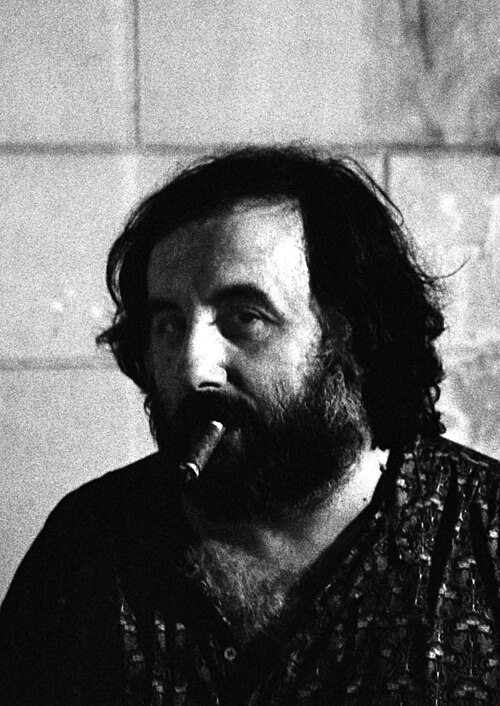
Kounellis was born in Piraeus on 23 March 1936 and grew up in the port city in the hard years of the Occupation and the Civil War; the ships, the sacks, the coal and the iron of the harbour stayed with him all his life. In 1956, at twenty, he left Greece for Rome to study at the Accademia di Belle Arti, and Rome became his home. He never stopped feeling Greek, but he made his career in Italy, in the circle of artists, critics and gallery owners that gathered in Rome in the 1960s.
His first solo exhibition, L'Alfabeto di Kounellis at the Galleria La Tartaruga in Rome in 1960, showed large canvases covered with letters, numbers and signs, a painted alphabet. In 1967 the critic Germano Celant gave the name Arte Povera, "poor art", to a group of young Italian artists who rejected traditional painting and sculpture, and Kounellis became one of its central members, beside Mario Merz, Michelangelo Pistoletto and others. From then on he exhibited all over Europe and the Americas, and in 1994 he returned to Greece with a famous installation on the ship Ιόνιον in the harbour of Piraeus. He remained active into his eighties, creating large installations in churches, factories and museums. He died in Rome on 16 February 2017, and Greek and Italian newspapers alike mourned him as one of their own.
Works

Kounellis began as a painter and always said that he remained one, even when he stopped using canvas. His early "alphabets", canvases with large stencilled letters, already turned painting into a kind of performance: from 1960 he took part physically in his own exhibitions at the Galleria La Tartaruga in Rome. From 1967 he brought living and raw things into the gallery: a live parrot perched in front of a painted panel, cacti, sacks of coal, wool, a gas flame shaped like a flower. The most famous of these works is the untitled installation of January 1969 at the Galleria L'Attico in Rome, in which twelve live horses stood tied along the walls for the days of the exhibition. The horses were not a symbol of anything simple; they were a living presence, a piece of reality and of the ancient world, placed where people expected pictures.
In the 1970s and after, his language grew darker and heavier: doorways blocked with stones, steel plates hung with coats and hats, bed frames, sacks, fire and the soot left by fire, fragments of classical statues. These works speak of the crisis of European culture after the war, of exile and of memory, but always through physical matter rather than explanation. Critics often compare them to theatre, and Kounellis indeed loved the stage: he worked on theatrical productions and turned many of his exhibitions into events. Through all of them runs a Greek thread, the sea, the port, the ancient fragments, the sense of tragedy.
Legacy in Greece today
Kounellis is one of the few Greek artists of the twentieth century with a truly international place in art history; his works are in major museums in Europe and America, and every history of Arte Povera discusses the horses of 1969. In 2019 the Fondazione Prada in Venice devoted a large retrospective to him. In Greece he is seen as a bridge between the Greek tradition and the European avant-garde, and young Greek artists still look to his example. If you visit a museum of contemporary art and see sacks of coal or a steel wall with a single flame, you may be looking at a Kounellis. Reading about him is also a good way to practise the Greek vocabulary of contemporary art.
Did you know?
- He left Piraeus for Rome at twenty and lived in Italy for the rest of his life.
- In 1969 he exhibited twelve live horses in the Galleria L'Attico in Rome, then housed in a former garage.
- His first solo show, in 1960, was called L'Alfabeto di Kounellis (Kounellis's Alphabet).
- In 1994 he made an installation on a ship in the port of Piraeus, the harbour where he grew up.
Key works
| Greek title | Title | Year |
|---|---|---|
| Τα «αλφάβητα» | The "alphabet" paintings | 1958–1960s |
| Χωρίς τίτλο (Παπαγάλος) | Untitled (Parrot) | 1967 |
| Μαργαρίτα της φωτιάς | Daisy of Fire (Margherita di fuoco) | 1967 |
| Χωρίς τίτλο (12 άλογα) | Untitled (12 Horses), Galleria L'Attico, Rome | 1969 |
| Εγκατάσταση στο πλοίο «Ιόνιον», Πειραιάς | Installation on the ship Ionion, Piraeus | 1994 |
From the works

Public-domain pictures from Wikimedia Commons.
A line to remember
Θέλω την επιστροφή της ποίησης μ' όλα τα μέσα: με την άσκηση, την παρατήρηση, τη μοναξιά, το λόγο, την εικόνα, την εξέγερση.
Thelo tin epistrofi tis poiisis m' ola ta mesa: me tin askisi, tin paratirisi, ti monaxia, to logo, tin eikona, tin exegersi.
I want the return of poetry by every means: through practice, observation, solitude, speech, the image, revolt.