Life
Almost everything known about Athenaeus comes from his own book. He came from Naucratis, an old Greek trading city in the Nile Delta, and in one passage he calls its people “my Naucratites”. He lived and wrote in Rome in the late second and early third centuries AD. He mentions the emperor Commodus, who died in 192, as belonging to his own time, so the work was finished after that year. Some scholars identify the dialogue’s chief speaker, Ulpian of Tyre, with the famous jurist Ulpian, who died in the 220s, and therefore date the book later; this identification remains uncertain.
The Deipnosophists also mentions two earlier works by Athenaeus, both now lost: a history of the kings of Syria and a short study of a fish named in Archippus’s comedy Ἰχθύες (Fishes). The dinner is hosted by Larensis, a distinguished Roman, and the guests include grammarians, philosophers, musicians and the physician Galen of Pergamon as a character. Athenaeus tells the whole story to his friend Timocrates, framing it in the manner of a Platonic dialogue. Nothing reliable is known about his family, his teachers or the date of his death.
Works

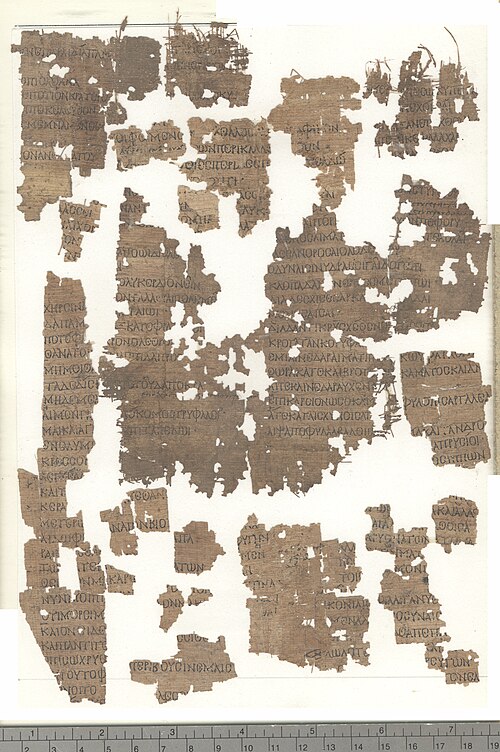
Δειπνοσοφισταί survives in fifteen books. The oldest complete manuscript, probably copied in the tenth century and now in Venice, has lost the first two books, the start of the third and passages of Books 11 and 15; those parts are known from a shorter epitome. The epitome says that the arrangement of the book imitates the lavishness of the dinner. Topics follow the table and the conversation: breads in Book 3, fish in Book 7, love and famous women in Book 13, garlands in Book 15. Each topic becomes a contest of quotation, as guests answer one another with lines from comedy, history, medicine and poetry.
In Book 7 the narrator promises Timocrates to list the fish alphabetically so that he can remember them. In Book 3 the guest Pontianus quotes Archestratus, a fourth-century BC poet of fine eating, who praises the barley of Eresos on Lesbos and the market bread of Athens. Athenaeus notes that this poem circulated under several titles, among them Γαστρονομία (Gastronomy) and Ἡδυπάθεια (Life of Pleasure). The layers matter: Archestratus wrote the verses, Pontianus is a character who quotes them, and Athenaeus composed the whole conversation. The surviving fragments of Archestratus, and many lines of lost comedies by poets such as Alexis and Antiphanes, are read today largely through such quotations.
Legacy in Greece today
Athenaeus’s table still sits inside everyday Greek. Δείπνο (dinner) is the ancient δεῖπνον, and ψάρι (fish) comes from ὀψάριον, a diminutive of ὄψον, a word for cooked food that the guests discuss in Book 7. Eresos, whose barley Archestratus praised, is still a village on Lesbos. Try this: reread the sentences about Archestratus’s bread verses in the Modern Greek passage on this page. Then write a Modern Greek menu of five dishes in alphabetical order, as Athenaeus did with his fish. Add two sentences of reported speech: Ο Αρχέστρατος γράφει ότι το καλύτερο κριθάρι βγαίνει στην Ερεσό (Archestratus writes that the best barley comes from Eresos) and Ο Ποντιανός παραθέτει τους στίχους του (Pontianus quotes his verses).
Did you know?
- The word δειπνοσοφιστής joins δεῖπνον (dinner) and σοφιστής (expert or sophist).
- The physician Galen of Pergamon appears among the guests as a character, delaying the meal with a talk on breads.
- Athenaeus says he arranged the fish of Book 7 alphabetically to make them easier to remember.
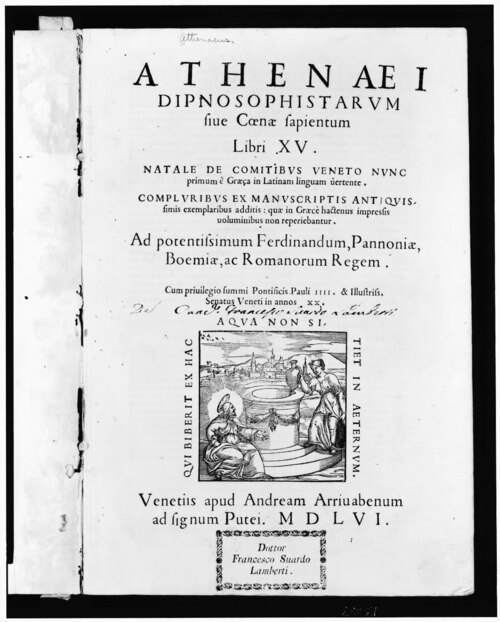
- A Latin translation by Natale Conti was printed in Venice in 1556.
Key works
| Greek title | Title | Year |
|---|---|---|
| Περὶ τῶν ἐν Συρίᾳ βασιλευσάντων | On the Kings of Syria — lost history, known only from a mention | ? |
| Μελέτη για τη θρᾷτταν στους «Ἰχθύες» του Αρχίππου | Study of a fish in Archippus’s Fishes — lost monograph | ? |
| Δειπνοσοφισταί, βιβλίο Γ΄ | The Deipnosophists, Book 3 — breads and Archestratus | after 192 AD |
| Δειπνοσοφισταί, βιβλίο Ζ΄ | The Deipnosophists, Book 7 — the alphabetical fish list | after 192 AD |
| Δειπνοσοφισταί, βιβλίο ΙΓ΄ | The Deipnosophists, Book 13 — love, wives and courtesans | after 192 AD |
A line to remember
ἵνα δὲ εὐμνημόνευτά σοι γένηται τὰ λεχθέντα, κατὰ στοιχεῖον τάξω τὰ ὀνόματα
In today's GreekΓια να θυμάσαι εύκολα όσα ειπώθηκαν, θα βάλω τα ονόματα σε αλφαβητική σειρά.
hína dè eumnēmóneuta soi génētai tà lechthénta, katà stoicheîon táxō tà onómata
So that what was said may be easy for you to remember, I will arrange the names in alphabetical order.