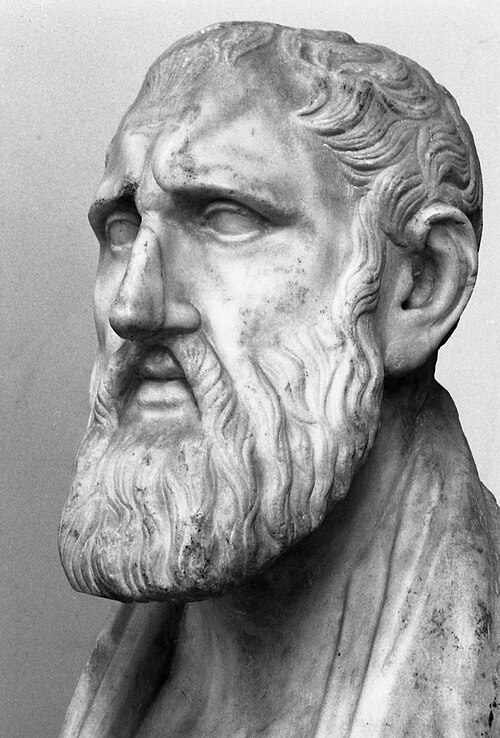
Life
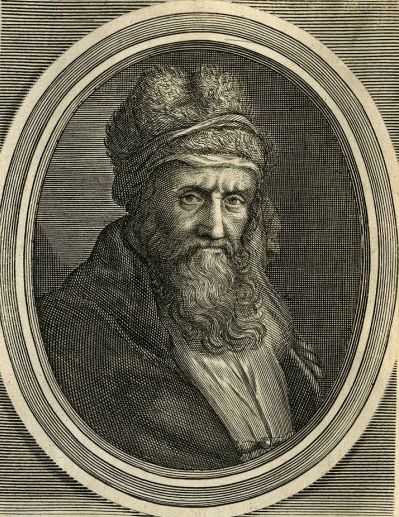
Polybius came from Megalopolis in Arcadia and belonged to the political elite of the Achaean League. He lived in the second century BC; the usual approximate birth and death dates should not be read as securely recorded birthdays. His political experience shaped the sort of historian he wished to be. He valued knowledge of government, warfare and places, rather than treating the past as a collection of attractive speeches detached from practical affairs.
In 167 BC, after Rome's victory over Macedonia, he was among the Achaeans taken to Italy and detained. This was constrained residence, not an ordinary voluntary study trip. He developed a close relationship with Scipio Aemilianus and obtained unusual access to Roman political circles. The surviving Achaean detainees were permitted to return in 150 BC. He later witnessed Rome's destruction of Carthage in 146 BC, an event that figures in his historical project. His background creates a complicated viewpoint: a Greek elite participant explaining Roman power, with loyalties, privileged contacts and political judgements. Access supplies valuable information, but it does not turn his account into a neutral voice shared by all the communities affected by Roman conquest.
Works

The Histories was a forty-book project; only part survives continuously, with much of the rest known through excerpts and fragments. It connects events across the Mediterranean to explain the expansion of Roman power. The narrative begins with introductory material reaching back to 264 BC, focuses on the interconnected developments from 220 BC, and extends to the settlement after the upheavals of 146 BC. These are dates of events, not a simple publication schedule.
The table lists sections of one work, not five separate books published in sequence. Book III includes the Hannibalic war and discussion of causes; Book VI examines the Roman constitution; Book XII debates historical writing. In that methodological discussion Polybius insists on investigating causes as well as what was said or done. The short quotation is an excerpt from his own authorial argument, not a speech recorded verbatim from a battlefield. He stresses documents, questioning informed people, geographical inquiry and practical experience. Yet his criticisms of other historians are themselves argumentative. His sympathy for Achaean leaders and his access to Scipio matter when assessing blame, praise and omitted perspectives. A careful reader can admire his demand for explanation while testing how he applies it, and can distinguish an author's explanation of Roman success from approval of every Roman action.
Legacy in Greece today
Take a short Modern Greek report and make two columns: σειρά γεγονότων and πιθανή αιτία. Put dated actions in the first; put a proposed explanation in the second, with the evidence that supports it. Write one sentence with έπειτα and another with επειδή. Check that the second says more than the first: an event happening later does not by itself prove a cause. Add σύμφωνα με τον συγγραφέα when the explanation belongs to Polybius. This exercise practises sequence, causal connectors and qualified claims. The B 2 grade describes the adapted Modern Greek reading; ancient historical prose and its manuscript problems require separate linguistic and scholarly support.
Did you know?
- He came from Megalopolis in Arcadia.
- He was detained in Italy from 167 BC.
- The Histories originally comprised forty books.
- His political connections are part of evaluating his evidence.
Key works
| Greek title | Title | Year |
|---|---|---|
| Ἱστορίαι Α΄ | Histories I: introduction | 2nd c. BC (section of one work; undated) |
| Ἱστορίαι Γ΄ | Histories III: Hannibal and causes | 2nd c. BC (section of one work; undated) |
| Ἱστορίαι Ϛ΄ | Histories VI: Roman constitution | 2nd c. BC (section of one work; undated) |
| Ἱστορίαι ΙΒ΄ | Histories XII: historical method | 2nd c. BC (section of one work; undated) |
| Ἱστορίαι ΛΗ΄–ΛΘ΄ | Histories XXXVIII–XXXIX:146BC and aftermath | 2nd c. BC (section of one work; undated) |
A line to remember
δεύτερον τὴν αἰτίαν πυνθάνεσθαι
In today's GreekΔεύτερον, να ερευνούμε την αιτία.
deuteron ten aitian pynthanesthai
Secondly, to investigate the cause.