Life
Lysippos came from Sicyon, a city near Corinth with a strong tradition of painting and bronze work. His exact dates of birth and death are unknown. The Roman writer Pliny the Elder places his peak in the 113th Olympiad (328–325 BC), the time of Alexander the Great, and his commissions point to a long career across much of the second half of the 4th century BC. Pliny reports, citing the Greek historian Duris of Samos, that Lysippos had no teacher and began as a simple bronze worker. When he asked the painter Eupompos which earlier master he should follow, Eupompos pointed to a crowd of people and answered that nature itself, not another artist, should be imitated. This is a later anecdote, not a contemporary record.
Lysippos became the sculptor most closely linked with Alexander. Plutarch writes that his statues showed Alexander’s appearance best, including the slight tilt of his neck, and that Alexander himself thought only Lysippos fit to portray him. Pliny adds that Lysippos made Alexander in many works, starting from his boyhood. He also tells a famous story: the sculptor put aside one gold coin from the fee for each statue, and after his death his heir found about 1,500 coins. The number may be exaggerated, but it shows his reputation for an enormous output. Pliny names his sons Laippos, Boedas and Euthykrates as sculptors trained in his workshop.
Works

Lysippos worked mainly in bronze, and almost none of his original statues survive. We know them through ancient descriptions, inscribed bases and later copies, so every attribution needs care. Pliny says that he changed the squarer proportions of older statues: heads became smaller, bodies more slender, and hair more detailed, so the figures looked taller. Pliny also reports the sculptor’s saying that earlier artists made people as they were, while he made them as they appeared to be.
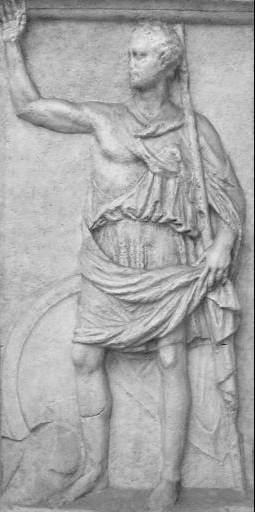
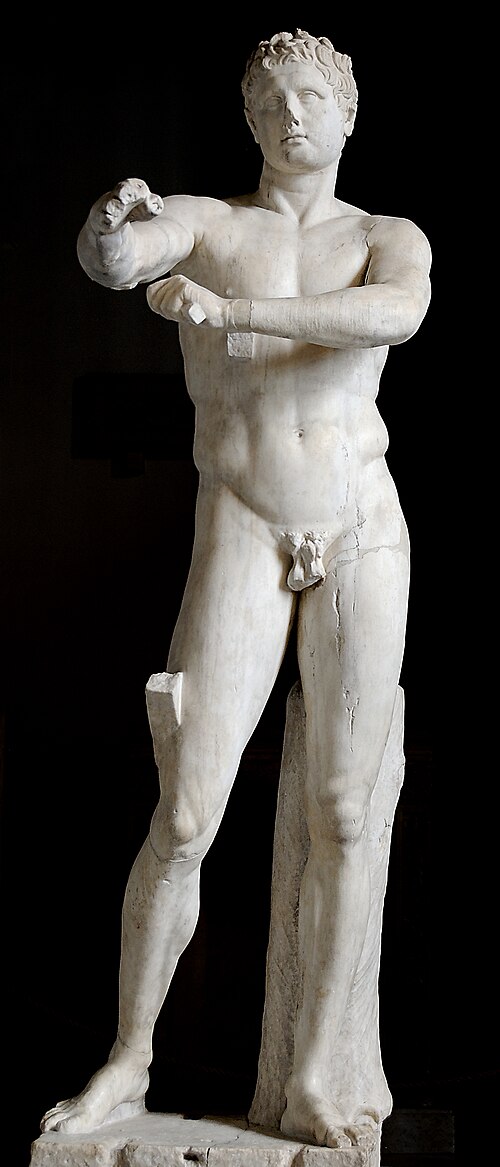
His most famous athlete was the Αποξυόμενος (the one scraping himself clean). The bronze showed a young man removing oil and sand from his arm with a strigil, a curved metal scraper, after exercise. In Rome, Agrippa set it up in front of his baths; according to Pliny, the emperor Tiberius moved it to his bedroom until protests in the theatre forced him to return it. A marble copy found in Trastevere in 1849 is now in the Vatican Museums. At Delphi, the marble statue of the athlete Agias, from the family monument of Daochos of Pharsalos, is considered a probable copy of a bronze by Lysippos. Other works are known only from texts: a bronze Zeus at Taras (Tarentum) forty cubits high, a statue of Καιρός (the opportune moment) and many figures of Heracles. The huge Farnese Heracles in Naples, signed by the copyist Glykon, follows a Lysippan model.
Legacy in Greece today
Lysippos helps explain the change from classical to Hellenistic sculpture, and his influence reached far: Pliny says that his pupil Chares of Lindos made the Colossus of Rhodes. In Greece, the clearest place to meet his style is the Archaeological Museum of Delphi, where the Agias stands with the Daochos group. For a short task, open a photo of the Vatican Apoxyomenos and write three Modern Greek sentences beginning Πριν από την άσκηση (Before exercise), Τώρα (Now) and Μετά (Afterwards). For example: Πριν από την άσκηση άλειψε το σώμα του με λάδι (Before exercise he oiled his body). Then add one passive sentence, such as Το άγαλμα σώζεται σε αντίγραφο (The statue survives in a copy). Remember that the photo shows a Roman marble copy, not Lysippos’s lost bronze.
Did you know?
- Pliny says the Roman public shouted in the theatre until Tiberius returned the Apoxyomenos.
- The Colossus of Rhodes was made by Chares of Lindos, whom Pliny calls a pupil of Lysippos.
- Pliny reports that the colossal Zeus at Taras was balanced so well that storms could not overturn it.
- The poet Posidippus wrote an epigram in which Lysippos’s statue of Kairos answers a passer-by’s questions.
Key works
| Greek title | Title | Year |
|---|---|---|
| Αγίας (ανάθημα του Δαόχου) | Agias: marble at Delphi, probable copy of a Lysippan bronze | c. 337–332 BC |
| Αποξυόμενος | Apoxyomenos (the athlete scraping himself): lost bronze, Roman copy in the Vatican | c. 320 BC |
| Πορτρέτα του Μεγάλου Αλεξάνδρου | Portraits of Alexander the Great: lost bronzes | 4th c. BC |
| Δίας του Τάραντα | Zeus at Taras: lost colossal bronze | 4th c. BC |
| Καιρός | Kairos (the opportune moment): lost bronze known from texts | 4th c. BC |
| Ηρακλής (τύπος Φαρνέζε) | Heracles, Farnese type: model for Glykon’s copy in Naples | 4th c. BC |
A line to remember
Τίς πόθεν ὁ πλάστης; Σικυώνιος. Οὔνομα δὴ τίς; Λύσιππος.
In today's GreekΠοιος είναι ο γλύπτης και από πού; Από τη Σικυώνα. Και το όνομά του; Λύσιππος.
Tís póthen ho plástēs? Sikyṓnios. Oúnoma dḕ tís? Lýsippos.
Who is the sculptor, and from where? From Sicyon. And his name? Lysippos.