Life
Almost nothing certain is known about Heraclitus' life. He was born around 535 BC in Ephesus, the Ionian city famous for its temple of Artemis, into the aristocratic family that held the hereditary title of «king» of the city; according to Diogenes Laertius, our main source, he gave the title up in favour of his brother. He belonged to the generation after the first philosophers of nearby Miletus, Thales and Anaximander, and he knew their ideas, as well as those of Pythagoras and the poets, all of whom he mocked: «much learning does not teach understanding».
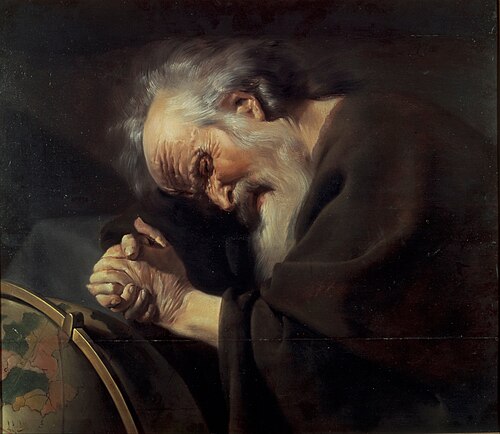
The ancient biographers paint him as a proud, solitary man who despised his fellow citizens, especially after they exiled his friend Hermodorus, and who preferred playing knucklebones with children in the temple to taking part in politics. He is said to have written a single book and deposited it in the temple of Artemis, perhaps so that only the serious would read it. Later tradition called him the «weeping philosopher», in contrast to the laughing Democritus, and told unreliable tales about his death from dropsy around 475 BC.
What matters historically is the book. Written in Ionic prose in short, oracular sentences, it was read and quoted by Plato, Aristotle and the Stoics, and it is only through such quotations that fragments of it survive. In the fifth century his followers, the «Heracliteans», pushed his idea of universal change to extremes, and Plato's picture of a doctrine in which nothing stays still is partly their work.
Works

Heraclitus' book, later called Περί φύσεως (On Nature), was said to have three parts, on the universe, on politics and on the gods. The fragments show one thought seen from many sides. First, everything changes: «on those who step into the same rivers, ever different waters flow» (fragment 12), a sentence Plato summarised as «πάντα χωρεῖ καὶ οὐδὲν μένει», everything moves and nothing stays, from which comes the popular «τα πάντα ρει». Second, change is not chaos but tension between opposites, which need each other: day and night, the road up and the road down are «one and the same» (60), and «war is the father of all and king of all» (53). Third, behind this tension lies the λόγος, a word meaning both «account» and «reason», a hidden measure common to all things, which most people fail to hear even after they have been told (1, 2).
The physical image of this order is fire: the cosmos was made by no god or man, «but always was and is and will be an ever-living fire, kindling in measures and going out in measures» (30). Other fragments are more personal: «I searched myself» (101); «character is a man's fate», ἦθος ἀνθρώπῳ δαίμων (119); «nature loves to hide» (123); the lord of the Delphic oracle «neither speaks nor conceals but gives a sign» (93), which is exactly how Heraclitus himself writes. His deliberately double-edged style, with words that can be read in two directions, made him «the Obscure» (ὁ Σκοτεινός) already in antiquity.
Legacy in Greece today
In Greek, Heraclitus is a living phrase rather than a dead author. «Τα πάντα ρει» is said about anything that changes, from politics to prices, and gives its name to shops, boats and television programmes; «δεν μπαίνεις δύο φορές στο ίδιο ποτάμι» is a common saying, and someone whose words are hard to follow may be called «σκοτεινός σαν τον Ηράκλειτο». Lyceum pupils meet the fragments in their philosophy classes, usually beside Parmenides, his great opposite, who denied that anything changes at all. Ephesus itself, near modern Selçuk in Turkey, is one of the most visited ancient sites in the world, and a learner can walk its marble street and stand where the temple of Artemis, the keeper of his book, once stood. Reading the fragments in Greek, a few words at a time, is the best possible exercise in slow, careful reading.
Did you know?
- He came from the family that held the hereditary title of king of Ephesus and, according to tradition, handed it to his brother.
- He deposited his only book in the temple of Artemis, one of the Seven Wonders of the ancient world.
- The famous «τα πάντα ρει» does not appear in his surviving fragments in those exact words; it is a later summary of his doctrine, based on Plato's report «πάντα χωρεῖ».
- The ancients paired him with Democritus as the weeping and the laughing philosopher, a contrast painters loved from the Renaissance onward.
Key works
| Greek title | Title | Year |
|---|---|---|
| Περί φύσεως (το χαμένο βιβλίο) | On Nature (the lost book, c. 500 BC) | c. 500 BC |
| Ο λόγος (αποσπάσματα 1, 2) | The logos, the hidden common measure (fragments 1, 2) | |
| Τα πάντα ρει (απόσπασμα 12) | Everything flows, the river fragment (fragment 12) | |
| Το αείζωον πυρ (απόσπασμα 30) | The ever-living fire (fragment 30) | |
| Πόλεμος πάντων πατήρ (απόσπασμα 53) | War is the father of all (fragment 53) |
From the works


Public-domain pictures from Wikimedia Commons.
A line to remember
Ποταμοῖσι τοῖσιν αὐτοῖσιν ἐμβαίνουσιν ἕτερα καὶ ἕτερα ὕδατα ἐπιρρεῖ.
In today's GreekΣε όσους μπαίνουν στα ίδια ποτάμια, άλλα και άλλα νερά κυλούν.
Potamoisi toisin aftoisin emvainousin etera kai etera ydata epirrei.
On those who step into the same rivers, ever different waters flow.
From the original
The text as Heraclitus wrote it, out of copyright, with our own translation beside it.
«Ἀποσπάσματα»Fragments
Seven of the sayings that later writers quoted from Heraclitus' lost book, numbered B 12, 49a, 30, 53, 101, 119 and 123 in Diels–Kranz: the river, the ever-living fire, war the father of all, and three aphorisms of three words each.
Fragments B 12, 49a, 30, 53, 101, 119 and 123 (Diels–Kranz), as quoted by later authors · Public-domain text, source: el.wikisource.org