Life
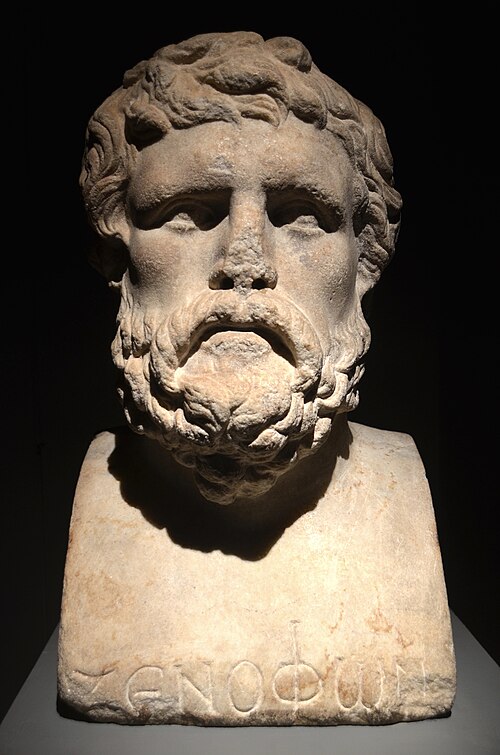
Xenophon was born around 430 BC in the Athenian deme of Erchia, into a family rich enough to keep horses, which made him a cavalryman, and conservative enough to feel uneasy in the radical democracy of the Peloponnesian War years. As a young man he followed Socrates. In 401 BC, against Socrates' advice, he accepted a friend's invitation to join the army that the Persian prince Cyrus the Younger was raising, officially against hill tribes, in reality against his brother, King Artaxerxes II.
Cyrus was killed at the battle of Cunaxa near Babylon, and soon afterwards the Greek generals were lured to a meeting and murdered by the satrap Tissaphernes. Xenophon, who held no command, spoke up in the night assembly, was elected one of the new generals, and over the next months helped bring some ten thousand men north through snow, hostile tribes and hunger to the Greek city of Trapezus on the Black Sea, then west to Byzantium. He went on to serve the Spartan king Agesilaus, fought on the Spartan side against Athens at Coronea in 394 BC, and was formally exiled from his city.
Sparta gave him an estate at Scillus near Olympia, where for twenty years he farmed, hunted, raised two sons and wrote. After Sparta's defeat at Leuctra in 371 BC he lost the estate and moved to Corinth; the Athenian decree of exile was revoked, and his son Gryllus died fighting for Athens in the cavalry at Mantinea in 362 BC. Xenophon died around 354 BC, in Corinth or Athens.
Works

Κύρου Ανάβασις (The Anabasis, «the march up-country») is the book that made him immortal: seven books telling, in the third person, how he and the Ten Thousand got home, with the famous moment in Book Four when the vanguard reaches the summit of Mount Theches and the shout «Θάλαττα, θάλαττα!» rolls back down the column. It is at once a war memoir, a travel book about Mesopotamia, Kurdistan and Armenia, and a study of how a democratic army governs itself by assembly and speech. Ελληνικά (Hellenica) picks up Greek history exactly where Thucydides broke off in 411 BC and carries it to 362, including the fall of Athens in 404, the rule of the Thirty Tyrants and the rise and fall of Sparta.
The Socratic writings are the other half of his legacy. Απομνημονεύματα (Memorabilia) defends his teacher against the charge of corrupting the young by recording his conversations; with the Απολογία (Apology) and Συμπόσιον (Symposium) they are our only portrait of Socrates not written by Plato. Οικονομικός (Oeconomicus), a dialogue on managing a household and farm, gave Europe the word «economics». Κύρου Παιδεία (The Education of Cyrus) is a novel-like life of Cyrus the Great, read for centuries as a manual of leadership. He also wrote short treatises on horsemanship, the cavalry commander, hunting, the revenues of Athens and the Spartan constitution, and a eulogy of Agesilaus. His Greek is clear, orderly and unadorned, which is why teachers from antiquity to today put him into beginners' hands.
Legacy in Greece today
Every Greek who finished lyceum has read Xenophon in the original: the Ελληνικά, with the surrender of Athens in 404 BC and the tearing down of the Long Walls «to the sound of flutes», is a set text of the first year of the Greek lyceum, and the Anabasis was the beginners' book for a century before that. «Θάλαττα, θάλαττα» is said, half in joke, by anyone who finally reaches the sea on a summer drive. A street named Ξενοφώντος runs off Syntagma Square in Athens. His Oeconomicus is the ancestor of the word οικονομία, economics, and the Anabasis has inspired works from Italo Calvino's essays to the 1979 film The Warriors, which moves the march of the Ten Thousand to the New York subway. The Greek text is free on el.wikisource and Perseus.
Did you know?
- The Anabasis is written in the third person; Xenophon speaks of himself as «Xenophon» throughout, and later readers suspected he first circulated it under another name.
- His son Gryllus died in the cavalry charge at Mantinea in 362 BC, and so many eulogies were written for him that Aristotle wrote a treatise about them.
- Xenophon fought against his own city at Coronea in 394 BC and was exiled for it; Athens revoked the decree about thirty years later.
- The 1979 cult film The Warriors is a retelling of the Anabasis, with gangs for Persians and Coney Island for the Black Sea.
Key works
| Greek title | Title | Year |
|---|---|---|
| Κύρου Ανάβασις | The Anabasis (The March of the Ten Thousand) | c. 370 BC |
| Απομνημονεύματα | Memorabilia (Recollections of Socrates) | c. 370 BC |
| Οικονομικός | Oeconomicus (On Household Management) | c. 362 BC |
| Κύρου Παιδεία | Cyropaedia (The Education of Cyrus) | c. 365 BC |
| Ελληνικά | Hellenica (Greek history 411–362 BC) | completed after 362 BC |
From the works


Public-domain pictures from Wikimedia Commons.
A line to remember
Καὶ τάχα δὴ ἀκούουσι βοώντων τῶν στρατιωτῶν «Θάλαττα, θάλαττα».
In today's GreekΚαι σε λίγο ακούνε τους στρατιώτες να φωνάζουν: «Θάλασσα, θάλασσα!»
Kai tacha di akouousi voonton ton stratioton «Thalatta, thalatta».
And soon they hear the soldiers shouting: «The sea, the sea!»
From the original
The text as Xenophon wrote it, out of copyright, with our own translation beside it.
«Κύρου Ἀνάβασις»The Anabasis
The Ten Thousand, Greek mercenaries retreating through the mountains of Armenia after Cyrus's defeat, climb Mount Theches and see the Black Sea at last. Xenophon, commanding the rearguard, tells the scene in the third person.
Κύρου Ἀνάβασις 4.7.21–25 (c. 370 BC) · Public-domain text, source: el.wikisource.org