Life
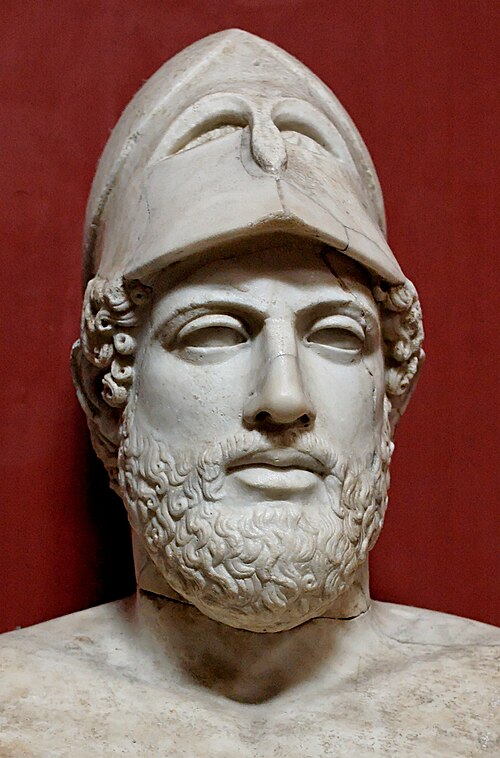
Pericles was born around 495 BC into the Athenian aristocracy: his father Xanthippus commanded the fleet that beat the Persians at Mycale in 479 BC, and his mother Agariste belonged to the Alcmaeonids, the family of the reformer Cleisthenes. He was taught by the philosopher Anaxagoras, kept company with the sculptor Phidias and the sophists, and was known for a reserve so complete that the comic poets nicknamed him «the Olympian». They also mocked his long head, which is why every portrait bust shows him wearing a helmet.
He entered politics in the 460s on the democratic side and, after the reforms of Ephialtes in 462/461 BC stripped the aristocratic council of the Areopagus of its powers, became the leading man of the assembly. From about 443 BC he was elected general (στρατηγός) every year, and he used the office to steer the city. He had the Delian League's treasury moved to Athens (454 BC), crushed the revolt of Samos (440 BC), and faced down Sparta in the crisis that led to the Peloponnesian War in 431 BC, persuading the Athenians to retreat behind their walls and trust in the fleet.
His private life was a public scandal: he divorced his wife and lived with Aspasia of Miletus, a foreigner of famous intelligence, with whom he had a son. When plague struck the crowded city in 430 BC he lost his two legitimate sons, was briefly deposed and fined, then re-elected. He died of the plague himself in the autumn of 429 BC. Thucydides judged that Athens under him was «in name a democracy, in fact the rule of its first citizen».
Works

Pericles' achievements are laws, buildings and a speech. The laws made the democracy radical. Pay for jurors, introduced on his proposal, meant that a poor farmer could sit in the courts of the people without losing a day's living, and pay for office followed. His citizenship law of 451/450 BC restricted citizenship to those with an Athenian mother as well as father, a measure that would later catch his own son by Aspasia, who had to be made a citizen by special vote.
The buildings were paid for partly from the tribute of the allies, which his opponents called robbery. The Parthenon was built between 447 and 432 BC by the architects Ictinus and Callicrates, with Phidias overseeing the sculpture and making the great gold-and-ivory Athena inside it; the monumental gateway of the Propylaea followed from 437 BC, and the Odeon beside the theatre of Dionysus. In fifteen years the Acropolis took the form the world still recognises. The same years were those of Sophocles, Herodotus in Athens, Socrates as a young man and the first works of Euripides, which is why Greeks speak of the «golden age of Pericles».
The speech is the Funeral Oration (Επιτάφιος) for the first dead of the war, in the winter of 431/430 BC, as Thucydides reports it in Book 2. It barely mentions the dead; it describes the city they died for: government by the many, equal justice, freedom in private life, openness to foreigners, courage that comes from reflection rather than drill, and the famous «we love beauty with simplicity and wisdom without softness». It was, in effect, the first written definition of a democratic way of life.
Legacy in Greece today
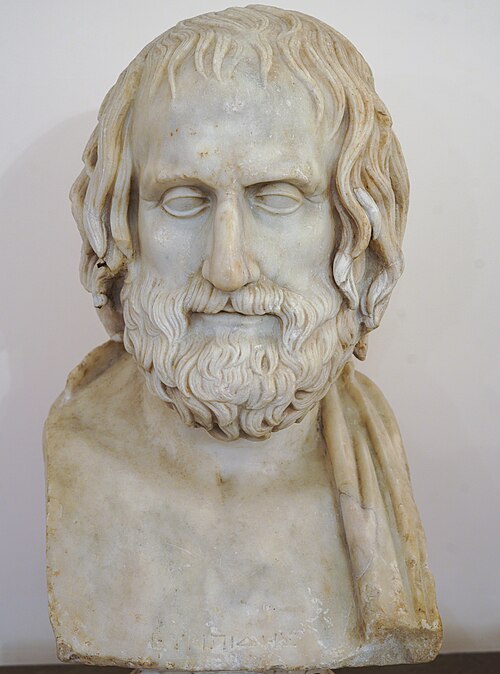
Greek pupils meet Pericles twice: in the history books of the gymnasium, where the fifth century BC is simply «the age of Pericles» (ο χρυσός αιώνας του Περικλή), and in the lyceum, where many read the Funeral Oration in the original Greek with Thucydides. The phrase «χρυσός αιώνας» has become the standard Greek term for any golden age. A visitor can follow him on the Acropolis, from the Propylaea to the Parthenon, and in the new Acropolis Museum below, whose frieze and metopes are the work he commissioned; the site's A2 reading on the Acropolis is a first step. His Roman portrait busts, copies of a lost bronze by Kresilas, are in the British Museum and the Vatican. Streets called Περικλέους exist in most Greek towns, and the Funeral Oration is still quoted in parliaments when democracy needs defending.
Did you know?
- The comic poets called him «squill-head» because of the shape of his skull, which is the traditional explanation for the helmet in all his portraits.
- By his own citizenship law of 451/450 BC his son with Aspasia was not an Athenian; after his legitimate sons died in the plague the assembly made an exception for the boy.
- He was elected general fifteen times in a row, by annual vote, which is how a democracy came to be led by one man for so long.
- The Funeral Oration survives only because Thucydides wrote it down, in his own words, from what Pericles «would have had to say»; no transcript existed.
Key works
| Greek title | Title | Year |
|---|---|---|
| Οι μεταρρυθμίσεις με τον Εφιάλτη | The democratic reforms with Ephialtes | 462/461 BC |
| Η μισθοφορά των δικαστών | Pay for jurors | c. 450s BC |
| Ο νόμος για την ιθαγένεια | The citizenship law | 451/450 BC |
| Ο Παρθενώνας | The Parthenon | 447–432 BC |
| Τα Προπύλαια | The Propylaea | 437–432 BC |
| Ο Επιτάφιος λόγος | The Funeral Oration (in Thucydides 2.35–46) | 431/430 BC |
From the works


Public-domain pictures from Wikimedia Commons.
A line to remember
Φιλοκαλοῦμέν τε γὰρ μετ' εὐτελείας καὶ φιλοσοφοῦμεν ἄνευ μαλακίας.
In today's GreekΑγαπάμε το ωραίο με απλότητα και καλλιεργούμε το πνεύμα χωρίς μαλθακότητα.
Filokaloumen te gar met' efteleias kai filosofoumen anef malakias.
We love beauty with simplicity and we love wisdom without softness.
From the original
The text as Pericles wrote it, out of copyright, with our own translation beside it.
«Ἐπιτάφιος»The Funeral Oration
From the Funeral Oration for the first Athenian dead of the Peloponnesian War, as Thucydides reports it: the heart of Pericles' portrait of Athens as a city of beauty, reason and public spirit. The page's quote opens the passage.
Ἐπιτάφιος, as reported by Thucydides, Ἱστορίαι 2.40.1–2 (winter 431/430 BC) · Public-domain text, source: perseus.tufts.edu