Life
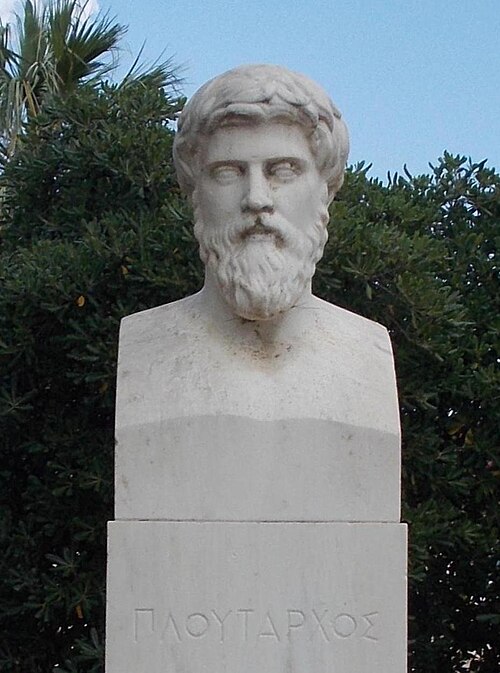
Plutarch was born around AD 46 in Chaeronea, a small town in Boeotia best known for the battle in which Philip of Macedon crushed the Greek cities in 338 BC. His family was old and well-off, and he studied philosophy and rhetoric in Athens under the Platonist Ammonius. He travelled to Alexandria and Asia Minor and several times to Rome, where he lectured and made powerful friends; one of them, Lucius Mestrius Florus, obtained Roman citizenship for him, so that his official name was Lucius Mestrius Plutarchus. Later tradition claimed that Trajan and Hadrian honoured him with high office, which may be exaggerated, but he certainly moved easily in the Roman world.
He chose, however, to live in Chaeronea. He said he stayed so that the town would not become smaller still, and he served it as magistrate and even as a supervisor of building works. For the last three decades of his life he was also one of the two permanent priests of Apollo at Delphi, a few hours away, and he worked to revive the sanctuary. He married Timoxena, and the letter of consolation he wrote to her on the death of their small daughter, also called Timoxena, survives among the Moralia. Of his sons, two reached adulthood. He kept a circle of friends and pupils at his house, and much of his writing reads like the talk of that circle. He died around 120, in his seventies.
Works

The Βίοι Παράλληλοι (Parallel Lives) are twenty-three surviving pairs of biographies, each matching a Greek with a Roman and usually ending with a short comparison: Theseus and Romulus, the founders; Alexander and Caesar, the conquerors; Demosthenes and Cicero, the orators; Pericles and Fabius Maximus; Lycurgus and Numa. Plutarch's interest is character, not events. As he says at the start of the Alexander, he is writing lives, not history, and a small remark or a joke often reveals a man better than a battle with ten thousand dead. So he collects the telling moment: the boy Alexander calming the horse Bucephalus by turning it away from its shadow; Caesar weeping before a statue of Alexander because he had done nothing yet at the same age; Archimedes killed while drawing figures in the sand.
The Ηθικά (Moralia) are some seventy-eight essays and dialogues on every subject: how to tell a flatterer from a friend, how to listen to lectures, advice to bride and groom, the delays of divine justice, the face in the moon, whether land or sea animals are cleverer, the oracles of Delphi, the gods of Egypt in Περί Ίσιδος και Οσίριδος (On Isis and Osiris). The Συμποσιακά (Table Talk) record dinner conversations on questions such as why old men read better at a distance. His collection of Spartan sayings preserves «ἢ τὰν ἢ ἐπὶ τᾶς», the mother's order to come back with your shield or on it. His Greek is the educated prose of the Roman Empire, long-sentenced, warm and digressive, and he was for centuries the most read of all Greek authors: Montaigne quoted him constantly, and Thomas North's English Plutarch of 1579 became the source of Shakespeare's Julius Caesar, Antony and Cleopatra and Coriolanus.
Legacy in Greece today
In Greece Plutarch is read in school in extracts, usually from the Alexander or the Pericles, and his anecdotes are everyday currency: «ἢ τὰν ἢ ἐπὶ τᾶς», «ο κύβος ερρίφθη» (the die is cast, which he reports Caesar saying at the Rubicon), and the title «Βίοι Παράλληλοι» itself, which Greeks use for any comparison of two careers. Chaeronea, near Livadeia, still has the marble Lion of the battlefield and a small museum, and at Delphi the sanctuary he served and its museum can be visited. There is a Πλουτάρχου street in Kolonaki in Athens and in most Greek towns. The Lives are available in Modern Greek translation in cheap editions, and a learner can start with the first pages of the Alexander, where Plutarch explains his method and tells the story of Bucephalus.
Did you know?
- His full Roman name was Lucius Mestrius Plutarchus, after the friend who secured his citizenship.
- He said he stayed in tiny Chaeronea «so that it should not become smaller still».
- He served as a priest of Apollo at Delphi for about thirty years, at a time when the oracle had lost most of its old fame.
- Shakespeare lifted whole speeches from North's translation of the Lives; Enobarbus's description of Cleopatra's barge is Plutarch almost word for word.
Key works
| Greek title | Title | Year |
|---|---|---|
| Βίοι Παράλληλοι | Parallel Lives | c. AD 100–120 |
| Ηθικά | Moralia (essays and dialogues) | c. AD 80–120 |
| Περί Ίσιδος και Οσίριδος | On Isis and Osiris | c. AD 100–120 |
| Συμποσιακά | Table Talk | c. AD 100–120 |
| Λακωνικά αποφθέγματα | Sayings of the Spartans | c. AD 100 |
| Παραμυθητικός προς την γυναίκα | Consolation to His Wife | c. AD 90–110 |
From the works


Public-domain pictures from Wikimedia Commons.
A line to remember
Οὔτε γὰρ ἱστορίας γράφομεν, ἀλλὰ βίους· … πρᾶγμα βραχὺ πολλάκις καὶ ῥῆμα καὶ παιδιά τις ἔμφασιν ἀρετῆς ἐποίησε μᾶλλον ἢ μάχαι μυριόνεκροι.
In today's GreekΓιατί δεν γράφουμε ιστορία, αλλά βίους· και συχνά μια μικρή πράξη, μια λέξη ή ένα αστείο φανερώνουν τον χαρακτήρα καλύτερα από μάχες με χιλιάδες νεκρούς.
Oute gar istorias grafomen, alla vious· … pragma vrachy pollakis kai rima kai paidia tis emfasin aretis epoiise mallon i machai myrionekroi.
For we are not writing histories but lives; and often a small deed, a word or a joke reveals character more than battles with ten thousand dead.
From the original
The text as Plutarch wrote it, out of copyright, with our own translation beside it.
«Βίοι Παράλληλοι, Ἀλέξανδρος»Parallel Lives, Alexander
The preface to the paired lives of Alexander and Caesar, where Plutarch states what his whole project is: not history but portraits of character, caught, as a painter catches a likeness, in the small telling gesture rather than the great battle.
Βίοι Παράλληλοι, Ἀλέξανδρος 1.1–3 (c. AD 100–120) · Public-domain text, source: el.wikisource.org