Life
Marika Kotopouli was born in Athens in 1887 into a family of travelling actors; her father, Dimitrios Kotopoulis, ran a small company, and she appeared on stage as a little girl. In 1902 she joined the Royal Theatre (Βασιλικό Θέατρο), the first attempt to create a serious, state-supported Greek stage, where she learned a more natural style of acting under its director Thomas Oikonomou. In 1908, aged only twenty-one, she became head of her own company, the «Θίασος Κοτοπούλη», which she would lead for the rest of her life; from 1912 it had its own theatre near Omonia.
Her great rival was Kyveli Adrianou, known simply as Kyveli, another brilliant young actress with her own company. The two women competed for audiences, plays and authors, and the Athenian public split into «Κοτοπουλικοί» and «Κυβελικοί», fans who argued about them in cafés and newspapers. The two later joined forces: in the early 1930s they formed a company together, with great success. Kotopouli was also, for several years, the companion of the writer and diplomat Ion Dragoumis, who was murdered in 1920.
From 1930 to 1932 she toured the Greek communities of the United States, and in 1936 she moved her company to the new Rex theatre on Panepistimiou Street, one of the most modern halls of Athens. She kept acting through the Occupation and the post-war years, and died in Athens in September 1954. Her villa in Zografou later became a museum devoted to her and to the Greek theatre.
Works

Kotopouli's career covered almost every kind of theatre the Athenian public loved: comedy and melodrama, the European repertoire of Ibsen, Shakespeare and the French boulevard, and the new Greek plays of the period. She had a remarkable range, from light comedy to tragedy, and audiences admired her for a voice and a presence that could fill a hall without forcing. Greek playwrights of her time, Gregorios Xenopoulos among them, found in her company a stage for their new plays, and for decades a première by Kotopouli was a social event.
She mattered, too, as a woman who ran a business. At a time when Greek women did not vote, she hired actors, chose plays, negotiated with authors and theatre owners, and organised long tours abroad. Her company trained generations of actors who would later lead the Greek stage, and her settling at the Rex gave Athens a modern theatre on its main avenue. Her rivalry with Kyveli was more than gossip: it pushed both women to raise the quality of their productions and helped turn the theatre into the central entertainment of Athenian life before the cinema took over.
Legacy in Greece today
Visit the Marika Kotopouli Museum in Zografou, in her former villa, which displays costumes, photographs, programmes and memories of the Greek stage of her era. On Panepistimiou Street, the Rex building, where her company played, now houses a stage of the National Theatre, the «Ρεξ», so you can still see a play under the same roof. In Greek theatre history her name and Kyveli's come together, and the expression «Κοτοπουλικοί και Κυβελικοί» is still used for any two passionate camps of fans. The site's page on Karolos Koun shows how the Greek theatre continued after her.
Did you know?
- She was on stage as a child, in her father's travelling company.
- Athenians divided themselves into «Κοτοπουλικοί» and «Κυβελικοί», fans of her or of her rival Kyveli.
- She led her own theatre company for over four decades, a rare achievement for a woman of her time.
- The Rex theatre where her company played is today a stage of the National Theatre of Greece.
Key works
| Greek title | Title | Year |
|---|---|---|
| Βασιλικό Θέατρο | Member of the Royal Theatre company | 1902 |
| Θίασος Μαρίκας Κοτοπούλη | Founds the Marika Kotopouli company | 1908 |
| Κοτοπουλικοί και Κυβελικοί | The rivalry with Kyveli | 1910s–1930s |
| Περιοδεία στις Ηνωμένες Πολιτείες | Tour of the United States | 1930–1932 |
| Θέατρο Ρεξ | Her company moves to the Rex theatre, Athens | 1936 |
From the works

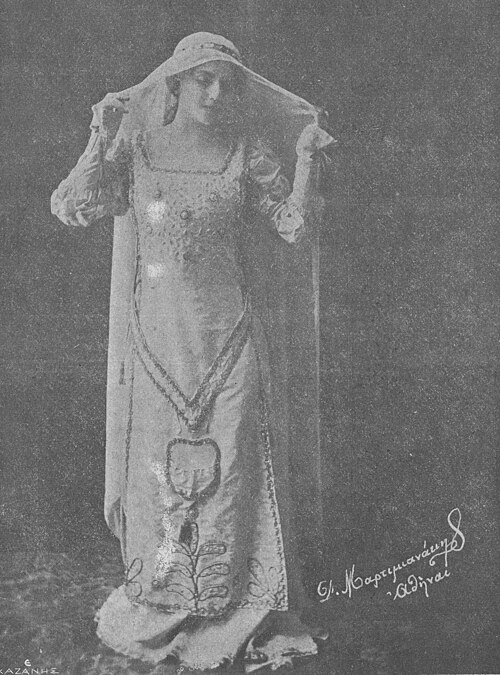
Public-domain pictures from Wikimedia Commons.
A line to remember
Καμουφλάριζε την ανθρωπιά της, με τη δικαιολογία του θεάτρου.
Kamouflarize tin anthropia tis, me ti dikaiologia tou theatrou.
She camouflaged her humanity behind the excuse of the theatre.