Life
Apelles (in Greek Απελλής) worked in the second half of the 4th century BC. Ancient writers disagree about where he came from. The Byzantine lexicon known as the Suda calls him a native of Colophon who became an Ephesian by adoption, and names his teachers as Ephorus of Ephesus and later Pamphilus of Amphipolis. The geographer Strabo lists him among the famous men of Ephesus, while the Roman encyclopedist Pliny the Elder calls him Apelles of Kos and places his peak in the 112th Olympiad, 332–329 BC. No exact dates of birth or death are known.
Pliny says that Apelles painted Philip II and Alexander the Great so often that listing the portraits would be pointless, and that Alexander, who had forbidden anyone else to paint him, often visited his workshop. Pliny also reports that Apelles wrote volumes on the theory of painting, now lost, and that he died while working on a second Aphrodite for Kos, leaving it unfinished.
Most of what is told about his life comes from anecdotes recorded centuries later. Pliny describes a visit to the painter Protogenes on Rhodes, a habit of hiding behind his panels to hear the comments of passers-by, and a dinner in Alexandria where he sketched in charcoal on the wall the man who had tricked him into coming. These stories are part of his ancient reputation rather than documented biography.
Works

No painting by Apelles survives, and no surviving picture can securely be called his. His work is known through texts, above all Pliny’s Natural History, book 35. Pliny names his special quality as grace, which he says the Greeks called χάρις (charis). According to Pliny, Apelles admired his rivals but claimed that none equalled him in this, and said that Protogenes did not know when to take his hand away from the panel. Pliny also credits him with a very thin dark varnish that protected his colours and softened their brightness.
In the temple of Artemis at Ephesus, Pliny writes, Apelles painted Alexander holding a thunderbolt, with fingers that seemed to stand out from the panel. His Aphrodite Ἀναδυομένη (Rising from the Sea) stood in the sanctuary of Asclepius on Kos, according to Strabo, until Augustus took it to Rome. Pliny adds a portrait of King Antigonus shown at an angle to hide his missing eye.
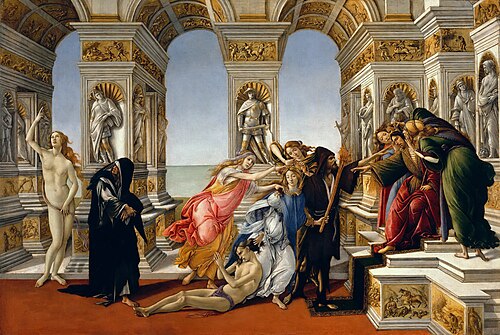
The most influential description comes from the Greek writer Lucian, in the 2nd century AD. He describes an allegory of Διαβολή (Slander): a seated man with huge ears, Ignorance and Suspicion beside him, Slander dragging a young man by the hair, Envy leading the way, and Repentance turning back towards Truth. Lucian links it to a false accusation before a King Ptolemy, but the revolt he mentions dates from 219 BC, long after Apelles’s death.
Legacy in Greece today
Apelles lives on through the texts that describe him. Pliny says that two of his habits became proverbs: drawing at least one line every day, and telling a shoemaker who criticised more than a sandal not to judge above the shoe. Lucian’s description inspired Renaissance painters, above all Sandro Botticelli, whose Calumny of Apelles (about 1495) hangs in the Uffizi in Florence; it is a reconstruction from words, not a copy. Try a short exercise with the Botticelli image on this page. First write what is visible: Βλέπω μια γυναίκα με αναμμένο δαυλό (I see a woman with a burning torch). Then add an interpretation: Μου φαίνεται ότι είναι η Διαβολή (It seems to me that she is Slander). Lucian himself hedges in the same way in his ancient Greek, so read him through our Modern Greek rendering.
Did you know?
- Pliny says Apelles and Protogenes competed by drawing ever finer lines on one panel, which later burned in a fire on the Palatine in Rome.
- According to Strabo, Kos received a reduction of 100 talents in tribute in exchange for the Aphrodite Rising from the Sea.
- Pliny claims that horses neighed only at a horse painted by Apelles.
- Lucian says a guide told him the names of some figures in the Calumny.
Key works
| Greek title | Title | Year |
|---|---|---|
| Αλέξανδρος κεραυνοφόρος | Alexander Holding a Thunderbolt: lost panel, Ephesus | 4th c. BC |
| Αφροδίτη Αναδυομένη | Aphrodite Rising from the Sea: lost panel, Kos | 4th c. BC |
| Πορτρέτο του Αντιγόνου | Portrait of King Antigonus: lost, described by Pliny | 4th c. BC |
| Διαβολή | Calumny (Slander): lost allegory, known from Lucian | 4th c. BC |
| Συγγράμματα περί ζωγραφικής | Writings on painting: lost, mentioned by Pliny | 4th c. BC |
A line to remember
περὶ δὲ αὐτὸν ἑστᾶσι δύο γυναῖκες, Ἄγνοιά μοι δοκεῖ καὶ Ὑπόληψις
In today's GreekΓύρω του στέκονται δύο γυναίκες, η Άγνοια, μου φαίνεται, και η Υποψία.
perì dè autòn hestâsi dýo gynaîkes, Ágnoiá moi dokeî kaì Hypólēpsis
Around him stand two women, Ignorance, it seems to me, and Suspicion.